




PARTY BUILDING
party building work
The Blood-stained "Lamp" -- Interview with the Hundred-year-old Red Army Wang Chengdeng
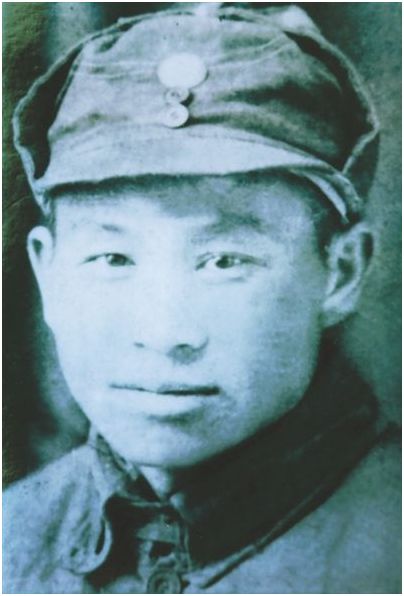
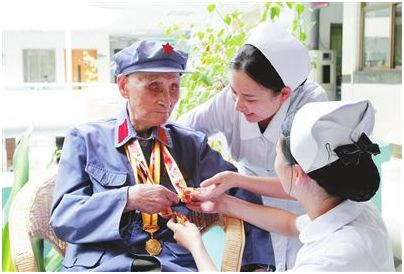
In the Huichun Building of Ganzhou People's Hospital, nurses are listening to Wang Chengdeng's story of the Long March.
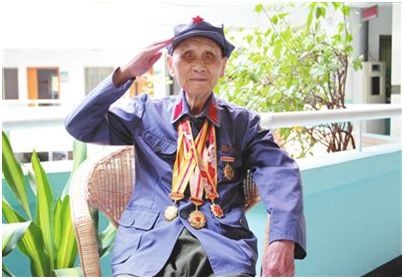
Hundred-year-old Red Army Wang Chengdeng saluted the army
Editor's Note
In May of this year, General Secretary Xi Jinping came to Yudu County to pay homage to the Central Red Army's Long March departure monument, inspect the former site of the Central Red Army's Long March departure, and visit the Central Red Army's Long March departure memorial. He emphasized that we must not forget the party's original intention and mission, we must not forget the revolutionary ideals and revolutionary purposes. We must continue to hold high the banner of revolution, carry forward the great Long March spirit, and march forward courageously towards the goal of the great rejuvenation of the Chinese nation.
The Long March has been over 80 years. A few days ago, this newspaper formed an interview group to "pay tribute to the 100-year-old Red Army" and interviewed Wang Chengdeng, Zeng Guangchang, and du Hongjian, three surviving Jiangxi-born 100-year-old Red Army who had completed the long March, to listen to their stories of the long March and feel the great spirit of the long March. Starting today, this newspaper has launched five special reports "Coming from the Long March-An Interview with the Centennial Red Army", so stay tuned.
● Wang Chengdeng File
Wang Chengdeng, a native of Xingguo County, Ganzhou, was born on August 22, 1915. He joined the Red Army in 1930, joined the Communist Party of China in 1934 and retired in 1980. He successively served as squad leader of the 12th regiment of the 4th division of the 3rd army, platoon leader of the 686 regiment of the 11th division of the 11th division, and battalion commander of the 2nd battalion of the 95th regiment of the 11th column of the third division of the Hebei Shandong Henan division. He served as a soldier in the fourth anti-"encirclement and suppression" Donggu Huangpi campaign, as a squad leader in the fifth anti-"encirclement and suppression" campaign in Guangchang County, and as a platoon leader in the Pingxingguan campaign. Won the honorary titles such as the special shooter of the 1st and 2nd Infantry Division of the Chinese People's Liberation Army, and the second "Most Beautiful Veteran Cadre" in Jiangxi Province.
On November 27, it was sunny for more than 3 months, and it rained for the first time this winter. Although the weather was suddenly cold, the second nursing room on the second floor of the Huichun Building of Ganzhou People's Hospital was as warm as spring. Several nurses are carefully guiding an old man to do rehabilitation exercises.
The old man was wearing an old military uniform, thin and small, with sunken eyes. He followed the nurse's instructions and raised his feet straight and up while raising his hands flat. The old man looked up at the nurses from time to time, showing a kind smile. The nurse leaned close to the old man's left ear and asked, "Wang, who are we?" The old man pointed to the older nurse and said, "You are the big golden flower", then looked at the younger nurse and said, "You are the little golden flower", then folded his hands together and smiled to express his gratitude to the medical staff.
The nurses said that the old man had a humorous speech, an optimistic personality, and a smile like a child, especially good-looking.
This old man is the 104-year-old Red Army-Wang Chengdeng.
■ "This shot in the head was the worst, and the blood was bleeding at that time"
In the nursing room, there are often some guests who come here to send flowers and fruits to the elderly to wish them health and longevity. The old love lively, like to recall the Long March, talk about tradition. When we met Wang Lao, his interest seemed higher than usual, and the more we talked, the more energetic we became.
When we asked the old man how old he was this year, Wang Jianguo, Wang's son, reminded him: "You have to say to his left ear, he can't hear it in his right ear."
Wang Lao told us: "I heard that he is over 100 years old, over 100 years old. I am not sure whether it is over 100 years old."
I don't know if I am "a hundred years old", which is true. One of the reasons is that he never knew his birthday.
Twenty-eight years ago, Wang Chengdeng was already a 76-year-old man. He used a little culture he learned in the Red Army school to start writing his memoirs: "I was born in a family that has been a farmer for all generations. I was born on a certain day in 1914. Because my parents died early, I can't remember my birthday."
We found relevant information from Wang Lao's family tree.
Wang Chengdeng's real name is Wang Chengdeng (simplified word "lamp"), not born in 1914, but "born on July 12 (Gregorian calendar August 22) in the Republic of China (1915 AD)".
The family tree also records in detail the birth and death years of Wang's parents and grandparents. His father, Wang Jizu, died at the age of 37 and his mother, Chen, died at the age of 31. His grandfather Wang Maiguan, great-grandfather Wang Tangyuan, and great-grandfather Wang Yuxian were all young when they died. Perhaps because of this, Wang Chengdeng's parents named him "Chengdeng", hoping that he would continue the incense and honor his ancestors.
There is another reason why Wang Lao does not know his actual age--
"I was out of my mind and was injured in Yan'an. I was studying in the Red Army School at the time. It was raining that day, and we were responsible for intercepting the enemy and dragging the enemy so that the comrades could move. I was afraid that the enemy would catch up, so I watched the situation with a cat on my waist, and one of the enemies gave me a shot in the head."
Wang Lao pointed to the lower orbital position of his left eye with his left hand: "Here, hit it." Fingers around the back of the right ear, and said: "wear out here. The eye is broken, the ear is deaf, the mouth is crooked." As he said, let's touch the part where the bullet passed: "You touch, you touch, you touch, touch hard."
Wang Lao said that he had been shot three times in total: one shot in the left leg, one shot in the right leg and one shot in the head. "This shot in the head is the most powerful." He said, "The first time was during the Long March, I was injured in Guangxi. If I hit the key, it would not be today. The second time was when I was seriously injured in Yan'an. If the wolf came that night, I would have fed the wolf. The third time was when I was hit in the foot by the enemy during the suppression of bandits in Guding."
Wang Lao had a physical examination on May 7, 1952. The doctor wrote in the physical examination report: "He was injured three times and his disability level was second class. Nose: There is a large perforation in the middle of the septum (traumatic), and the right lower nail adheres to the septum (traumatic). Left thigh: penetrating gunshot wound of middle lateral segment, healed. Head: through the face of the gunshot wound (bullet from the left eye under the orbit into the right ear hole under the exit). Right calf: lateral bullet abrasion." "Disability" is "slight limp in the right leg, deafness in the right ear, and frequent pus in the right eye"; "previous major disease" is "frequent dizziness due to head injury", and "current major disease" is "frequent dizziness".
His children once sorted out a memory of him in the Red Army School. At the beginning, he wrote: "he entered the Red Army School in 1936 and was seriously injured in a battle to defend the Party Central Committee and was hospitalized." Detailed records of Wang Lao's second injury--
Around May 1936, the Party Central Committee and Chairman Mao lived in Wayaobao. Our Red Army School is more than ten miles away from Wayaobao. We lived here for a long time, and then the enemy attacked Wayaobao on a large scale, and the Party Central Committee ordered the officers and men of our Red Army School to meet them quickly.
My Red Army school troops marched in the direction of the enemy and walked about 20 miles before encountering the enemy. In order to clamp down on the enemy and seize the commanding heights, the school ordered us to leave a detachment of the 8th company to block the enemy. After I received the order, I discussed with the platoon commander, and separated the detachment according to the battle formation to counterattack the enemy's attack ...... In the battle, the comrades calmly and bravely repelled the enemy's attack again and again, and fought with the enemy for about 30 minutes, and we have completed the blocking task assigned by our superiors. For the safety of the comrades, the platoon leader and his detachment left the battlefield first, leaving me to block the enemy. In order to enable the unit to quickly follow the large army, I drew the enemy's forces to me. The enemy surrounded me and shot at me. I was watching the enemy's situation with my cat's waist. A bullet hit me and entered under my left eye... This shot gave me a heavy blow. My face was so swollen that I couldn't even drink water.
Wang Lao said that as a soldier, he was so lucky to wear it in a hail of bullets and not die. "Death always passes me by, injuring me three times and becoming a disabled revolutionary soldier. As Chairman Mao said in his poems, he dares to teach the sun and the moon to change the sky for the sake of sacrifice."
■ "The Red Army protects the poor and will not harm the common people"
We asked Mr. Wang, "Before joining the Red Army, did you know what the Red Army did?" Mr. Wang said, "Yes, fight the local tyrants and divide the fields to protect the poor."
He joined the Red Army because he was on the verge of despair: "How will the lost parents live in the future? Who to rely on? Where to stay... My brother and I knelt under the bed where my mother died, crying to death, shouting loudly 'I want my mother, I want my mother'......"
In which year did the ancestors flee from Ganzhou Xingguo to Ji 'an? Wang Cheng could not register. He only knew that he had been farming in rich fields since his grandfather's generation.
More than 100 years ago, the Wangs lived in Futian, but the fields were not fat and the family was not rich. As soon as his mother left, 7-year-old Wang Chengdeng began to learn to do farm work: collecting firewood, herding cattle, mowing grass, cooking, transplanting rice seedlings, harvesting, everything. In winter, the fields are frozen, and they have to work in the fields. "There are several cracks in the heel, and one step at a time is a blood mark." Wang Lao said that until the age of 14, he did not wear cotton jackets, but used single clothes for the winter, shivering with cold. I ate sweet potato rice. I was too hungry to walk, so I went to find a bowl of cold water to appease my hunger.
To this day, the 104-year-old Wang Chengdeng still calls the local tyrants and evil gentry "the old money of the landlord": "The peasants should give 70% of their annual harvest to the old money of the landlord. The peasants can only get 30%. If they borrow a bucket of millet from the old money of the landlord, they will have to pay him back two buckets next year. If they can afford it, they can't afford it!" "On New Year's Eve, the landlord Lao Cai comes to ask for the debt. If he can't pay the debt, he will lift your pot and take away your cattle. How can farmers grow without cattle? So the poor are afraid of the New Year. One year, the landlord came to my house to force the debt, but my family had no money to pay him back, so he took away a cow raised by our four families."
March 1929 was a new starting point for Wang Chengdeng's life. This year, he was 14 years old. From then on, he put on a "cotton jacket" and joined the local armed forces led by the Communist Party. A year later, this local armed forces and other local armed forces were reorganized into the Red 20th Army. He said: "From March this year, I became a Red Army servant."
In 1934, Wang Chengdeng's three legions began the Long March. He recalled: "The Red Army set out from Yudu County. That night, it was very dark and it was raining. We crossed the river by a pontoon bridge not far from the city......"
It was also this year that Wang Chengdeng joined the Communist Party of China in Zunyi.
When he became the Red Army and joined the Communist Party, Wang Chengdeng, who was born in poverty, did not forget his roots.
Wang Lao said that during the Long March, whenever the Red Army went to camp in a place, it had to speak well with the villagers, comfort the villagers, and tell the villagers that the Red Army would only stay here for one night and would not harm the people. "The villagers also know that our Red Army is good and support it." said the old man.
Wang recalled that after the Red Army approached Zunyi, it swept hundreds of miles around Zunyi and liberated more than a dozen counties in northern Guizhou. The central organs held a mass meeting of 10,000 people in Zunyi to publicize our party's policies and expand the ranks of the Red Army. "At that time, Guizhou was very poor. There was a saying that: the sky was not sunny, the land was not flat, and the family was not worth three cents. Many people had no clothes to wear. Some families wore a pair of trousers, and whoever went out wore them." Wang Lao said, "The Red Army has been resting in northern Guizhou for more than half a month, mobilizing the masses, organizing the establishment of local power, and expanding the Red Army."
■ "Red Army soldiers use blood and sweat to walk a bright road"
In the nursing room, we had a good chat with Wang Lao. When asked whether the Long March was bitter or not, Wang Lao said, "Do you think about it? It's hard! Carrying a gun and a bag on your back, you walk a hundred miles of Hualu every day."
In his memoirs, Mr. Wang wrote down fragments of the Long March.
"Jiajin Mountain (I. e. snow mountain) is a mountain several kilometers high above sea level, and there is snow on the peak all year round. Starting from 12 o'clock in the evening, you have to get to the top of the mountain before 12 o'clock at noon. In the afternoon, it is windy and easy to close the mountain, so you must pass the mountain ahead of time, otherwise you will not be able to pass the mountain."
When crossing the grassland, "there are no people in more than 300 miles, and each person has to prepare more than 20 catties of grain. There is no food, so we have to eat wild vegetables to live on. As it got dark, the troops camped wherever they went. In case of bad weather and heavy rain, I spent the night drenched in rain. If you cross the grassland, you have to walk 50 or 60 miles a day. There is no road. If you cross the mountain and cross the water, you cross the water. Without direction, I walked north to the compass needle and walked for 7 days. The Red Army is like this, stepping out of a bright road with blood and sweat."
Wang Lao was the monitor in the Long March. Many people say that he must be a good shot. Wang Lao smiled: "marksmanship? Generally speaking, it is more difficult to shoot accurately." He further explained, "Because we seldom shoot. We can't shoot indiscriminately if we don't meet the enemy. To save bullets, we can't shoot indiscriminately."
Wang Lao is very modest. The fierce confrontation between the Long March and the enemy is now in the memory of the old man, "talking and laughing".
In the early 1970 s, on the eve of Wang Chengdeng's return to Ganzhou from Guizhou for retirement, a comrade of the army named Ren Zhonghou interviewed him. Wang Lao received him warmly and told him about traditions and war examples. When talking about the battle at Loushan Pass, Wang Lao said that in early 1935, his Red 12th Regiment went to camp in Chumipu, 8 kilometers away from Tongzi, and learned that the Kuomintang Wang Jialie's troops had rushed from Zunyi to Tongzi. The higher authorities ordered the 12th regiment to annihilate the enemy together with the 10th and 11th regiments, opening the way for the capture of Zunyi. When the comrades of the 12th regiment heard that there was going to be a war, they all rubbed their hands, and the fatigue of marching for days was swept away. Some of them grinded and ground their broadswords, some wiped and wiped their "earth bullets", and some said, "now we have to meet the" double gunmen "again!"
Speaking of the "double gunmen", Wang Chengdeng said: "Wang Jialie's army has two 'guns', a big gun and a smoking gun. If you eat a lot of smoke, you can fight it, otherwise you can't fight it. Early that morning, it was raining lightly, and our 12th regiment launched an attack on the enemy. A battalion swooped along the road from the front and rushed up the barrier in one fell swoop. The enemy fought fiercely to defend the" gate "and fought fiercely. But because the road is narrow, I formation dense, a battalion casualties larger. The regiment immediately transferred 30 young soldiers from each company to form a commando team with good skills in stabbing, bombing and shooting. Under the cover of machine gun fire, the regiment bravely moved forward and dropped bombs. Wang Jialie's troops discarded a lot of materials on their way back, including heavy smoking guns, backpacks and copper pots."
Later, Ren Zhonghou compiled this story and other war examples into a book and sent a copy to Wang Chengdeng. Wang old treasure to this day.
■ "Believe in the Communist Party, believe in what the leaders say"
Every time I talk about the Long March, Wang Lao's thinking is very clear.
Someone once asked Mr. Wang for confirmation, saying that a small number of Red Army soldiers could not bear hardships during the Long March and returned to their hometown halfway.
Every time he heard this, the old man would be angry like a child: "Few people go home, very few, almost none. Don't listen to their nonsense! Soldiers can't just walk. Soldiers or officers are good. They can't walk around. Is it okay to walk around? Everyone can't leave, can't they."
We asked Wang Lao, "Do you know where the troops are going and where they are going during the Long March?"
Wang Lao said, "I know. There are instructors and company commanders in the company. They will tell the soldiers where we are going to camp today and how far we are from the place where we are going to camp."
Wang Chengdeng's tenacious will was forged before the Red Army's Long March. He said that in the Red Army's counter-campaign against "encirclement and suppression", he worked as a correspondent in the 12th Regiment of the Fourth Division of the Third Army. Fighting in the south, we often encounter the situation of delivering letters at night. "Sometimes a person has to walk more than ten miles or even dozens of miles to deliver letters at night. I have met this situation several times and shed tears many times." One night, he received another order to inform the 2nd Battalion to withdraw from the battle. The troops were scattered deep in the mountains. It was dark and there was no road in the deep mountains, so where could I find the Second Battalion? He recalled: "This kind of task is the most troublesome thing, don't go, it's an order; go, it's dark, people are hard to find, and I'm afraid of encountering enemies or wild animals on the road. I was crustily skin of head to carry out this task, so I cried while walking." He wanted to send someone with him, but in the end he didn't have the courage to do so. He thought, "I am a Red Army soldier, a revolutionary soldier, and it is my duty to obey orders." So he took the courage to go on the road, turned over a mountain after a mountain, in a deep ravine, finally found the second battalion!
In his memory, the Red Army Lazikou Battle left a deep impression on him. "Lazikou terrain is extraordinary, surrounded by mountains, there is no other way to go, must pass here. The enemy is very strict in defense here, it is not easy to approach, there are cliffs everywhere, there is only one path to pass, you can't go there without destroying the enemy. Due to the poor quality of the grenades made by the Red Army, some of the grenades did not explode after being thrown out, even if the explosion was only a few large pieces, it did not have much power. Finally, we climbed to the cliff and wiped out the enemy. Lazikou was the last pass of the Red Army's Long March, and it was finally successfully passed. After a long march of the Red Army, the Party Central Committee led us first to northern Shaanxi and opened up a new base area."
We asked Mr. Wang, as an ordinary soldier who had completed the Long March in 25,000, did he believe that the Red Army and the Communist Party could win the final victory?
Wang replied affirmatively, "Believe! Believe the Communist Party and what the leader said. The leader made it clear to us where we were going, and we soldiers would not be afraid and would not desert."
Unconsciously, more than an hour passed. Wang Jianguo said that he seldom talked for such a long time recently.
"Wang Lao, you are really great! We all want to learn from you!" When we bid farewell to Wang Lao, we gave Wang Lao a thumbs up.
Wang Lao waved his hand and said, "Ah! It's no big deal. A soldier, a revolutionary soldier, a revolutionary fighter, has done something, what's the big deal? It's our Party, our country, the achievements of the people of the whole country, without our Party, without our country, without the leadership of our Party, we couldn't have won such a great victory."
Source: Jiangxi Civilization Network
Reprinted from: Party Building Network

Address: Buildings 4 and 5, Kechuang Huigu Park, Hongshun Road, Huaming High-tech Zone, Dongli District, Tianjin
Tianjin High-end Equipment Research Institute, Tsinghua University, Copyright
Website Construction: China Enterprise Power Tianjin
Business License
sweep
Pay attention to the official WeChat public number