




PARTY BUILDING
party building work
Red Memory in Numbers
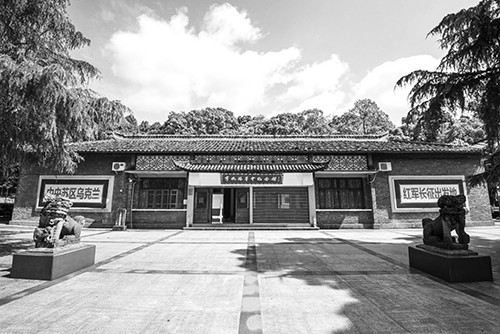
Revolutionary Memorial Hall of Ninghua County, Fujian Province
In Ninghua County, Sanming City, Fujian Province, one of the starting points of the Long March, 13700 people joined the Red Army. More than 6000 of them participated in the Long March. Only 58 people successfully arrived in northern Shaanxi, while only 3301 martyrs are currently registered. The rest became unsung heroes.
In Sanming, Fujian, there are many such red stories. Sanming Ninghua is the core area of the Central Soviet Area and the first red area in northwest Fujian. In March 1929, Mao Zedong and Zhu De led the Fourth Red Army into the Fenghuang Mountain area of Ninghua and ignited the revolutionary fire; in July 1933, the Eastern Army of the First Red Army entered Fujian and captured the Spring and Earth Fort, and Chihua County, Ninghua A total of 3 counties, 28 districts, and more than 190 township Soviet regimes and party organizations and mass organizations have been established in Ninghua.
Ninghua is known as "Soviet Ukraine" and is a key county of "expanding red supply" in the Central Soviet Area. In those days, Ninghua County had only a population of more than 130000, one tenth of whom joined the Red Army. Ninghua people raised more than 200,000 piculs of grain, more than 60000 stones of rape, more than 200,000 pairs of straw sandals, more than 540000 yuan of money and a large number of loads to support the front line. They organized more than 20,000 stretcher teams and transport teams to support the front line.
"Don't drink Xiangjiang River water for three years, and don't eat Xiangjiang fish for ten years", Sanming still has such a saying, behind which is the tragic Xiangjiang River battle. In November 1934, after breaking through the enemy's three blockade lines in a row, the Central Red Army entered the Xiaoshui and Xiangshui areas on the border between Hunan and Guangxi, and encountered the joint efforts of about 300000 troops from 26 enemy divisions.
In order to break through the enemy's fourth blockade, the Central Revolutionary Military Commission issued a fighting order to forcibly cross the Xiangjiang River. The 34th Division of the Red Fifth Army, mainly composed of the children of Ninghua and Qingliu in western Fujian, was ordered in the face of danger. In the face of an enemy more than ten times its own, it fought desperately for four days and five nights. In the end, it ran out of ammunition and food. 6000 soldiers in western Fujian blood stained the Xiangjiang River in exchange for the westward advance of the main Red Army.
Chen Shuxiang, the Hunan division commander who led this desperate guard division, is forever fixed at the age of 29. In order to cover his comrades in arms, he was captured by the enemy, lying on a stretcher, enduring the severe pain, stretching his hand from the wound into his abdomen, and fulfilling the oath of "shed the last drop of blood for Soviet New China.
In Ninghua, there is also a little-known red army of women. They cut their hair short and joined the revolution. They sang the folk song "leeks bloom with a heart, cut off the jizi to become the Red Army; Long live the Red Army and be willing to cut off the jizi.
In May 1932, after listening to the work report of Zhang Dingcheng, chairman of the Soviet Union in Fujian Province, Zhang Wuxiu, a woman in Hokou Township, immediately ran into the shop nearby, took out scissors and scattered the jizi. Despite her husband's opposition, she cut off her long hair and waist in public. Under the mobilization of Zhang Wuxiu, by the end of that year, women in the southwest area of Ninghua had cut off their jizi, and the number of women participating in the women's company and the Red Guard in the county reached 775.
In the summer Soviet government's grain borrowing campaign in 1934, Su Huizhu, the women's minister in the southern suburb, persuaded the owner of the "Dayou" firm to lend 4500kg of all the grain in his family, and organized the women's transport team to carry 9000 grain to the Changting front line by carrying it on their shoulders and carrying it on their backs, which strongly supported the Red Army in its operations. In August 1934, Su Huizhu was transferred to the women's minister of the Ninghua County Party Committee of the Communist Party of China; in February of the following year, he was unfortunately arrested due to pregnancy and inconvenient movement. He died in Zhangzhou at the age of 22.
Source: China Organization and Personnel News

Address: Buildings 4 and 5, Kechuang Huigu Park, Hongshun Road, Huaming High-tech Zone, Dongli District, Tianjin
Tianjin High-end Equipment Research Institute, Tsinghua University, Copyright
Website Construction: China Enterprise Power Tianjin
Business License
sweep
Pay attention to the official WeChat public number