




PARTY BUILDING
party building work
The New Fourth Army annihilates the enemy during the Spring Festival.
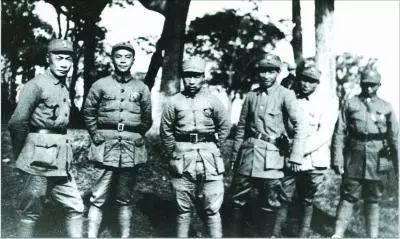
In January 1938, the Red Army Corps in southern Henan was reorganized into the eighth regiment of the fourth detachment of the New fourth Army. On March 29, the eighth regiment of the fourth detachment of the New fourth Army, led by Zhou Junming, head of the regiment, and Lin Kai, political commissar, was ordered to go to the anti-Japanese front in eastern Anhui in Xingji, Xinyang County. During the more than three months of anti-Japanese guerrilla warfare in central Anhui, Zhou Junming led a delegation to deal with the Japanese army skillfully, and eliminated a number of bandits and traitors in one fell swoop, and gradually grew and grew in the battle.
In 1939, the Eighth Regiment of the Fourth Detachment of the New Fourth Army fought guerrillas in Longcheng, Dianbu and Huaji, Tongyang and Xiange of Chaoxian County in Hefei. They continued to fight against the falsehood, extermination of traitors and extermination of bandits. They improved some equipment by fighting and captured, and their troops grew from more than 1000 to more than 2000. On the eve of the Spring Festival, the eight regiments moved to Liangyuan Town and the area to the east of Hefei to crack down on the Japanese invaders and carry out mass work. zhang yunyi arrived at the regiment headquarters of the eighth regiment the day before the spring festival for inspection, and he instructed the troops to step up their combat mobilization.
On February 19, 1939 (Spring Festival), when the Japanese army and the people of our country celebrated the Spring Festival, they mobilized more than 1000 troops from Hefei, Tongyang, Chaoxian and other strongholds along the Huainan Railway from the 17th and 6th divisions to mop up the 8th regiment of the 4th detachment of the New Fourth Army, which was active in the area of Fucha Mountain in the north of the nest.
On the morning of February 19, more than 200 enemies of Hefei attacked the 8th regiment headquarters. At that time, only the regimental headquarters and the guard battalion were stationed, and the regimental commander Zhou Junming led the troops to meet the attack. The enemy was hit head-on and retreated to the Big Liu Gang area, 5 miles from Liangyuan Town, to confront the Eighth Regiment. After several hours of fierce fighting between the two sides, the Japanese army was defeated and retreated hastily.
On the night of the 20th, another enemy group of more than 700 people pounced on Fangji Township, Chao County, at the eastern foot of Cha Mountain, and attacked the main force of the Eighth Regiment stationed at Dongshan Pass near Zhegao Town, with the intention of encircling and annihilating the Eighth Regiment. The enemy arrived at Dafang Old Man Wa Village at dawn on the 21st. At that time, three battalions of the Eighth Regiment, with more than 1,000 people, and the Chao County Anti-Japanese Guerrilla Brigade, which acted with the regiment, camped in a triangle around the village. The Second Battalion was stationed in the village. The Third Battalion, the First Battalion and the Chao County Anti-Japanese Guerrilla Brigade were stationed in the surrounding villages in the east, northeast and southeast of the village. When the enemy approached, the heads of the eight regiments either seized the commanding heights, or used the terrain to calm down, or detoured behind the enemy, while avoiding the enemy's artillery fire, while sniping at the approaching enemy.
The Japanese commander ordered the troops to concentrate their fire on the second battalion position. Seeing the strong firepower of the enemy, in order to avoid fighting hard, the second battalion commander commanded his troops to quickly avoid the enemy and quickly rushed to the north of the village to seize the favorable terrain of the mountain. The Japanese army saw this and went eastward in a roundabout way. The commander of the third battalion commanded the whole battalion to take advantage of the terrain to fight calmly. In addition to blocking the forward positions with rifles and light machine guns, he also relied on earth-made rifles, broadswords, spears and bombs to kill the Japanese army at close range. He repelled the enemy's charge several times in a row and held the Japanese army back, winning time. At this time, after occupying the favorable terrain, the second battalion of the eighth regiment and other troops quickly carried out side attacks: the first battalion and the anti-Japanese guerrilla brigade of Chaoxian County attacked from the northeast and southeast, and the second battalion attacked from the north mountain.
When the advance was blocked and the left and right were hit, the Japanese army relied on its firepower superiority and organized a three-sided attack under the cover of grenade and 92 short guns. The battalions of the Eighth Regiment used terrain and features as mobile guerrillas, avoiding enemy fire while sniping at the enemy. In the afternoon, the enemy offensive weakened and the battalions of the Eighth Regiment began to organize counterattacks.
The fighting between the two sides continued until dusk, and the enemy suffered heavy casualties and had to retreat to the west. Zhao Qimin, chief of staff of the regiment, immediately ordered the first division of the second battalion to follow the chase, and the chase with the troops did not stop until the Dongshan Kou. During the battle, a seven-member team led by a deputy company commander of the eight regiments of the four detachments died heroically and was buried in Daye Village.
In this battle, the Eighth Regiment killed more than 150 enemies and more than 30 casualties on our side. It was another influential battle after the victory of the fourth detachment of the New Fourth Army in the first battle of the Anti-Japanese War, the Jiangjiahe Ambush. It not only successfully smashed the enemy's large-scale offensive, inspired the confidence and courage of the army and the people to adhere to the victory of the Anti-Japanese War behind the enemy in eastern Anhui, but also a successful attempt by the Jiangbei troops of the New fourth Army to develop from a small-scale guerrilla war to a larger-scale resistance war. it also created conditions for the formation of the fifth detachment on the basis of the eighth regiment soon."
Source: People's Daily Online
Previous Page
Previous Page

Address: Buildings 4 and 5, Kechuang Huigu Park, Hongshun Road, Huaming High-tech Zone, Dongli District, Tianjin
Tianjin High-end Equipment Research Institute, Tsinghua University, Copyright
Website Construction: China Enterprise Power Tianjin
sweep
Pay attention to the official WeChat public number