




PARTY BUILDING
party building work
The Story of Party Constitution Revision
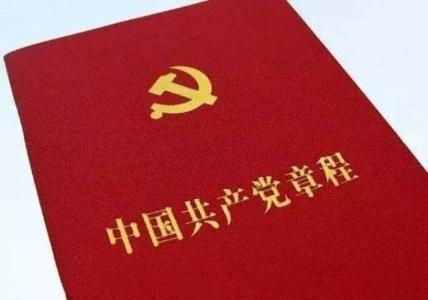
From the beginning of the three major, it has become a common practice to make partial amendments to the party constitution. The history of the revision of the party constitution is the process in which the Communist Party of China constantly revised its direction and led the Chinese people to the truth.
The first three revisions
The central topic of the Third National Congress of the Communist Party of China held in 1923 was to discuss cooperation with the Kuomintang. After heated discussion, it was decided that Communist Party members would join the Kuomintang in their personal capacity and establish a joint front with the Kuomintang in the form of inner-party cooperation in order to accomplish the task of the national revolution against imperialism and feudalism. The conference passed seven documents, one of which is the "First Amendment to the Constitution of the Communist Party of China." However, the three major parties did not reformulate the party constitution, but made partial amendments to the party constitution formulated by the second party congress, so the title is "Amendment of the constitution". The style of its chapters remains completely unchanged, with six chapters on party members, organizations, meetings, discipline, funding and by-laws. On the basis of basically maintaining the contents of the two major party constitutions, the three major changes have been made: first, to strictly join the party; second, to give full play to the role of local committee-level organizations; and third, to adjust the time for holding various meetings. For the first time, it was also stipulated that party members could "invite themselves out of the party", which was later referred to as voluntary withdrawal from the party. On the last day of the three major events, all the representatives came to the Huanghuagang Martyrs Cemetery, where Qu Qiubai and Zhang Tailei taught to sing the "Internationale". In the majestic and powerful song, the three major victories closed. The practice of singing the Internationale at the closing ceremony of the Party Congress also began.
In January 1925, the Fourth National Congress of the Communist Party of China was held in Shanghai. The Fourth National Congress clearly put forward the issue of the leadership of the proletariat in the democratic revolution and the issue of the alliance of workers and peasants, made relatively complete regulations on the content of the democratic revolution, and deployed various mass movements such as workers, peasants, youth, and women. A total of 11 resolutions were adopted. At the same time, the Second Amendment of the Constitution of the Communist Party of China was adopted.
From April to May 1927, the Fifth National Congress of the Communist Party of China was held in Wuhan. The conference entrusted the Political Bureau of the Central Committee to formulate the "Decision on the Third Amendment of the Constitution of the Communist Party of China" after the meeting.
The only party constitution amended and adopted abroad
The only time the Communist Party of China has held a party congress abroad so far is the Sixth National Congress. The only party constitution that has been amended and adopted abroad is the party constitution adopted by the Sixth National Congress.
The venue of the meeting was a noble manor called "silver Villa" in Wuyi Village (now known as Wuyi Town) in the Narofaminsk region on the outskirts of Moscow. The Big Six met from June 18 to July 11, 1928. Compared with the five major party constitutions, the revised party constitution has increased the number of chapters and reduced the number of articles, and the style and content have changed greatly. First, define the name of the party. The first sentence of the party constitution is very special: "The Communist Party of China is named as a part of the Communist International, named the'Communist Party of China', and the branch of the Communist International. "The unified and standardized definition of the name of the party actually positions the party more strictly under the scope and leadership of the Communist International. Second, strengthen the leadership of the Communist International. Third, the principle of democratic centralism should be more clearly defined. Fourth, the functions and powers of the Central Committee have been more clearly defined and increased. The Six Party Constitutions clearly stipulate: "The Central Committee shall be the highest organ of the Party during the period of the Party's National Congress. "Fifth, a number of adjustments have been made to the Party's organizational structure.
for the first time, the 'national conference of the party' system was established in the six national party statutes, and a special chapter was set up for this purpose, stipulating that it has less power than the central committee. In addition, the six party constitutions have also made some new adjustments and regulations on party members, grassroots organizations, meeting systems, and disciplinary actions.
The First Independent Party Constitution
From April 23 to June 11, 1945, the Seventh National Congress of the Communist Party of China was held in Yan'an. Prior to this, in 1943, the Communist International had been dissolved and our Party ended its organizational relationship with the Communist International. Thus, the Seventh Congress of 1945 was held without the guidance or intervention of the Communist International. The "Party Constitution of the Communist Party of China" passed by the conference became the first party constitution that was completely revised and formulated by our party independently.
On February 24, 1944, when the Secretariat of the Central Committee discussed the agenda of the Seventh National Congress of the Communist Party of China, it was formally decided that Liu Shaoqi would report to the Congress on organizational issues and amend the party constitution. On March 31, 1945, Liu Shaoqi submitted the revised draft of the party constitution to the Seventh Plenary Session for discussion, and briefly explained the main issues in the revision. At the Seventh Congress, Liu Shaoqi discussed these issues in more detail. The revised Constitution of the Communist Party of China was unanimously adopted.
The seven party constitutions have many major highlights and characteristics, mainly as follows: first, the general outline part has been added for the first time. The general outline part is not an organizational norm, but mainly clarifies the nature, purpose, guiding ideology, organizational principles, etc. of the party, as well as the nature, tasks, motivation and characteristics of the Chinese revolution. Second, Mao Zedong Thought was established as the guiding ideology of the whole party for the first time. Third, for the first time, the content of the principle of democratic centralism has been clearly defined. Fourth, for the first time, the requirements of the mass line were included in the Party Constitution. Fifth, for the first time, four obligations and four rights of party members are stipulated in the party constitution. Sixth, the post of chairman of the Central Committee was established for the first time. Seventh, for the first time, the establishment of the Central Secretariat was clearly stipulated in the Party Constitution. Eighth, for the first time, a chapter on "underground organizations of the Party" has been added to the Party's Constitution. Ninth, for the first time, it is stipulated that the Party Congress shall be held every three years. Tenth, the establishment, composition, functions and powers of the party's organizations at all levels have been adjusted and enriched. The establishment of a central supervisory committee and the establishment of local supervisory committees were re-established.
The Seventh Party Constitution is the first party constitution independently formulated by our party. It reflects the philosophy of the Communist Party of China at that time and the major steps taken by the Communist Party of China on the road of independence.
Source: People's Daily Online
Next Page
Next Page

Address: Buildings 4 and 5, Kechuang Huigu Park, Hongshun Road, Huaming High-tech Zone, Dongli District, Tianjin
Tianjin High-end Equipment Research Institute, Tsinghua University, Copyright
Website Construction: China Enterprise Power Tianjin
sweep
Pay attention to the official WeChat public number