




PARTY BUILDING
party building work
Cai Tingkai Joins Qiong to "Suppress Bandits"
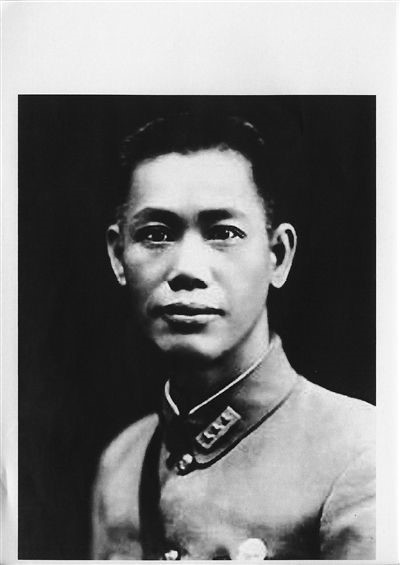
Cai Tingkai
"Gao Laocai" is the main opponent of the Qiongya Red Army in the early stage of the TV series "Blood in the End of the World". He is thin and tall, resourceful, and has a good way to direct operations, causing heavy losses to the Qiongya Party organization and the Red Army. In particular, when he appeared in the third episode, he presided over a combat meeting. At the meeting, on the one hand, he appeased Ye Zhao, commander of the 33rd regiment, and affirmed his "achievements in suppressing bandits", which shows that his political skills are not vulgar; on the other hand, he decided to divide the troops into three routes to "suppress", to carry out a surprise attack on the Qiongya Special Committee and to encourage his subordinates: "to make dumplings. Such an important role did have a historical prototype in the real history of Qiongya Revolution. He was Cai Tingkai, the later commander of the 19th Route Army of the National Revolutionary Army. Cai Tingkai is a native of Luoding, Guangdong. He is over 1.8 meters tall. It is rare for southerners to be tall and solid, so he is nicknamed "Gao Lao Cai".
Forced to participate in the Nanchang Uprising
Cai Tingkai was born in Xianchu. In his early years, he worked in agriculture, studied tailoring and opened a small grocery store. He joined the camp before the Revolution of 1911 and later worked for the Guangdong Army. He served as a battalion commander in the special regiment of Sun Yat-sen's base camp. He served as the 28th commander of the 10th Division during the Northern Expedition and was later promoted to the 10th Division. He was a fellow countryman with Ye Ting and had a good personal relationship.
On the eve of the Nanchang Uprising, Cai Tingkai served as the commander of the 10th Division of the National Revolutionary Army. He happened to be stationed in Nanchang City. When Ye Ting led the 24th Division to prepare for the uprising, he pulled on the 10th Division. When the leading organs of the uprising held a meeting, Cai Tingkai reluctantly arrived at the meeting. At that time, everyone spoke enthusiastically, demanding to oppose the Wuhan government and establish a new political power, that is, the Revolutionary Committee of the Chinese Kuomintang. Cai himself did not speak for a long time, but in fact, he was reluctant. However, as the 10th Division was just sandwiched between Ye Ting and He Long's two uprising troops, it was difficult to escape, so Cai reluctantly agreed to the Nanchang Uprising plan at the meeting. On the day of the uprising, Cai Tingkai's division did not really take part in the military action of the uprising and strictly adhered to neutrality. The provisional revolutionary government established after the Nanchang Uprising appointed Cai Tingkai as "member of the Military Commission, deputy commander of the Eleventh Army, commander of the Tenth Division and left-wing commander". Cai was hesitant to accept the post. Afterwards, Cai Tingkai recalled in his autobiography that "the fundamental beliefs are different, and the opinions are also different, and the only thing to do is to wait and decide to advance and retreat". It can be seen that Cai Tingkai did not agree with the Communist Party's ideas in his heart at that time, but because the head of the 30th regiment, the main force of the division, was a member of the Communist Party, he expressed his firm support for the uprising in advance. There are also many Communists in the 29th Regiment, and the political work department of the entire 10th Division is controlled by the Communists, so Cai was unable to pull the team away for a while.
On the way to the south of the Nanchang Uprising troops, Cai Tingkai found the right opportunity to detain more than 30 Communist Party political workers in the troops, and release them peacefully after giving them travel expenses, which can be regarded as mercy.
The "suppression of bandits" in Qiong was deeply shocked.
After Cai Tingkai led the 10th Division south, he was sent to Hainan Island by the Kuomintang government to "suppress bandits". The so-called bandits, in fact, mainly refers to the Qiongya Red Army. Because at that time the Kuomintang rightists equated the Red Army with the burning and extorting bandits in order to confuse right and wrong. Cai Tingkai was not conscious enough at that time, but he still kept moving closer to Jiang and worked hard for him. After Cai Tingkai arrived in Qiong, he first created anti-communist and "suppression of bandits" public opinion, and issued the "Regulations on Suppression of Bandits", claiming that "no matter communists, peasant bandits or bandits, all those who harm the local government should be suppressed; all peasant associations and peasant armies organized by communists should be disbandits". In late April, Cai Huojun went west and gathered more than 1000 people from the 3rd Battalion of the 28th Regiment, the 1st Battalion of the 29th Regiment and the local militia to attack the revolutionary base areas of Chengmai and Lingao. Led by Feng Ping, commander-in-chief of the Qiongya Red Army and commander-in-chief of the West Road, the soldiers and civilians of the West Road occupied favorable terrain in the Taiping area and repelled enemy attacks many times. Later, due to the great disparity between the enemy and ourselves and the lack of ammunition in the Red Army, they were forced to transfer. Feng Ping was unfortunately arrested for betraying a traitor.
The day after Feng Ping was arrested, Cai Tingkai personally persuaded him to surrender. Cai Tingkai persuaded Feng Ping: "If you change your faith, you can become an official in the province. Feng Ping replied, "It is harder for me not to believe in communism than for the sun to come up from the west. "Cai Tingkai said:" You are a Soviet student, learned, young, and looking back. "Feng Ping said:" I live for the revolution, but also die for the revolution, why do you waste your time. "Cai Tingkai was interrogated many times, but Feng Pingning died unyielding and held his head high. Cai Tingkai failed to persuade him to surrender many times in a row, and he hesitated about how to deal with Feng Ping. Later, a subordinate reported: "The Red Army of Qiongya is preparing to rescue Feng Ping by armed force on the road from Chengmai to Haikou. "When Cai got the news, he was shocked and felt that if the key criminals of the Communist army were rescued, he would have a great responsibility, so he decided to execute Feng Ping on the spot in Chengmai. Feng Ping's heroic and unyielding spirit before his execution had a great influence on Cai Tingkai. Since then, he was not as active in "suppressing the Communist Party" as before, and gradually shifted the focus of his suppression to the bandits who were brutal, vicious, abducting and extorting.
Debriefing in Guangzhou in distress
At that time, the Ye Yingfeng bandits in Changliu Township of Haikou killed and oversold goods in the Fuhai area, and did all sorts of evil. After Cai Tingkai learned about it, he organized forces to eliminate these bandits and stabilized the security in the Fuhai area. However, they did not want Ye Yingfeng's bandits to collude with the pirates in Dapeng Bay in Baoan area of Guangdong for a long time, and the pirates in Dapeng Bay were weakened because of the death of rabbits and the sorrow of the fox. Therefore, they naturally concentrated their hatred on Cai Tingkai.
At the beginning of 1929, Cai Tingkai was ordered to go to Guangzhou to report on his work and board the British Shang Swire. On the way, more than ten pirates were searching around the ship. Two of them broke into Cai Tingkai's cabin and looked around, asking, "Can Mr. Cai be in the room?" Seeing that the man had a hideous face and a strange look, Cai suddenly felt bad, so he immediately became alert and replied, "Mr. Cai is not included in our house. "After pulling away the pirates, Cai Tingkai hurriedly hid in the coal pile in the stern engine room, took out a piece of black canvas and covered it with a thin layer of coal cinder, exposing only two nostrils. As soon as they were hidden, several big fellow broke into the computer room and questioned the workers if anyone came here. The workers took the initiative to cover and deceive the pirates. When the ship arrived in the Castle Peak area of the New Territories of Hong Kong, more than a dozen pirates took a sampan to leave. Cai lay rigidly in the coal pile for more than 10 hours, and finally escaped the pain all over.
After this incident, Cai was treated in Hong Kong for more than 10 days. He recalled the two things he encountered in Hainan. The former regarded death as home, generous and tragic, faithful in faith, awe-inspiring, and moving; the latter retaliated narrowly and took risks in desperation., Murder and cross the goods, obscene and small, despicable. There was a big difference between the two. Cai Tingkai's heart gradually became clear who was the real bandit. Later, Cai's consciousness was rising, from supporting Chiang Kai-shek to opposing Chiang Kai-shek, and then to becoming a sincere friend of the Communists, which was closely related to the stimulation of his two events in Qiongya.
Chen Lichao
Source: Hainan Daily

Address: Buildings 4 and 5, Kechuang Huigu Park, Hongshun Road, Huaming High-tech Zone, Dongli District, Tianjin
Tianjin High-end Equipment Research Institute, Tsinghua University, Copyright
Website Construction: China Enterprise Power Tianjin
sweep
Pay attention to the official WeChat public number