




PARTY BUILDING
party building work
Seventh National Congress of the Communist Party of China: Constructing the First Theoretical Building
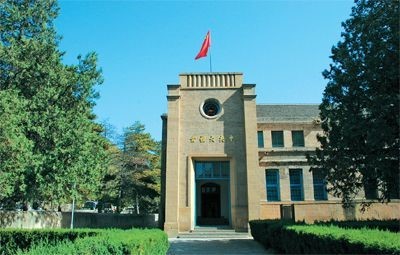
The Central Auditorium is located at the former site of the Yangjialing Revolution in Yan'an, where the Seventh National Congress of the Party was held in 1945.
The Seventh National Congress of the Communist Party of China is a landmark meeting. Today, most of the representatives attending the meeting have passed away. However, through the precious memories handed down by mouth, people can still touch the traces of history, and one story after another winds in it......
The holding time has been changed several times.
The Sixth National Congress of the Communist Party of China was held in Moscow in June 1928, while the Seventh National Congress of the Communist Party of China was not held in Yan'an until April 23, 1945, exactly 17 years apart. There are special historical reasons for such a long time apart. The biggest factors in the seven repeated delays are unrest and war.
As early as January 1931, at the Fourth Plenary Session of the Sixth Central Committee of the Communist Party of China, there was a motion to prepare for the Seventh National Congress. As the Kuomintang successively launched counter-revolutionary "encirclement and suppression" campaigns against the Central Soviet Area, the Party should concentrate its main energy on the war. In addition, during this period, Gu Shunzhang and Xiang Zhongfa were arrested and mutinied, and the Central Committee of the Communist Party of China was forced to move from Shanghai to the Central Soviet Area. In this way, the convening of the Seven Nature is unable to take care of, and the preparations for the meeting have been interrupted.
In October 1936, the Red Army's Long March arrived in northern Shaanxi. The "Xi'an Incident" followed ". After the outbreak of the all-out war of resistance, the Politburo meeting of the CPC Central Committee held in December 1937 passed the "Resolution of the Politburo of the CPC Central Committee on Convening the Seventh National Congress" and established the Seventh National Congress Preparatory Committee, with Mao Zedong as the chairman and Wang Ming as the secretary. The meeting is just around the corner. However, due to the successive occurrences, the resolution was ultimately not implemented.
In March 1938, the Political Bureau of the CPC Central Committee met again to discuss matters related to the convening of the Seventh National Congress. In November of that year, the Sixth Plenary Session of the Sixth Central Committee of the Communist Party of China passed a resolution on the convening of the Seventh National Congress of the Communist Party of China, and made certain provisions and clear instructions on the drafting of the report of the Seventh National Congress, the agenda, the distribution of representatives and the method of generation. In June and July 1939, the Secretariat of the CPC Central Committee issued two notices to local party organizations to elect deputies to the Seventh National Congress. Soon, however, the Kuomintang launched two anti-communist upsurges in succession, and the convening of the Seventh National Congress was once again put on hold.
On March 12, 1941, the Politburo meeting decided to hold the Seventh National Congress on May 1st International Labor Day that year. Later, Zhang Wentian and Mao Zedong handed over the work of the party's general secretary and the rectification and mass production movements were postponed again.
On July 17, 1943, the Secretariat of the Central Committee proposed to the Political Bureau of the Central Committee to convene the Seventh National Congress within 8 to 9 months. On August 1, the "Instructions on the Delegates of the" Seventh National Congress "to attend the General Assembly in Yan'an were issued. Later, due to the reconvening of the rectification meeting by the Political Bureau of the Central Committee, the meeting process that had already started was interrupted again. Until the Seventh Plenary Session of the Sixth Central Committee of the Communist Party of China, the Central Committee of the Communist Party of China formally decided on the date and agenda of the Seventh National Congress. On April 23, 1945, the Seventh National Congress of the Communist Party of China was finally opened.
Party Congress in self-built houses
Like the several changes in the time of the Seventh National Congress of the Communist Party of China, the determination of the meeting place has been repeated many times.
According to information, the Central Committee of the Communist Party of China initially considered the venue of the meeting to be held in Ansai County, northern Shaanxi. In May 1940, Ren Bishi, Secretary General of the CPC Central Committee, and Li Fuchun, Deputy Secretary General, who were in charge of this work, personally visited Ansai. They believe that the environment there is hidden and easy for air defense, which is an ideal place for holding large meetings. However, there are also several unsatisfactory points: first, the transportation is inconvenient; second, it is far away from Yan'an, where the Party Central Committee is located; third, there is a lack of living materials there, and the supply is difficult to keep up. After repeated consideration, the central leadership had to abandon the plan.
After Ansai's plan was abandoned, the relevant departments put the meeting place in Yan'an Zaoyuan. The advantages of jujube garden are dense trees, tall trees and easy to hide. Close to the residence of the central leadership, easy to report and communicate; Zaoyuan has more materials than Ansai, which is convenient for procurement and supply. However, when everything was ready, it was found that the water source here was seriously insufficient, and the water quality was not good, and the accommodation of the delegates was also a problem. In this way, the jujube garden also gave up.
Later, after many weighing and reporting to the Central Secretariat for approval, the site of the Seventh National Congress was finally selected in Yangjialing, Yan'an.
Construction of the Central Auditorium began in 1941 and was completed in 1942. The whole auditorium building is simple and generous, spectacular and beautiful, reflecting the design style of the combination of Chinese and Western-the appearance is imitation of the Soviet style, the interior is a cave-style stone arch structure in northern Shaanxi, which can accommodate thousands of people. It was also the only large building in Yan'an that year with wooden beams and columns. Because the first six party congresses were held in houses built by others, Zhu De said jokingly that this is the first time that our party has held a congress in a house built by itself. From April 23 to June 11, the Seventh National Congress lasted a total of 50 days. In the house built by itself, the Central Committee of the Communist Party of China built the first theoretical building-Mao Zedong Thought. The Seventh National Congress of the Communist Party of China went down in history as a "congress of unity and victory.
Although the Seventh National Congress of the Communist Party of China was finally held smoothly, it is little known that the 700 delegates attending the meeting arrived in Yan'an through hardships. Due to the war, the delegates' journey to Yan'an was full of difficulties, dangers and even risking their lives. Many of them came from the enemy-occupied areas and had to pass through the enemy's blocked areas. The transportation was inconvenient. Some rode horses and more often walked. Because of the long journey and the dangerous environment, some disguised themselves as businessmen, peddlers or beggars, even set out several years in advance and traveled day and night on a pair of feet. Some were escorted by guerrillas, others through the internal relations of the puppet army. Some returned from abroad. Some comrades were seriously injured when they were attacked by the enemy on the road, and even died on the way. Loyalty to the party and yearning for Yan'an made the delegates gather at the bottom of the pagoda mountain.
"Don't push out people who have made mistakes"
The election of the Seventh Central Committee of the Party is an important agenda of the Seventh National Congress. Seven elections, there is a process. First is the brewing phase. In the brewing stage, one of the most debated issues among the delegates was whether to elect comrades who have made mistakes?
In his report on the election policy, Mao Zedong pointed out: "we should not only elect those comrades who adhered to the correct line during the Agrarian Revolutionary War to the new Central Committee, but also elect those who made mistakes at that time, admitted mistakes and corrected mistakes to the new Central Committee. For comrades who made mistakes at that time, we should not "push them away", as long as we admit our mistakes and are determined to correct them. After learning, we will have greater immunity. "After full deliberation and discussion by the delegates, the meeting elected a new Central Committee, including Wang Ming and several other comrades who had made mistakes.
Gao Yangwen attended the meeting as a representative of Taiyue District. When the Central Committee was elected, Gao Yangwen served as a teller. After the vote, a tall man suddenly appeared in front of the tellers. Everyone looked up and it turned out that Mao Zedong had come to their work site.
Mao Zedong sat down and asked with a smile about the votes each candidate had won. Everyone reported the number of votes that had been counted to Mao Zedong. He asked with great concern about the votes of Luo Fu (Zhang Wentian) and Bogu (Qin Bangxian), and specifically asked Wang Ming how many votes he got. Since the votes had not yet been counted, the tellers answered truthfully.
Mao Zedong pondered for a moment and then said, "It's best to be elected. He added: "The Seventh Congress is a united congress, and those who have made mistakes are also represented ...... We should not push out those who have made mistakes, but unite them. If you make a mistake, change it. "Then Mao sat there calmly, patiently waiting for the tellers to count the votes. When Mao Zedong saw Qin Bangxian and Wang Ming finally elected to the Central Committee, a smile appeared on his face.
Wang Jianzhu
China Organization and Personnel News
Previous Page
Previous Page

Address: Buildings 4 and 5, Kechuang Huigu Park, Hongshun Road, Huaming High-tech Zone, Dongli District, Tianjin
Tianjin High-end Equipment Research Institute, Tsinghua University, Copyright
Website Construction: China Enterprise Power Tianjin
sweep
Pay attention to the official WeChat public number