




NEWS
News Center
Wang Jiadao's team from the National Key Laboratory of Interface Science and Technology for High-end Equipment of Tsinghua University has made important progress in the field of micro-nano manufacturing based on colloidal self-assembly.
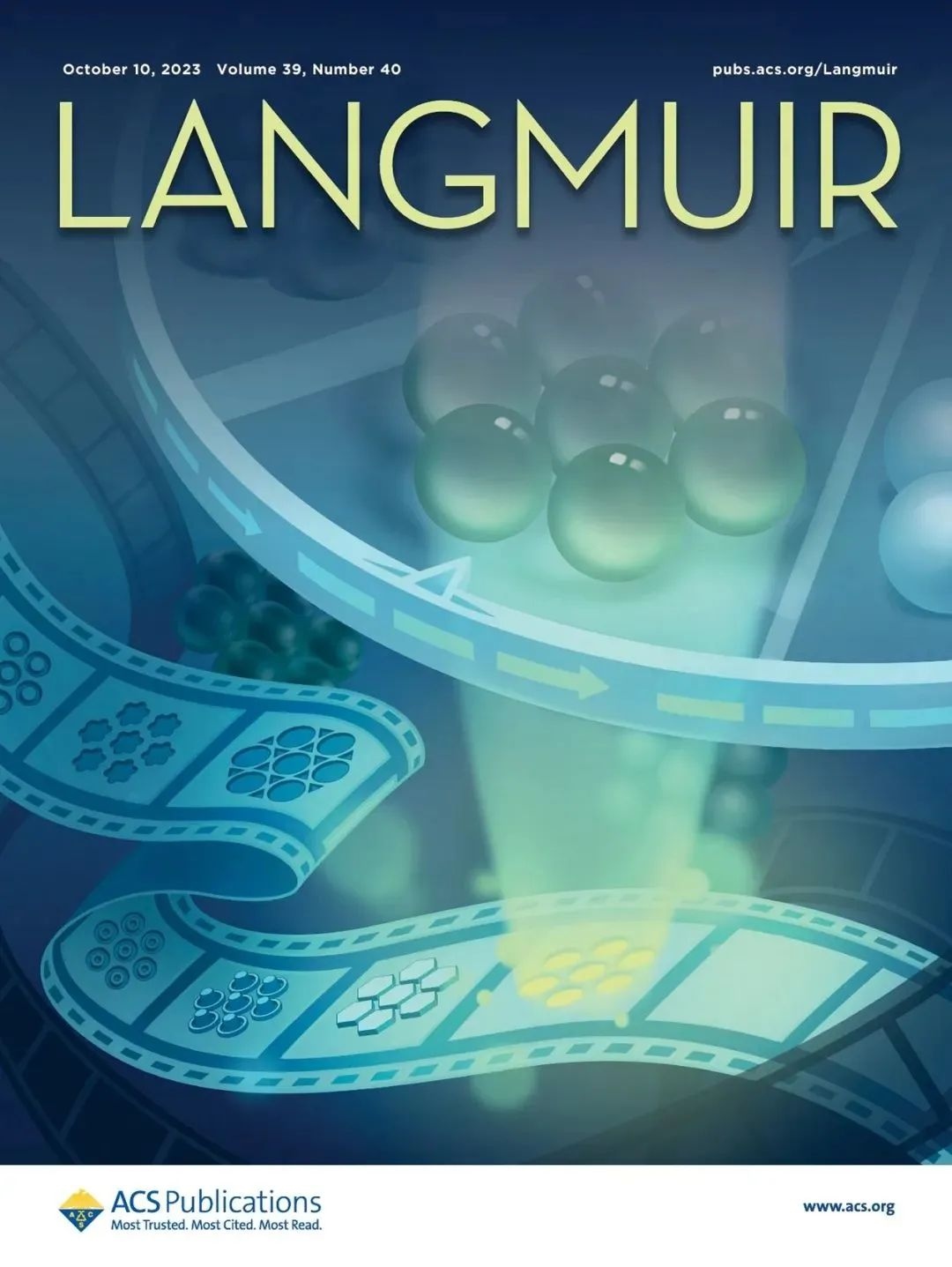
Recently, the National Key Laboratory of High-end Equipment Interface Science and Technology of Tsinghua University has made important progress in the field of micro-nano manufacturing based on colloidal self-assembly. Relevant results were published in the journal Langmuir (Langmuir) under the title of "Shape Analysis of Microsphere Lithography Patterns" (Analysis of the pattern shapes obtained by micro/nano-spherical lens photolithography) and were selected as the cover article of the journal.
research background
Microsphere lithography (SLPL) is based on traditional lithography, using self-assembled microsphere film instead of mask, and using the optical effect of microspheres to realize the preparation process of sub-wavelength scale features. Compared with the traditional mask lithography method, it has gained more and more attention because of its advantages of low cost, high throughput, easy implementation and high precision. However, microsphere lithography is primarily used to produce simple pattern shapes, such as circular arrays. Although many literatures have reported that complex patterns can be formed by a single exposure, there has been a lack of systematic theoretical analysis, especially the prediction analysis of the realizability of various non-circular shapes. At the same time, the numerical simulation of microsphere lithography technology has many conditions and difficult analysis problems, and it is difficult to obtain guiding conclusions directly from the simulation results.
research ideas and conclusions
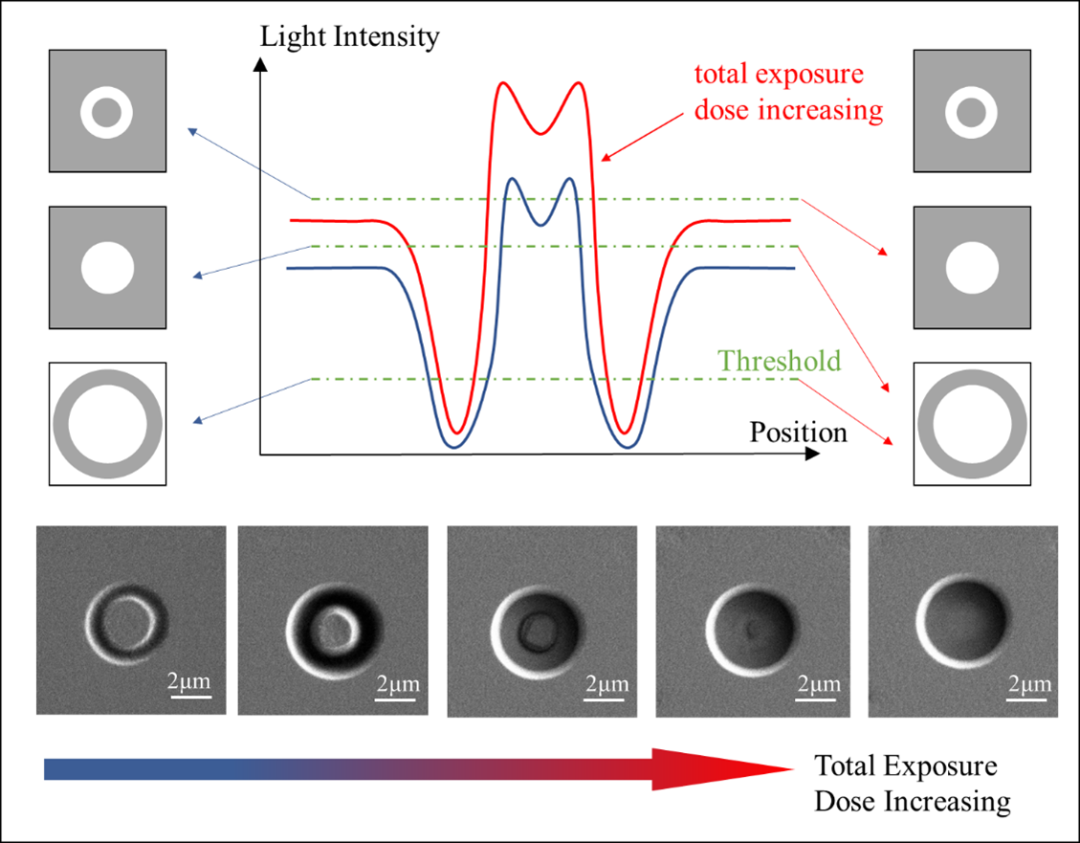
In view of the above problems, based on the tension gradient induced nano-particle liquid-gas interface rapid large-area self-assembly method proposed in the previous research, the group successfully prepared the ring and the ring with holes in the pattern shape by replacing the complex traditional nano-lithography method with the close-packed ordered colloidal particle self-assembly structure as a template, and systematically analyzed and summarized the various patterns that can be obtained by microsphere lithography technology by applying Mie scattering theory, the theory is conducive to the use of relatively intuitive analytical solutions to calculate, predict and optimize the results of SLPL process, and analyze the physical laws of various influencing factors. The pattern shape obtained by SLPL is mainly controlled by two variables, the normalized diameter (ratio of microsphere diameter to exposure wavelength) and the normalized refractive index (ratio of microsphere refractive index to medium refractive index). Most of the non-circular patterns obtained in the previous literature can be directly predicted by this simplified model.
After the plane light passes through the microsphere, the light intensity distribution on the tangent plane to the microsphere can be mainly divided into three regions, including the peak region, the middle valley region and the outer platform region. Among them, the peak region has the ability to form sub-wavelength microstructures, and is the most likely part to achieve nanoscale processing. The lower normalized refractive index is the most critical factor in order to obtain diversified shapes in this region. As the normalized diameter increases, the number of peaks in the peak region also increases. However, the excessive size will lead to a large error between theory and experiment, and bring difficulties to the control of exposure parameters. It is usually difficult to obtain multiple concentric circle structures.
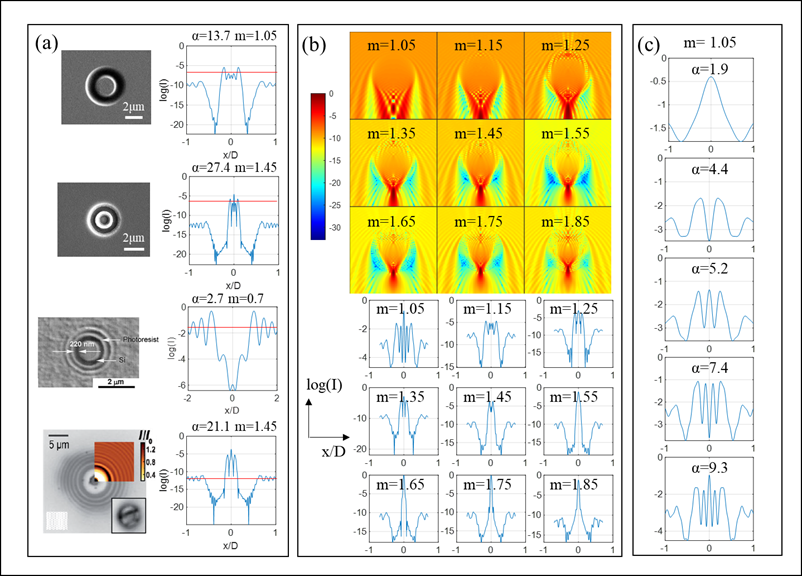
Based on this theory, the research group obtained single ring and perforated ring structures through experiments, which expanded the application scope of SLPL technology. Using the simplified model of Mie theory, a more comprehensive combing and prediction of various possible patterns is carried out, and the theoretical basis of SLPL technology is further improved. These findings help promote the wider application of SLPL in future scientific research and industry.
Author
Yu Guo Xu, a 2022-level doctoral student from the National Key Laboratory of High-end Equipment Interface Science and Technology in Tsinghua University, is the first author of the paper, Professor Wang Jiadao and Assistant Researcher Ma Yuan are the co-corresponding authors of the paper, postdoctoral Yu Bowen, doctoral students Li Xuan, Zhang Xuanhe, Chen Yiqing and Liang Zhenwe have made contributions to the work, which is supported by funding from the National Natural Science Foundation of China and other projects.
Reprint | National Key Laboratory of High-end Equipment Interface Technology

Address: Buildings 4 and 5, Kechuang Huigu Park, Hongshun Road, Huaming High-tech Zone, Dongli District, Tianjin
Tianjin High-end Equipment Research Institute, Tsinghua University, Copyright
Website Construction: China Enterprise Power Tianjin
sweep
Pay attention to the official WeChat public number