




PARTY BUILDING
party building work
"Gu Lin Investigation": Li Zhuoran's "Dissecting Sparrows"
From September 24 to November 25, 1941, Li Zhuoran, then head of the propaganda Department of the Northwest Bureau of the CPC Central Committee, "organized a six-person delegation" to conduct a two-month detailed investigation of Gulin County under the Shaanxi-Gansu-Ningxia Border region Government, resulting in a "Gulin investigation" of more than 100000 words, covering population and class composition, economic and social conditions, the work of the grass-roots party and government, it became a very detailed investigation report during the Yan'an period. "Gu Lin Investigation" was printed as a "party publication" in March 1942. There are currently no more than five copies in the world, one of which is stored in the Yan'an Revolutionary Memorial Hall and is a national cultural relic. The original text of the report is included in books such as "Li Zhuoran Memorial Collection", which has important historical value and reference significance for us to deeply understand the situation of the border area and carry out in-depth investigation and research.
A special survey in a special year
1941 was a very important and special year. At the beginning of the year, the Southern Anhui Incident, which shocked China and foreign countries, broke out; on May 1, the "Shaanxi-Gansu-Ningxia Border Region Policy Program" approved by the Central Committee of the Communist Party of China was officially published, and the Communist Party of China and various parties and mass organizations organized the Anti-Japanese democratic regime in accordance with the "three-three system" The practice of being written into the "Constitution" of the Border Region Government; in June, the Soviet-Germany War, many heroic deeds such as the "Five Heroes of Langya Mountain" emerged; in December, the Japanese attacked Pearl Harbor, the Pacific War broke out, and World War II ushered in an important turning point......
In troubled times, in the face of changes, strengthening self-construction has become a key move for our party to face the wind and rain and the mainstay. In response to the problem that many comrades in the Party "do not yet understand that systematic and thorough social investigations are the basis for policy decisions" and "lack a systematic and thorough understanding of the internal and external environments of their own work areas ......", on August 1, 1941, the Party Central Committee issued two documents, the Decision of the Central Committee of the Communist Party of China on Investigation and Research and the Decision of the Central Committee of the Communist Party of China on the Implementation of China, and set up the Central investigation and Research Bureau, with Mao Zedong as the director and Ren Bishi as the deputy director, to promote the whole party to carry out an in-depth investigation and research activity, setting off an upsurge of investigation and research of the whole party. Investigation and research has been established as an important work system of the Party.
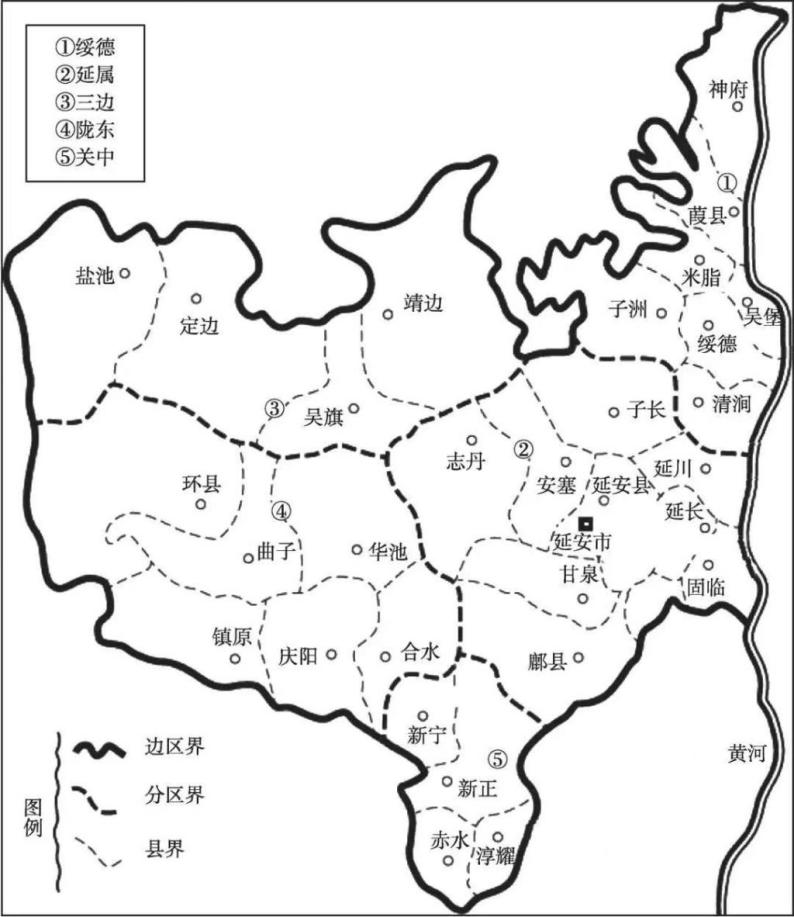
Schematic Diagram of Shaanxi-Gansu-Ningxia Border Region
Propaganda work, as an extremely important work of the party, especially needs to have an in-depth understanding of all aspects of the situation, and effectively promote it in a targeted and effective manner. On May 13, 1941, the Central Committee of the Communist Party of China decided to merge the Northwest Working Committee of the Central Committee of the Communist Party of China and the Central Bureau of the Shaanxi-Gansu-Ningxia Border Region to establish the Northwest Bureau of the Central Committee of the Communist Party of China to lead the party in the Northwest Region including the five northwestern provinces and related regions of Shanxi and Inner Mongolia. Work, appointed Li Zhuoran as alternate member and head of the Propaganda Department. The newly established Northwest Bureau has a wider scope of work, more work responsibilities and higher work requirements. In this regard, the Northwest Bureau plans to refer to the experience and practice of successfully holding the Shaanxi-Gansu-Ningxia Border Region Propaganda Conference in 1939 to prepare for the second Border Region Propaganda Conference. "In order to understand some specific conditions under the border region as a preparation for the second all-border region propaganda meeting," Minister Li Zhuoran led a team to conduct in-depth investigations and studies in the three districts of Gulin County.
Gulin County was established in December 1937. It is located in the area of Yanchang County and Yichuan County. It faces the Yellow River in the east and faces Shanxi across the river. It was replaced by Hongyi County and integrated Guzhou of Yichuan County (now Zhaojiahe, Yanchang County, Shaanxi Province). It took the name of Guzhou and the original Hongyi County Government's resident Linzhen as the first words and was abolished in 1948. Gulin County is located in the southeast of Yan'an, more than 100 kilometers away from Yan'an City. At that time, Yichuan County in the east belonged to the Kuomintang ruled area, and Nanniwan in the west, which belonged to the junction of the Shaanxi-Gansu-Ningxia Border Region and the Kuomintang-controlled area. The work is located in the middle reaches of the whole border area, and it is highly representative to carry out investigation and research here. At the same time, Gulin County is the hometown of the two comrades in the delegation. "The old people are familiar with the place, the investigation is convenient, and the materials obtained are relatively reliable."
A model of comprehensive "dissecting sparrows"
"Gu Lin Investigation" is composed of five parts: the investigation of Zhang hometown in Gengle District, the investigation of Zhaojiahe in Baihu Township in Qingyuan District, the investigation of Linzhen District, the investigation of district and township work, and the investigation of Linzhen Street. The content involves the production and living conditions of farmers, the change of class composition in the countryside, the work of salt transportation, organization, propaganda, trade union, education, self-defense, anti-rape, women, and youth rescue, it also includes the minutes of some major meetings and the life records of the staff, which comprehensively, objectively and three-dimensionally reflect the production and living conditions of the people and the work at the grass-roots level. The style of the report is simple and the content is fresh. Reading it carefully is like watching a historical documentary, full of "pictures" and "sounds", giving people a sense of being on the scene.
The reason why this research report more than 80 years ago can produce the charm of spanning time and space is mainly because they have adopted scientific research methods. The five parts of the report involve five different places. The research content is closely related and has its own emphasis. It is comprehensive, specific and detailed. It records a large number of specific examples, character dialogue, data charts, etc., which clearly and authentically reflect the situation at the grass-roots level. For example, during the investigation in Zhang's hometown in Gengle District, a total of 26 families were interviewed by the individual family visit method. Family members, land and livestock, crop cultivation, income and expenditure, and participation in revolutionary work should be asked and recorded. Five of them were selected for inclusion in the report. They included poor peasants, middle peasants, rich peasants, primary school teachers and "loafers", which were very representative. In order to fully reflect the work of the grass-roots party Committee and government, the report also has special chapters, recording in detail "the 20-day life of township secretary Meng haoxian" and "miscellaneous notes on the half-month life of township chief Zhang zhong" in the form of diaries, ranging from the work of delivering grain and salt to the work of carrying water and grinding flour at home. During the investigation in Juade Village, a township in Linzhen District, the village's mobilization of the national salvation public grain meeting on the evening of November 16 was recorded in detail. Even some ordinary people were talking small words, and Shi Mou, deputy chief of the district security department, shouted, "What are you talking about!" No such details have been omitted.
In the course of the investigation, in addition to striving for detailed and objective records, the research team led by Li Zhuoran also paid special attention to the use of comparative methods for observation and analysis. In terms of vertical comparison, various data from 1934 to 1941 were collected and sorted out, and the changes in population, number of educated people, number of livestock, income and burden of farmers before and after land distribution in 1935 were comprehensively analyzed. The data showed that before and after the agrarian revolution, the burden of farmers became lighter, the political status improved, the number of educated people increased, and so on. In terms of horizontal comparison, it is mainly to compare the income and burden between different classes, the situation between the heaviest and the lightest, and the policies between the border areas and the Kuomintang-controlled areas, so as to confirm the innovative practices and existing problems in grass-roots work.
There is no doubt that the "Gulin investigation" is a typical case of using the comprehensive investigation method, which is inseparable from Comrade Li Zhuoran's long-term revolutionary work and great importance to investigation and research. Li Zhuoran was born in November 1899 in a peasant family in Xiangxiang County, Hunan Province. In 1920, he went to France for work-study programs with Zhou Enlai and Zhao Shiyan. Since 1925, he has studied in Moscow Oriental University, Moscow Sun Yat-sen University, and Leningrad Military and Political College. He was more interested in politics and willing to do some investigations. After graduating in 1929, he returned to China and engaged in military training in Shanghai, frequent investigations and studies; since the second half of 1931, he has served as a member of the Gannan Special Committee and secretary of the Ganxian County Party Committee. This experience has also taught him that "if a person has not worked at the grassroots level, has not worked in the countryside, and does not know the workers and peasants, this kind of person It's not good at work." In the preface of "Gulin Investigation", Li Zhuoran wrote clearly: "Chairman Mao's" Rural Investigation "is the only book we carry with us during this investigation group. His method has given us extremely valuable instructions."
"This investigation gave us a big boost"
In the revolutionary era in full swing, investigation and research plays a very important role in summarizing work, finding problems and correcting deviations. According to the detailed investigation materials, the "solid temporary investigation" put forward four aspects of the problem. These problems, expressed in the current discourse, can be roughly understood as the weakness of grass-roots organizations, the failure of agricultural productivity, the weakness of ideological struggle and publicity and education in rural areas, and the infrequent establishment of work and learning systems at the county and district levels. and discusses in detail the specific manifestations, causes, related hazards, improvement measures and so on.
For example, when explaining the first question: "The lower-level organizations of the party and the political power-the branch committee, the township government committee, the township council, etc., have not established their own regular work, it is clearly pointed out that" among the five officers of the branch committee (branch secretary, organization, propaganda, economic construction and military) and the seven committee members of the township government (township head, economic construction, anti-rape, culture, excellent resistance, health and arbitration), there are all those who do not know what they want to do "." The organization of trade unions and women's federations in villages is empty, and the Youth Rescue Committee has only a little formal work ", and analyze the main reasons for this state, on the one hand, some people in the higher leading organs" because of subjectivism and bureaucracy ", so that some decisions are not in line with reality and do not work at the grass-roots level, on the other hand, most of the district and township cadres are workers and peasants," the level of education is too low, and lack of specific education and help in daily work ", easy to be complacent and self-righteous, the directive documents of the higher authorities and the serious voices of the masses are" often ignored in the past "; pointing out that" the results of these two reasons "will not only lead to the rigidity of the work of party and government organizations in the countryside, but also" give an opportunity to a small number of selfish or corrupt and rebellious elements to make chaos or even spread rumors in the countryside, affecting the disconnection between the party and the masses ".
In response to these problems and shortcomings that were not noticed or paid attention to at ordinary times, Li Zhuoran said frankly in the "Gu Lin Investigation" that this investigation gave us a big stimulus and made us begin to seriously realize what we had done in the past. The mistakes-careless and self-righteous style; made us understand this truth: "The actual policy decision must be based on the specific situation, what you imagine in the house and what you write in a careless written report are by no means specific. It is dangerous to decide policies based on 'taken for fathom' or unrealistic reports." This truth is a passage in the preface to the "Xingguo Survey" written by Mao Zedong in 1931.
There is no end to revolutionary work and no end to investigation and research. In fact, on the 11th day before Li Zhuoran led a team to conduct an in-depth investigation in Gurin County, that is, on September 13, 1941, when Mao Zedong made a speech on the investigation of women's life in rural areas to the Central Women's Committee and the Northwest Bureau, he emphasized this truth again. He said: "We believe in science and do not believe in theology. Therefore, our investigation should be oriented to the lower level, not fantasy. At the same time, we believe that things are moving, changing and progressing. Therefore, our investigation is also long-term."
Today, although we can easily obtain all kinds of information through highly developed information technology, in the face of profound and complex changes in the domestic and foreign environment, in the face of endless new situations, new problems and emerging new practices and new experiences, we also need to overcome carelessness and self-righteousness, adhere to a rigorous, objective and meticulous attitude, adhere to the eyes down, go to the front line, go deep into the grass-roots level, and "dissect sparrows", find, analyze and solve problems more accurately, and push the work forward continuously.
Source: New Xiang Comments
Next Page
Next Page

Address: Buildings 4 and 5, Kechuang Huigu Park, Hongshun Road, Huaming High-tech Zone, Dongli District, Tianjin
Tianjin High-end Equipment Research Institute, Tsinghua University, Copyright
Website Construction: China Enterprise Power Tianjin
sweep
Pay attention to the official WeChat public number