




PARTY BUILDING
party building work
While having a meal on the march, Mao Zedong made an important survey.
Passing by a place and having a meal is too common for most people. However, there will be fewer people who can take advantage of this opportunity to pay attention to investigations, and even fewer will be able to produce important investigations.
Mao Zedong took advantage of the opportunity to have a meal to do an important survey-"Mukou Village Survey." This is a special survey conducted by Mao Zedong on November 21, 1930, when he passed through a small village called Mukou in Jishhui County, Jiangxi Province. The purpose was to understand "the composition of the village government members and the composition of the reactionists killed in the village". This survey is short and concise, the language is simple and concise, the data is detailed, detailed, targeted, and the thinking is of great significance.
"Don't miss the opportunity to have a meal and investigate"
Mukou Village is a natural village with beautiful scenery in Jishui County, Jiangxi Province. The village is surrounded by mountains, and the Wujiang River flows around the village into the Ganjiang River. More than 90 years ago, Jishui County was a red hot land, and the agrarian revolution was in full swing. The older generation of proletarian revolutionaries such as Mao Zedong, Zhu De, Huang Gonglue and Zeng Shan successively engaged in revolutionary activities in Jishui.
The situation at that time was that the Red Army abandoned Ji'an on November 18, 1930. On the 19th, Mao Zedong, Gu Bai and Xie Weijun went from Ji'an to Fujita, Yongfeng, to join the main forces of the Red Army. On the 21st, I took the mountain road from Shuinan Town, Jishu County to Baisha and had lunch at Peng Family Temple in Mukou Village. Mao Zedong seized the time before and after lunch and asked the village cadres to hold an investigation meeting at Peng Clan Temple to investigate the organization of the agrarian revolutionary struggle in the village, the composition of the village government members and the peaceful division of land, as well as the killing of reactionary elements in the village.
For this small village, Mao Zedong recorded the relevant situation and analyzed the composition of the village government's office staff, labor force and economic and social situation one by one: "Mukou Village, the eighth township of Shuinan District, Jishui County, belongs to. The village has 200 people. Forty-six able-bodied men of the village's labor force are all incorporated into the Red Guards. The village government is located in the ancestral hall." "There are nine office members of the village government: chairman, secretary, land committee, social insurance committee, Chiwei committee, grain committee, referee committee, women committee and youth committee." "There are one small landlord, three middle peasants and three poor peasants in the above seven village governments. Among them, the middle peasants are all assigned to the land."
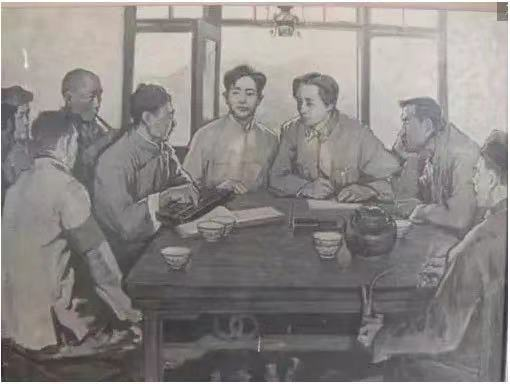
During the investigation, Mao Zedong made a detailed investigation on how many people in each family ate, how much the land produced, how much the family's economic income, how the land was divided, whether the family had enough food to eat, and his personal habits.
With the establishment of the rural revolutionary base areas, the Communist Party of China began to lead the people to carry out the agrarian revolution. The vast number of poor farmers have been given land and sincerely support the Communist Party, which has become an important basis for the existence and development of the base areas. However, due to the lack of practical experience, there is a "left" tendency in the land policy to crack down on the middle and rich peasants and confiscate all land, and there is also a right-leaning error of not carrying out the struggle to divide the land, which is not conducive to uniting all forces that can be united. As a result, Mao Zedong's "Mukou Village Survey" is of great practical significance.
In this investigation report, Mao Zedong made a detailed investigation into the "killing of seven reactionaries in this village. "The village killed seven reactionaries: Peng Jiaguang, Peng Jiashan, Peng Jiajun, Peng Peijun, Peng Changlong, Peng Changxi, and Wen Zhigui." "Of the seven reactionists killed above, three each were small landlords and rich peasants, and one was a rogue." From this, we can know that although the peasants knew about the agrarian revolution at that time, they did not understand it properly. They just blindly overthrown the landlords and rich peasants. After understanding the real situation, Mao Zedong came to the conclusion: "the middle peasants not only lost nothing but also gained in the equal distribution of land, while the rich peasants and small landlords would go to the counter revolutionary camp in the fierce struggle of the peasants." However, it is also questioned whether each of the seven people should be killed.
Through investigation, Mao Zedong found that there was a "left" wrong tendency in dealing with the rich peasants, small landlords and middle peasants, and there were possible deviations and problems in the policy of dealing with the landlord class. He analyzed the wavers in the revolutionary ranks from the point of view of class, and also deeply reflected on the Soviet Union's government's practice of countering and expanding the anti-revolution.
Mao Zedong made five consecutive surveys in Ji'an that month.
There is a time period in modern Chinese history worth mentioning: Mao Zedong in 1930.
This year, the "Central Plains War" took place. The Red Army hit Ji'an nine times, Ganzhou one time, and Changsha for the first time ".
This year was also the "year of investigation" of Mao Zedong's early revolution ". He conducted a series of famous investigations and studies, such as "Xunwu Investigation" and "Xingguo Investigation. In November 1930, in just one month, he conducted five consecutive social surveys in rural Ji'an, and accumulated a lot of rich, vivid and profound survey materials.
On October 30, 1930, the Committee of former enemies of the Red Army decided to smash the Kuomintang's first "encirclement and suppression" of the Central Soviet area in Luofang, Xinyu, with the principle of "luring the enemy deep". At the end of the Luofang meeting, Mao Zedong returned to Ji'an to deploy the Red Army to retreat and transfer. On the way, he made five social surveys in five villages of Dongtang, Daqiao, Lijiafang, Xiyiting and Mukou in Ji'an.
On November 7, Mao Zedong, dressed in casual clothes, came to Dongtang Village, 15th Township, Tongshui District, Jishui (now Dongtang Village, Fengjiang Town, Jishui County, Jiangxi Province), the Old Hall of the Soviet Government. Mao Zedong convened Hu Deshun, a teacher of the village's civilian school, and other village cadres overnight to hold a forum in front of the "Old Hall" to learn about the village's population, number of households, land distribution, family sideline, and people's lives, and wrote the "Dongtang Survey."
At 10 a.m. on November 8, Mao Zedong came from Dongtang to Daqiao Village, No. 9 Township, Jintan District, Jishui (now Daqiao Village, Huangqiao Town, Jishui County, Jiangxi Province), and the village chairman Yang Xiuen and some people cordially started their daily life. Subsequently, he also asked people to find cadres in this township to hold a forum to investigate the distribution of land, the economic situation of farmers, and the recruitment situation in Jintan District, and to publicize to the cadres and the masses the significance of expanding the red support to the front line. Because he didn't have enough paper with him, he took out a cigarette case, wrote down one by one in detail on this small cigarette case paper, and wrote "Bridge Investigation" on the basis of extensive investigation.
On the same afternoon, Mao Zedong also made special social surveys in Lijiafang and Xiyiting Village. In Lijiafang, Mao Zedong focused on investigating the administrative scope, institutional settings, funding sources, and staff of the village government and township government, so as to understand "the organization and activities of the village and township soviets in these places in the land struggle". Mao Zedong said, "Before this investigation, my concept of those situations was vague." After the investigation, it was found that "I don't know that the actual situation is completely different!" In Xiyiting Village, Mao Zedong focused on the investigation of land distribution. Through the investigation, Mao Zedong found that "the seriousness of land distribution by village committee units" and believed that the village-based land distribution method that is beneficial to the rich peasants and unfavorable to the poor peasants "should be changed".
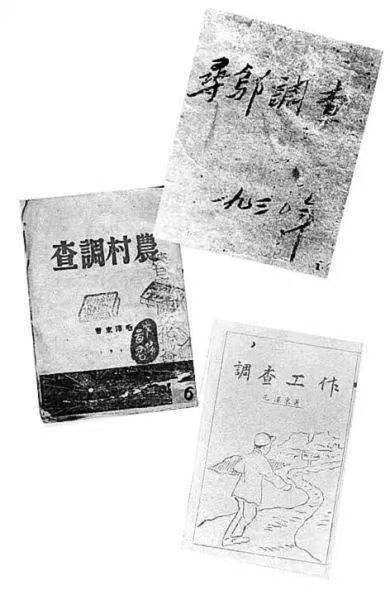
Next, on November 21, 1930, the "Kimouchi Village Survey" mentioned above was done. These five surveys are random and fruitful. The main contents of the survey are: one is about the current land distribution in rural areas; the second is about the organization and activity forms of the Soviet government at the village and township levels in the land struggle; the third is about Policies to treat rich peasants, small landlords, and middle peasants. At that time, this provided rich and accurate first-hand materials and important basis for the party and the Red Army to understand the situation in rural and urban areas, study the outstanding problems existing in the revolutionary struggle, and formulate correct principles and policies, and provided valuable historical data for future generations to study the economic, political and various social conditions of China's rural and urban areas.
“Eyes down, don't just look up at the sky"
Investigation and research is the scientific method of work advocated by Comrade Mao Zedong throughout his life, and it is the method of thinking that he strongly admired throughout his life.
The correct path is deeply buried in the soil of national conditions. To find it out, we must pick up the "hoe" of investigation and research ". Mao Zedong stressed that to do a good job in investigation and research, we should "look down, not just look up at the sky". "If you don't have the interest and determination to look down, you won't really understand China for the rest of your life." "The actual decision-making must be based on the specific situation, what you imagine in the house, and what you see in the careless written report. It is by no means a specific situation. If you decide on policies based on'taken for fathom' or unrealistic reports, it is dangerous."
Therefore, during the period of revolution and construction, when Mao Zedong thought about problems and made decisions, he took investigation and research as the basis of all work, and put forward many good ideas, good methods, and good measures suitable for China's reality. He often goes in person, in person, and does things in person. He wants to go to the near and far, and the good and the bad. He must listen to the praise and criticism of the cadres and the masses, and obtain the "first-hand information" of the "thousands of weather" at the grassroots level ". He also managed to sympathize with the people, "to be friends with the people, not to be a detective".
The purpose of investigation and research is to see the whole picture, discover the truth, analyze the truth, understand the real national conditions and social conditions, the hearts and minds of the people, and make correct judgments. This is a process of peeling off the cocoon in contradiction, clarifying the train of thought and finding the optimal solution. Therefore, under the harsh revolutionary struggle environment, a series of investigations and studies conducted by Mao Zedong involved social, economic, military and other aspects. In fact, they were closely related to the revolutionary situation at that time, and they all had a core direction, that is, to mobilize and lead the broadest masses of the people, overthrow the reactionary forces at home and abroad, and strive for the victory of the revolution.
Although it has been more than 90 years since the investigation of Mukou village, its investigation methods and art, as well as its in-depth and meticulous investigation style and attitude, are of great significance in today's Daxing investigation and research. We must draw spiritual nutrients from this survey in Mukou Village, draw on the wisdom of the masses, and let the survey become the source of our scientific decision-making.
Source: New Xiang Comments

Address: Buildings 4 and 5, Kechuang Huigu Park, Hongshun Road, Huaming High-tech Zone, Dongli District, Tianjin
Tianjin High-end Equipment Research Institute, Tsinghua University, Copyright
Website Construction: China Enterprise Power Tianjin
sweep
Pay attention to the official WeChat public number