




PARTY BUILDING
party building work
The First National Seal of New China as a Symbol of the People's Power"
On October 1, 1949, the the People's Republic of China Central People's Government was established in Beijing. In the History Exhibition Hall of the Communist Party of China, the first "national seal" of New China-the seal of the the People's Republic of China Central People's Government is displayed. It used to be a token of official documents printed by the President of the State or the Central People's Government when issuing various decrees, orders, instructions and exercising other powers. It is a symbol of the highest power conferred by the people's power on the Central People's Government of the the People's Republic of China.
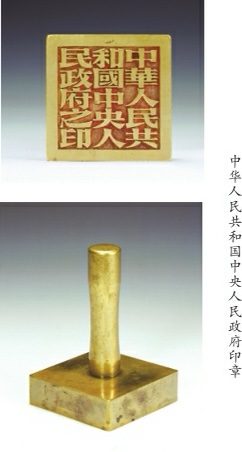
This national seal is a national first-class cultural relic. The side length of the printing surface is 9cm, the thickness of the chapter body is 2.5cm, and the handle length is 10.9cm. The front of the national seal is engraved with the traditional Song characters "The Seal of the Central People's Government of the People's Republic of China". The printed text is symmetrical and rigorous, with clear and solemn impressions and handwriting. The back section adopts the engraving technique of tilting the knife head and chiseling with sharp points. It is engraved with the inscription, opening time and serial number: "the People's Republic of China the seal of the Central People's Government No. 1 of November 1, 1949". The words are clear and delicate. Compared with other government printed letters, the copper used in the production has high density, high viscosity, more ammonium and harder texture. National seal square round handle, print handle and print body respectively casting, rotary joint, copper color soft, fine production. As a witness of the Central People's Government exercising political power on behalf of the people in the early days of the founding of New China, it silently tells visitors the history of the socialist revolution and construction period.
With the decisive victory of the War of Liberation, the task of preparing for the establishment of a new China was put on the agenda of the CPC Central Committee. In June 1949, the first plenary meeting of the preparatory meeting of the New Political Consultative Conference was held in Peiping (now Beijing). The meeting elected Mao Zedong as the chairman of the Standing Committee of the Preparatory Committee, Zhou Enlai, Li Jishen, Shen Junru, Guo Moruo, and Chen Shutong as deputy directors, Li Weihan as secretary-general, and Yu Xinqing and Qi Yanming as deputy secretaries-general. Zhou Enlai entrusted Chen Shutong to handle the printing of the Central People's Government and its subordinate and affiliated institutions, and Qi Yanming was responsible for the specific work.
Qi Yanming is not only a smart and capable organization leader, but also an expert in calligraphy, painting and seal cutting. In order to carve and cure this national seal, he invited the famous Beijing seal masters Zhang Yuecheng, Dunlifu, Tang Zuishi and Wei Changqing to study and discuss together.
Zhang Yuecheng, born in Xinhe County, Hebei Province in 1883, has studied in the village school for several years and is a little fluent in writing and ink, but he has a high talent and writes well. At the age of 14, Zhang Yuecheng came to Beijing Liulichang Yiyuanzhai lettering shop as an apprentice. In the face of the previous prints, Zhang Yuecheng pondered day and night, and gained a lot. After leaving the school, I decided to run the grid by myself, specializing in lettering. He engraved the words "Dragon Flying Tiger Sleeping" written by Liang Qichao. This character was engraved and became famous. It was called "Iron Painting Silver Hook" by insiders and won the reputation of "Iron Pen Master. In 1912, Zhang Yuecheng, who became famous at one stroke, set up his own office and opened his own office in Lailichang to Xun Ge Qin Shu, with the store name "Tonggu Tang". There are more and more people seeking its printing. Celebrities in Beijing and Tianjin are proud to have Zhang Yuecheng's printing.
On August 19, 1949, the "Symposium on Government Printing and Casting Issues" was held at the Beijing Hotel, attended by 14 people including Zhang Yuecheng. The meeting formulated printing and casting issues such as the "type", "font", "material", and "character" of the printing and casting of the new Chinese government, and at the same time revised and passed the "Organization Regulations of the Printing and Casting Bureau of the Central People's Government Administration". From September 21 to 30, the first plenary session of the Chinese People's Political Consultative Conference was held. The meeting passed the "the People's Republic of China Central People's Government Organization Law" and other documents. The name of the "the People's Republic of China" country was determined in a form that conforms to the law, and the national seal "the People's Republic of China the seal of the Central People's Government" was finally formally determined.
In order to carve and cure the national seal, Zhang Yuecheng, who is good at the art of copper carving and has excellent seal cutting skills, began intensive preparations, turning over the data, looking for the seal, and drawing the seal of Li, Song, Han and Qin. Then Zhang Yuecheng handed the printed sample to Qi Yanming. Qi Yanming immediately submitted the printed samples to the central leadership for review. In order to make the masses can understand, Mao Zedong finally chose the printing pattern of Song characters.
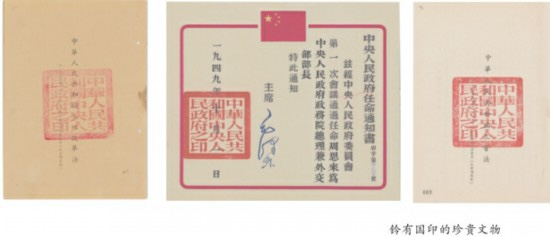
There are very strict special rules for engraving the national seal, and proofing is not allowed to leave the bottom after the engraving is completed. Before delivery, the four corners should be a little higher and cannot be flat. Before the official opening of the national seal, it will be smoothed and called "unsealed". On October 31, 1949, the national seal was officially engraved and handed in for use. According to textual research, the "Central People's Government Order" (issued at 9 o'clock on October 31, 1949) regarding the issuance of a copper seal of the People's Revolutionary Military Commission is the earliest document found to have a national seal. Precious cultural relics such as "the first meeting of the Central people's Government Committee approved the appointment of Zhou Enlai as Premier and Minister of Foreign Affairs of the Central people's Government Administration Council" and "the the People's Republic of China Land Reform Law" and "the the People's Republic of China Trade Union Law" adopted at the eighth meeting of the Central people's Government Committee "on display in the History Exhibition Hall of the Communist Party of China all bear national seals.
In September 1954, the first session of the first National People's Congress was held and the the People's Republic of China Constitution was formulated. According to the Constitution, the National People's Congress is the highest organ of state power, and the State Council is the highest executive organ of state power. So far, the seal letters the People's Republic of China the Central People's government and its subordinate and subordinate administrative organs have completed their historical mission and have all been handed over to the new Central People's government, the State Council. In May 1959, the Secretary's Office of the State Council transferred these precious government seals to the Museum of the Chinese Revolution (now the National Museum of China) for collection.
Today, the national seal no longer performs its duties and is quietly displayed in the exhibition hall. But it is a true testimony of the people's power. It witnessed that extraordinary and prosperous years, witnessed that our party united and led the people of all ethnic groups in the country to achieve the most extensive people's democracy in a country with thousands of years of feudal social history, and the people truly became the country, society and their own destiny. Master.
Source: Learning Times

Address: Buildings 4 and 5, Kechuang Huigu Park, Hongshun Road, Huaming High-tech Zone, Dongli District, Tianjin
Tianjin High-end Equipment Research Institute, Tsinghua University, Copyright
Website Construction: China Enterprise Power Tianjin
sweep
Pay attention to the official WeChat public number