




PARTY BUILDING
party building work
The Historical Status of the Dabie Mountains Revolutionary Base Area
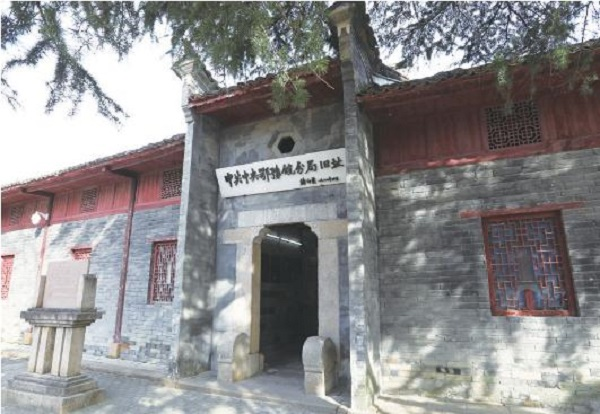
Former Site of Hubei-Henan-Anhui Branch of CPC Central Committee
Dabie Mountain is located at the junction of Hubei, Henan and Anhui provinces, facing the Jianghuai Plain in the east, the Pinghan Railway in the west, the Yangtze River in the south and the Huaihe River in the north. It is an important mountain range winding between the Yangtze River and the Huaihe River from west to east in central China. Dabie Mountain is not only a green mountain, but also a red mountain, a revolutionary mountain and a heroic mountain. From the birth of the Communist Party of China in 1921 to the founding of New China in 1949, the party led the people in the Dabie Mountains to create a revolutionary miracle of "the red flag will not fall for 28 years". With great sacrifice, it has won the lofty historical position of the important party-building base of the Communist Party of China, the main activity place of the Chinese revolution, the important birthplace of the people's army, and the strategic transfer place of the Chinese revolution.
After the October Revolution, a group of advanced intellectuals such as Dong Biwu, Yun Daiying, and Lin Yunan who accepted communism earlier began to spread Marxism and cultivate revolutionary talents through running schools and journals in various parts of the Dabie Mountains. In July 1921, 23 progressive youths including Yun Daiying and Lin Yunan established a communist revolutionary group coexistence club in Huanggang, Hubei on the basis of Liqun Book Club. In November 1921, Chen Tanqiu established the CCP Chen Celou and Badouwan Party Group in his hometown of Huanggang, Hubei. This is the earliest party group in the Dabie Mountains and the earliest rural party organization in the country. From 1923 to 1924, Dong Biwu organized student party members from Huang 'an and Macheng to set up the CPC Huang 'an Working Group and the CPC Macheng Working Group respectively. In western Anhui, the special branch of Xiaodianji in Shouxian County of the Communist Party of China was established in the winter of 1923, which was the first rural party branch in Anhui Province. In the southeastern region of Henan, in 1924, the two counties of Shangcheng and Guangshan established party groups. During the Great Revolution, the Dabie Mountains were one of the most active areas of the peasant movement. A massive peasant movement was generally carried out, a large-scale peasant self-defense armed struggle was carried out, and the revolution was baptized and tempered.
During the Agrarian Revolution, in response to the party's call to carry out the Agrarian Revolution and armed struggle, in November 1927, the revolutionary masses in the Dabie Mountains launched the Jute Uprising under the leadership of the Jute Special Committee, occupied Huang'an County, and established the Huang'an Peasant Government and the Workers and Peasants Revolutionary Army. The Eastern Army ignited the revolutionary beacon in the Dabie Mountains. Due to the attack of the Kuomintang army, the insurgents moved to the Mulan Mountain area of Huangpi County to carry out guerrilla warfare in order to preserve the revolutionary forces. At the beginning of 1928, the uprising troops were reorganized into the Seventh Army of the Workers' and Peasants' Revolutionary Army (later renamed the Eleventh Army of the Workers' and Peasants' Red Army), and began to create the Hubei-Henan border revolutionary base centered on Chaishanbao. After that, under the leadership of the party, the Dabie Mountains successively launched the Shangnan Uprising and the Liuhuo Uprising, and initially established the Southeast Henan Revolutionary Base and the West Anhui Revolutionary Base.
In April 1930, the party organizations in the three regions of Hubei and Henan, southeastern Henan and western Anhui, in accordance with the instructions of the Central Committee of the Communist Party of China, formed the Special Area Committee of the Hubei and Henan border with Guo Shushen as the secretary, and reorganized the 11th Red Army into the Red Army. In June of the same year, the first Congress of workers, peasants and soldiers in the Hubei, Henan and Anhui border areas was held, announcing the establishment of the Soviet government of the Hubei, Henan and Anhui special zone. In this way, the Hubei-Henan-Anhui revolutionary base centered on the Dabie Mountains was formally formed. From November 1930 to June 1932, the Hubei, Henan and Anhui revolutionary base areas successively won the first, second and third anti "encirclement and suppression" wars, and in November 1931, Xu Xiangqian was formed as the commander-in-chief. The Red Fourth Front Army. With the victory of the anti-"encirclement and suppression" war, the base areas and the Red Army have achieved great development. The Red Fourth Front Army has grown to 45000 people, and revolutionary regimes have been established in 26 counties. At its peak, it covered an area of more than 40000 square kilometers and a population. About 3.5 million million, it was the second largest revolutionary base in the country during this period after the Central Soviet Area. In July 1932, Chiang Kai-shek mobilized the 300000 army to launch the fourth "encirclement and suppression" of the revolutionary base areas in Hubei, Henan and Anhui ". At that time, Zhang Guotao, the main leader of the Hubei, Henan and Anhui revolutionary base areas, blindly belittered the enemy and adopted the policy of military adventurism. As a result, the Fourth Red Army failed to break the "encirclement and suppression" of the Kuomintang army ". In October of the same year, the main force of the Red Fourth Front Army crossed the Pinghan Railway and moved westward. After more than two months of fighting, it arrived in southern Shaanxi and northern Sichuan at the end of the year, and then opened up the Sichuan-Shaanxi Revolutionary Base.
After the main force of the Fourth Red Front Army was transferred, the main Red Army units remaining in the revolutionary base areas of Hubei, Henan and Anhui were organized into the 25th Red Army, which persisted in the revolutionary struggle in the Dabie Mountains. In November 1934, in accordance with the instructions of the Central Committee of the Communist Party of China, in order to cooperate with the Long March of the Central Red Army, the Red Twenty-Five Army decided to implement a strategic transfer to the Hubei-Henan-Shaanxi border, and subsequently established the Hubei-Henan-Shaanxi Revolutionary Base. When the Red Twenty-Five Army was transferred, the Hubei, Henan and Anhui Provincial Committee of the Communist Party of China decided to leave Gao Jingting, member of the Standing Committee of the Provincial Party Committee and Secretary of the Northwest Anhui Provincial Committee, to rebuild the Red Twenty-Eight Army and persist in the struggle in the Hubei, Henan and Anhui border areas. After the outbreak of the Anti-Japanese War of the whole nation in 1937, the Red 28th Army, which insisted on being reorganized into the fourth detachment of the New Fourth Army in the Dabie Mountains, advanced eastward into central and eastern Anhui and put into the anti-Japanese battlefield.
The party established anti-Japanese armed forces in eastern Hubei, southern Henan and western Anhui, and successfully created anti-Japanese base areas. Under the leadership of the party, closely relying on the local people and unremittingly carrying out armed struggle, the fourth detachment and the fifth division of the New fourth Army became the mainstay of the war against Japan in the Hubei, Henan and Anhui border areas, and gradually formed the Central Plains liberated area with the Dabie Mountains as the center.
The Central Plains liberated area is located between Nanjing, Wuhan and Zhengzhou, and its strategic position is very important. The insistence of the army and the people in the liberated areas of the Central Plains is very important for other liberated areas to prepare for Chiang Kai-shek's all-out civil war, and the liberated areas of the Central Plains contain a large number of Kuomintang troops, thus reducing the pressure on other liberated areas accordingly. In June 1946, the Kuomintang troops besieging the liberated areas of the Central Plains reached a total of 220000 men in eight integrated divisions and two brigades. In order to preserve the effective strength of the Central Plains Liberation Army, according to the instructions of the Central Committee of the Communist Party of China, Li Xiannian, Zheng Weisan and others led the Central Plains troops to successfully break through. Mao Zedong commented on this that the Central Plains Liberation Army "once suppressed more than 30 brigades of Chiang Kai-shek's regular army, enabling our main force in North and Central China to survive the most difficult period of Chiang Kai-shek's offensive, and played a great strategic role".
On June 30, 1947, in accordance with the strategic deployment of the Central Committee of the Communist Party of China, the main force of the Shanxi-Hebei-Shandong-Henan Field Army led by Liu Bocheng and Deng Xiaoping broke through the natural danger of the Yellow River in one fell swoop and leapt thousands of miles into the Dabie Mountains, opening the prelude to the strategic offensive. By late November of this year, democratic regimes in 33 counties had been established in the Dabie Mountains, and the strategic development in the Dabie Mountains was initially completed. By the end of October 1947, people's political power had been established in 33 counties, the liberated areas of Hubei, Henan and western Anhui had been opened up, more than half of the Kuomintang army on the southern line had been effectively contained, and the fundamental transformation of the war of liberation from strategic defense to strategic attack had been realized. Since then, the Hubei-Henan and Western Anhui liberated areas have become an important part of the new Central Plains liberated areas.
In the long-term revolutionary struggle, more than 200 million heroic sons and daughters joined the army in the Dabie Mountains. The main force of the Red Army, such as the First Army of the Chinese Workers and Peasants Red Army, the Fourth Red Army, the Red Twenty-Five Army, and the Red Twenty-Eight Army were also formed to conform to the development and changes of the revolutionary situation, and revolutionary armed forces such as the Fourth Detachment of the New Fourth Army, the Fifth Army, the New Fourth Army, the Fifth Army, and the New Army, and Local Gun Army, local guerrilla Army. Whether in the struggle against "encirclement and suppression", or in the various battlefields of the Japanese army and the Central Plain breakout and strategic attack; whether it is the formation of the first Red Army, the fourth Red Army and the fourth Red Front Army, or the long march of the Red 25 Army, Liu Deng's army leaping thousands of miles into the Dabie Mountains, the Dabie Mountains have not only forged people who dare to fight, brave and fight, tenacious, it has also cultivated and formed a fine style of listening to the party's command, obeying orders, taking into account the overall situation, and being absolutely loyal.
According to incomplete statistics, during the revolutionary war years, nearly 1 million people died bravely in the Dabie Mountains, 130351 martyrs left their names, and countless unknown martyrs lay in the ground. The Dabie Mountains have created a glorious and important chapter in the history of the Chinese revolution by mobilizing the revolutionary masses and forming a wide scale of revolution.
The spirit of Dabie Mountain is the precious spiritual wealth of our party and an important part of the spiritual pedigree of the Chinese Communists. In September 2019, General Secretary Xi Jinping pointed out during an inspection in Xinyang, Henan: "The base area of the Hubei, Henan, Anhui and Soviet areas is an important party-building base for our party," and the spirit of Dabie Mountain "is our party's precious spiritual wealth". The spirit of the Dabie Mountains is the Chinese Communists and the masses of the people in the Dabie Mountains for national independence, national liberation, and people's happiness. They insist on "the red flag will not fall for 28 years" and the revolutionary fire will not be extinguished. The sum of revolutionary beliefs, revolutionary will, and revolutionary qualities condensed with blood and life has the distinctive characteristics of loyalty, dedication, people, and revolution, it is embodied in "sticking to faith, keeping the overall situation in mind, forging ahead in unity and being a forward".
Source: Learning Times
Previous Page
Previous Page

Address: Buildings 4 and 5, Kechuang Huigu Park, Hongshun Road, Huaming High-tech Zone, Dongli District, Tianjin
Tianjin High-end Equipment Research Institute, Tsinghua University, Copyright
Website Construction: China Enterprise Power Tianjin
sweep
Pay attention to the official WeChat public number