




PARTY BUILDING
party building work
China's Innovation in Dongfanghong No.1
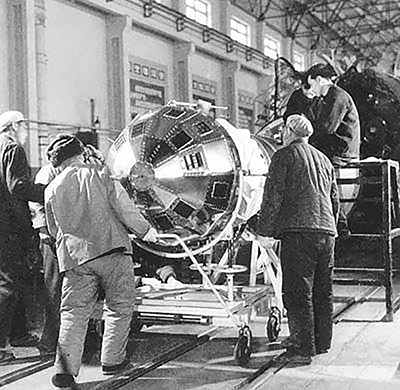
In early 1970, researchers were testing the Dongfanghong-1 satellite in the plant.
On April 24, 1970, after years of unremitting efforts by the majority of participants, my country's first man-made earth satellite "Dongfanghong-1" was successfully launched. As an important part of the "two bombs and one satellite" project, the successful launch of the "Dongfanghong-1" satellite opened the prelude for the Chinese nation to explore the mysteries of the universe, peacefully use space, and benefit mankind.
"We also need satellites"
In October 1957, the Soviet Union successfully launched the first artificial earth satellite, shocking the world. The United States followed suit with the launch of an artificial satellite, opening a chapter of the US-Soviet "space race.
At this time, although the new China was very backward in economy, science and technology, it had a strong determination to stand among the nations of the world. In May 1958, at the second meeting of the Eighth National Congress of the Communist Party of China, Chairman Mao Zedong proposed with great foresight and great courage: We must also build artificial satellites.
However, during that period, China's cutting-edge technology development policy was "two bombs, missile first". Under such circumstances, the plan to launch an artificial satellite can only "give way" to the development of sounding rockets, learn skills, lay the foundation, and train the team.
1964 was a bumper year for China's high-tech sector. In June, China's first self-designed medium-and short-range rocket was successfully launched. In October, China's first atomic bomb was successfully exploded. In addition, the scientific research team, which has been "building the foundation" before, has made breakthroughs in satellite energy, satellite temperature control, satellite structure, satellite test equipment and so on.
Scientists think the launch of a satellite is on the agenda. At the end of this year, Qian Xuesen, Zhao Jiuzhang and other famous scientists wrote to the Central Committee, suggesting that the development of artificial satellites should be carried out. The suggestions of scientists were highly valued by the older generation of party and state leaders such as Mao Zedong and Zhou Enlai. In May 1965, entrusted by Mao Zedong, Premier Zhou Enlai instructed the Chinese Academy of Sciences to come up with a specific plan for the first artificial satellite.
Qian Ji, a scientist in charge of the overall satellite group, led the young scientific and technological workers to come up with a preliminary plan and reported directly to Zhou Enlai. When Zhou Enlai learned that Qian Ji's surname was Qian, he couldn't help but say humorously: We are engaged in cutting-edge science, atomic bombs, missiles, and satellites, and they are really inseparable from "money!
"Go up, catch, hear, see"
After rigorous argumentation by hundreds of experts, the nature, mission, launch time and success of the first man-made satellite have been determined: this is a scientific exploration and test satellite, and the mission is to develop China's earth observation, communication and broadcasting., Meteorology, etc. to obtain basic experience and design data, the launch time is set in 1970, the sign of success is: "I can go up, catch, hear and see."
The so-called "going up" is to ensure that the satellite flies into the sky; "catching" is to be able to track and measure after the satellite is launched, no matter what the weather is; "hearing" means that the whole country and the world can listen to the sound sent by China's first satellite; "visible" means that the observer on the earth can see the satellite with the naked eye.
Since the satellite work plan was formally proposed in January 1965, Premier Zhou named the code name of the artificial earth satellite project "651" mission at the Central Committee. The meeting clearly stipulated that people and property across the country will be given the green light when they encounter "651. Since then, "Dongfanghong No.1" has entered the substantive stage of engineering development.
Scientific research activities are extremely hard. Researchers once tested a component outdoors in the middle of winter and the cold wind was blowing. Test, improve, re-test, re-improve, regardless of day and night, regardless of wind and snow, meticulously test, do not let go of every fault.
Since the early launch vehicles were developed on the basis of missiles, the weight of China's first man-made satellite actually demonstrated the country's military strength. This is of great practical political significance in the specific international environment of the breakdown of Sino-Soviet relations and the confrontation between China and the United States.
Although China's satellite project started late, experts all believe that China's starting point is higher, and the first satellite should be more advanced than the first satellite of the United States and the Soviet Union in terms of weight and technology. The first Soviet satellite weighed 83.6kg and the first US satellite 8.2kg. After scientists' hard work and skillful work, the actual weight of "Dongfanghong No.1" reached 173kg.
sun jiadong is the person in charge of the overall design of the "dongfanghong-1" satellite. He recalled that the biggest challenge faced by researchers at that time was to use the most rudimentary equipment to realize China's first space mission. In order to make the satellite "visible", researchers added an observation ball to the third stage of the launch vehicle., Coated with reflective materials, it can reflect sunlight in a large area.
Many people of the older generation remember the familiar melody played by "Dongfanghong No.1. The receiving and broadcasting system of this piece of music is unique to China's first satellite. It does not rely on a tape recorder, but uses electronic circuits to simulate the sound of an aluminum plate piano.
"What I thought at that time was to pass on a piece of music from" The East is Red ", and also pass on a piece of engineering data in the middle. After the first eight verses, there was a long time in the middle, which was the sound of" Ji Li Jia ", which was to pass on data." Sun Jiadong memories.
"It is a miracle that Dongfanghong No.1 was born!"
On April 1, 1970, the "Dongfanghong-1" satellite and the "Long March 1" carrier rocket arrived at the Jiuquan launch site in northwest my country.
After everything was ready, at 21:35 on April 24, the satellite launch time finally arrived. With the roar of the engine, "Dongfanghong-1" ejected with the "Long March 1" carrier rocket, left the launch pad, and soared into the sky.
At 21:48, the satellite separated and the satellite went into orbit. At 21:50, the State Broadcasting Administration reported that it had received the music of "Dongfanghong" from China's first satellite, with a clear and loud voice.
The next day, Xinhua News Agency solemnly announced to the world: On April 24, 1970, China successfully launched the first man-made earth satellite. The satellite's orbit has a perigee altitude of 439 kilometers and an apogee altitude of 2384 kilometers. The angle between the orbital plane and the earth's equatorial plane is 68.5 degrees, and it takes 114 minutes to circle the earth. The satellite weighs 173 kilograms and broadcasts the music of "Dongfanghong" at a frequency of 20.009 trillion weeks......
The gongs and drums were blaring, firecrackers were blaring, and thousands of people across the country formed a huge parade. Everyone was excited and cheered the first man-made earth satellite developed by China.
After the satellite went into the sky, some international friends visited the satellite development base in my country. The environmental conditions at that time made the visitors exclaim: "It is a miracle that the'Dongfanghong-1 'was born!"
From the first man-made satellite "Dongfanghong-1" to today, more than 200 satellites developed and launched by China have been flying in orbit.
Reprint source: "Great Changes -70 Years of Historical Leap in China's Science and Technology"

Address: Buildings 4 and 5, Kechuang Huigu Park, Hongshun Road, Huaming High-tech Zone, Dongli District, Tianjin
Tianjin High-end Equipment Research Institute, Tsinghua University, Copyright
Website Construction: China Enterprise Power Tianjin
sweep
Pay attention to the official WeChat public number