




PARTY BUILDING
party building work
China is still a hot spot for investment in the eyes of foreign investors (China's economy in depth)-how to view the current situation of the use of foreign capital.
At 00:50 a.m., Wal-Mart's South China Fresh Food Distribution Center in Dongguan, Guangdong Province was in a hot scene: the staff picked up and loaded the goods in an orderly manner. An hour later, the cold chain truck loaded with fresh vegetables set off for Wal-Mart's designated stores, waiting to meet with consumers early in the morning. As a fresh food distribution center customized by Wal-Mart, the total investment of the project exceeds 0.7 billion yuan.
"The new version of the" Catalogue of Industries Encouraging Foreign Investment (2019 Edition) "issued by the National Development and Reform Commission and the Ministry of Commerce includes logistics and related technical services such as the joint distribution of general commodities, cold chain logistics of fresh agricultural products, and low-temperature distribution of special drugs. This makes us more determined to expand investment in China." "in the next 10 years, we will invest 8 billion yuan in China to build or upgrade logistics distribution centers," said McRuien, senior vice president of supply chain at Wal-Mart China."
"China's policy of utilizing foreign capital will not change, the protection of the legitimate rights and interests of foreign-invested enterprises will not change, and the direction of providing better services for enterprises from all over the world to invest in China will not change." Since the 18th National Congress of the Communist Party of China, the Party Central Committee with Comrade Xi Jinping at its core has attached great importance to the use of foreign capital, which has greatly enhanced the confidence of foreign investors in China. my country's use of foreign capital has maintained a steady and positive development momentum.
What do you think of the current situation in the use of foreign capital? Will changes in the external environment have an impact on China's foreign investment? Can the use of foreign capital continue to maintain a good situation? The reporter conducted an investigation and interview.
The scale is "stable", the structure is "excellent", and the use of foreign capital is good enough.
In Shanghai, a new blueprint is unfolding: at a signing ceremony for foreign investment projects held at the end of May, 38 projects totaling nearly 50 billion yuan were finalized one after another;
In Guangdong, a new record is being set: a new integrated production base with a total investment of 10 billion US dollars is about to rise, which is the largest investment project of global chemical giant BASF in the world;
In Liaoning, a new magnetic force is emerging: 7693 Japanese and Korean foreign-funded enterprises have taken root in Dalian, with a cumulative actual investment of US $26.35 billion as of the end of April......
Multinational enterprises have increased their investment, and China has made good use of foreign capital.
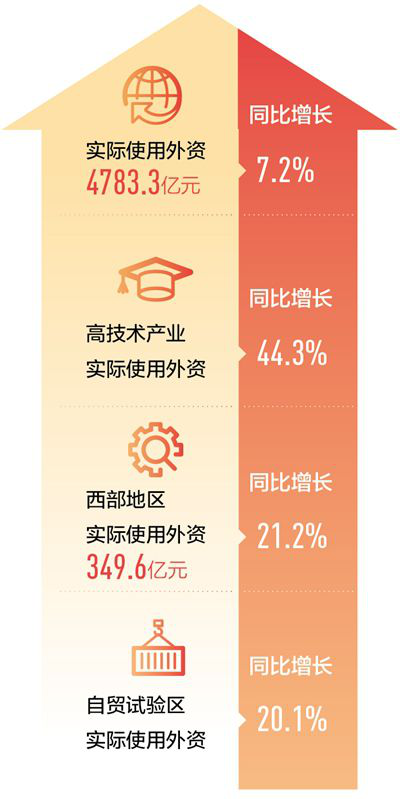
Looking at the total amount, the scale of China's utilization of foreign capital has grown steadily. Last year, China's actual use of foreign capital reached a record high. In the first half of this year, the utilization of foreign capital continued to grow well, with the actual use of foreign capital of 478.33 billion billion yuan, an increase of 7.2 percent over the same period last year.
"The darker the night sky, the brighter the stars. In the context of international trade and investment, we can better see the quality of our country's use of foreign capital." Sang Baichuan, a professor at the University of International Business and Economics, said that the overall situation of global transnational investment is tightening, and countries are facing greater challenges in attracting investment. A recent report released by the United Nations Conference on Trade and Development shows that the total scale of global cross-border direct investment has dropped from US $1.9 trillion in 2015 to US $1.3 trillion in 2018. "It is not easy for China to use foreign capital to achieve a steady increase against the trend."
Not only "stable quantity", but also "high quality", the quality of my country's use of foreign capital is also manifested in the continuous optimization of the level and structure of foreign investment.
Foreign investment in the field of high technology is eye-catching. In the first half of the year, the actual use of foreign capital in high-tech industries increased by 44.3, accounting for 28.8. Among them, the actual use of foreign capital in the high-tech manufacturing industry increased by 13.4 year-on-year, and the actual use of foreign capital in the high-tech service industry increased by 71.1 year-on-year, both of which were much higher than the overall growth rate of foreign capital utilization.
The geographical distribution of foreign investment is more reasonable. In the first half of the year, the actual use of foreign capital in the western region was 34.96 billion billion yuan, an increase of 21.2 percent over the same period last year; the actual use of foreign capital in the free trade pilot zone increased by 20.1 percent over the same period last year, and the growth rate was significantly higher than the national average.
The main body of foreign investment is diversified, and the "circle of friends" of attracting investment is growing. In the first half of the year, investment in my country's main investment sources grew well. Investment in China by South Korea, Singapore, Japan, and Germany increased by 63.8, 10.5, 13.1, and 81.3 respectively; the actual investment of the European Union, ASEAN, and countries along the "Belt and Road" The amount of foreign capital increased by 22.5, 7.2 and 8.5 respectively year-on-year.
China is still an attractive investment destination for foreign investors.
The impact of unilateralism and protectionist measures on the use of foreign capital is generally controllable.
At present, global economic growth is weak and the prospects for trade and investment are bleak. The global investment "market" is not optimistic and the "flow" is not abundant. Some countries have introduced measures to compete for the "cake" of foreign investment ". Some people are worried that this will have a greater impact on "stabilizing foreign investment?
"The external environment has changed, and there must be pressure." Xing Houyuan, director of the China Service Outsourcing Research Center of the Ministry of Commerce, said that since the international financial crisis, global cross-border direct investment has shown an overall downward trend. In 2016, 2017 and 2018, it fell for three consecutive years, reaching the lowest level in history last year. In order to attract foreign investment, some countries have made "ruthless moves", such as substantial tax cuts and lower energy prices. The international competition to attract cross-border direct investment is becoming more and more fierce.
In the face of external challenges and pressures, China has issued a series of policies to stabilize foreign investment and played a set of "combined punches" to stabilize the confidence of foreign businessmen and market expectations, so that China still maintains a strong competitiveness in the world investment market. The World Investment Report 2019 released by the United Nations Conference on Trade and Development shows that global foreign direct investment declined in 2018, but China's total foreign investment attracted bucked the trend by nearly 4%, accounting for more than 10% of the world's total foreign direct investment, and continues to become the world's second largest foreign capital inflow country.
At present, economic globalization has encountered some twists and turns in its in-depth development, trade and investment disputes have intensified, and unilateralism and protectionism have severely impacted the international order and the multilateral trading system. Some people worry whether this will also affect China's utilization of foreign capital?
"There is an impact, but the overall controllable." Zhang Yansheng, chief researcher of China International Economic Exchange Center, said.
Unilateralism and protectionist measures such as tariffs will mainly increase foreign investment's expectations of production costs, which will have an impact on foreign investment's decision to invest in destinations. Especially for foreign enterprises in labor-intensive industries, this is an important reference factor.
At present, there is indeed a phenomenon that some export-oriented labor-intensive enterprises transfer their production capacity from China to foreign countries. "We should treat this phenomenon objectively, analyze it rationally and keep a normal mind." Zhang Yansheng said.
First of all, although enterprises may save some costs, they also face other uncertain risks, such as industrial supporting capacity, economic development environment, labor quality, and so on. Enterprises will comprehensively consider the proportion of foreign-funded enterprises transferred simply to avoid unilateralism and protectionist measures.
Secondly, some foreign-funded enterprises shut down individual factories in China and transfer their production capacity to other countries for various reasons, not all of which are affected by unilateralism and protectionist measures. Some of these companies are due to their own poor management; some belong to the low-end manufacturing field, taking into account the rising costs of labor and land in my country, transferring production capacity to the outside.
"The global industrial chain is dynamically adjusted and will evolve with the changes in the international division of labor and the global industrial layout. Therefore, the relocation of industrial chains is a normal phenomenon in a market economy." Zhang Yansheng said that the transfer of foreign capital in a small number of low-end manufacturing fields conforms to the stage and law of China's economic development.
A small number of low-end industrial chain of foreign investment outward transfer is not terrible, the key depends on whether high-quality foreign investment has come in. Facts have proved that, thanks to a series of new measures to expand and open up, the actual use of foreign capital in high-tech manufacturing industries such as my country's pharmaceutical manufacturing industry, electronic and communication equipment manufacturing industry increased by 12.8 and 25% year-on-year in the first half of the year. The use of foreign capital in high-tech service industries such as information services, R & D and design services, and scientific and technological achievements transformation services increased by 68.1, 77.7 and 62.7 respectively. The rapid growth of foreign investment in these areas shows that China has shown strong attraction to high-level and high-quality foreign investment.
Xing Houyuan believes that China has a complete industrial system, which can form a good industrial ecology and has obvious advantages in scale effect; there is an increasing supply of high-quality talents, which can undertake high-end manufacturing, R & D and even high-tech services, while the wage level is relatively low compared with developed countries, which are favored by foreign investors. "High-quality foreign investment will still choose to stay in China, and more high-quality foreign investment will enter our country."
The use of foreign capital was stable in the past, is stable now, and will be stable in the future.
"Looking ahead, a series of policies and measures to stabilize foreign investment will gradually take effect, and China has the foundation and conditions to achieve the development of foreign investment to a higher level and higher quality." Zhang Yansheng said.
-- The firm pace of opening wider to the outside world has given foreign investors more stable expectations and stronger confidence. Zhang Yansheng said that China will do what it says, and the door of opening up to the outside world is opening wider and wider. From daily consumption to manufacturing services, heavy measures to expand opening up have been implemented one after another, giving foreign investment a "reassurance".
An electric car drove into a gas station. The driver quickly charged the car while ordering a cup of freshly ground coffee in the station. In a short time, the gas station staff will send steaming coffee to the car. This is not a movie picture, but a real scene of British Petroleum (BP) in a new gas station in Jinan, Shandong Province.
"China, which is becoming more and more open, is glamorous in the international market." Dr. Yang Xiaoping, chairman and president of BP (BP) China, said the company will add 1000 new gas stations in China in the next few years.
-- Broad market prospects, like a super magnet to attract foreign investment. Recently, the German company ThyssenKrupp as a supplier to participate in the creation of Geely's first sedan SUV officially listed. The car is equipped with an electronic power steering system from ThyssenKrupp's steering system manufacturing base in Changzhou, with a project investment of 0.2 billion euros. "In recent years, thanks to the huge Chinese consumer market, ThyssenKrupp's investment in China has maintained an annual level of 1 billion yuan, and the total investment has exceeded 15 billion yuan." Dr. Gao Yan, CEO of ThyssenKrupp Greater China, said.
The huge market of nearly 1.4 billion million people and the strong purchasing power of more than 0.4 billion middle-income groups are huge consumer forces that no country can match. China's huge market is not only expanding in size, but also rapidly upgrading in structure. Consumers need more high-quality information, medical, health, financial, cultural and other service products. Multinational companies have obvious advantages in these fields and have a bright future.
-- Continuously optimize the business environment, so that foreign investors feel the real convenience. Continuously pushing forward the reform of "letting go", reducing administrative approval and licensing matters; promulgating the Foreign Investment Law to strengthen the promotion and protection of foreign investment; and implementing larger-scale tax and fee reductions to allow enterprises to travel light ...... According to the World Bank's Doing Business 2019 Report, China's business environment improved significantly by 32 places last year compared to the previous year.
The "soft" environment is good, and the "hard" investment is coming. "Our development in China has received more efficient support and services, thanks to China's increasingly optimized business environment." Yang Guochao, senior vice president of Royal Dutch Friesland China, said that last year Friesland invested an additional 0.1 billion euros in China for channel sinking and the expansion of major brand products and catering channel business.
A recent survey by the American Chamber of Commerce in Shanghai showed that more than 80% of US-funded companies are optimistic about their development prospects in China in the next five years. A recent survey by the German Federal Agency for Foreign Trade and Investment showed that there are more than 5200 German companies in China. As China continues to open up, more companies will increase investment in China. "We have no members leaving China because the attraction of the Chinese market is hard to resist." Said Harry Sayadin, president of the American Chamber of Commerce in South China.
"On the whole, China's use of foreign capital has the foundation and conditions for sustained and stable growth. It was stable in the past, is stable now, and will be stable in the future." Chu Shijia, director of the General Department of the Ministry of Commerce, said.
Source: People's Daily-People's Daily

Address: Buildings 4 and 5, Kechuang Huigu Park, Hongshun Road, Huaming High-tech Zone, Dongli District, Tianjin
Tianjin High-end Equipment Research Institute, Tsinghua University, Copyright
Website Construction: China Enterprise Power Tianjin
Business License
sweep
Pay attention to the official WeChat public number