




PARTY BUILDING
party building work
Mao Zedong and the Initial Mission
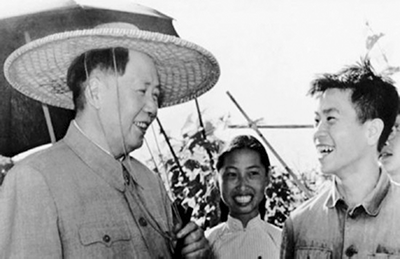
Mao Zedong with the people
Seeking happiness for the people and rejuvenation for the nation is Mao Zedong's lifelong pursuit. Mao Zedong once said: "Communists are a special kind of people. They do not seek personal gain at all, but only seek the welfare of the nation and the people." This is the original intention and mission that Mao Zedong set for the Chinese Communists, and he himself completely practiced it in this way.
For the lifelong pursuit of faith, the first heart does not change
For the welfare of the vast majority of people, for the happiness of all mankind, and for every worker to develop freely and form a union of free men, this is the original intention of Marx and Engels for the Communist League. The connotation of this original intention is clearly written in the "Communist Manifesto" and has become the belief of Marxists.
Mao Zedong's belief in Marxism was initially established by reading Marxist-Leninist works such as the Communist Manifesto. In October 1936, when he talked with the American journalist Snow about his "eagerly searching for the very few Chinese texts of communist documents that could be found at that time" during his stay in Beijing in the spring of 1920, he clearly said: "There are three books that are particularly profound. Remembered in my heart, it made me establish my belief in Marxism". The three books he mentioned are the Manifesto of the Communist Party, the Class Struggle and the History of Socialism. Mao Zedong, like the advanced intellectuals in China at that time, finally found the truth of Marxism after repeatedly seeking and comparing various ideological trends and doctrines in the process of searching for the truth of saving the country and the people for a long time. From then on, Mao Zedong firmly believed in Marxist theory and firmly pursued the cause of communism. He "has never wavered" in the firmness of theory and the firmness of the road throughout his life ".
Judging from Mao Zedong's theoretical study, thinking, and practical exploration throughout his life, whenever he encountered major problems and ideological difficulties, he had to repeatedly read Marxist-Leninist works such as the Communist Manifesto to find wisdom, ideas, and methods; in the final analysis, it is to constantly strengthen the original mind and strengthen the power of faith. In his later years, Mao Zedong still loved the "Communist Manifesto" and other works, and constantly asked the party to strengthen its study, especially reminding: "Senior party cadres, no matter how busy they are at work, must squeeze time and read some books on horses and columns. Distinguish between true and false Marxism-Leninism." He also wittily said to the staff around him, "I have to study every day I live, and learn as much as I can, otherwise, what will happen when I meet Marx?" Until his death, at least three versions of the Communist Manifesto, which he often read, were placed beside Mao's bedroom bed. This precisely confirms the fact that Marxist theoretical works accompanied Mao Zedong's life. He is a great Marxist who has completely and thoroughly fought for the interests of the people and the cause of communism all his life.
Devotion wholeheartedly for the people
What kind of political party is the Communist Party of China? What is her fundamental purpose and governing philosophy? What is the fundamental difference between her and other political parties? These fundamental questions have been clearly answered by Party leaders such as Mao Zedong from the relationship between the Party and the people, and the most representative answers are some of Mao Zedong's classic expositions below.
The first sentence: "The Communist Party is a political party that works for the interests of the nation and the people, and it has no selfish interests of its own. It should be subject to the supervision of the people and should never go against their will."
The second sentence: "Communists are a special kind of people who do not seek personal gain at all, but only seek the welfare of the nation and the people. They are rooted in the people. They are the sons of the people and the teachers of the people. They are always on guard not to divorce from the masses. No matter what happens, they always take the interests of the masses as the starting point for considering problems. Therefore, they can win the heartfelt support of the broad masses of the people, which is the basis for the inevitable victory of their cause."
The third sentence: "Another remarkable sign that distinguishes us Communists from any other political party is that we have the closest ties with the broadest masses of the people. Serving the people wholeheartedly and never separating from the masses for a moment; proceeding from the interests of the people, not from the interests of individuals or small groups; the consistency of being responsible to the people and to the party's leading organs; these are our starting points."
The fourth sentence: "Our team is completely for the liberation of the people and is thoroughly working for the interests of the people."
The fifth sentence: "Our responsibility is to be accountable to the people. Every word, every action, and every policy must suit the interests of the people, and if there are mistakes, they must be corrected. This is called being accountable to the people."
The sixth sentence: "the Communist Party is to struggle, that is, to serve the people wholeheartedly, not to serve the people half-heartedly or 2/3-heartedly and 2/3."
There are many such classic languages. Mao Zedong's positioning of the fundamental purpose of the Communist Party and the Communists profoundly revealed the fundamental attributes of the party, reflected the most basic truth of the historical materialism created by the people, and clarified the complete consistency between the party's propositions and the people's propositions.
When Mao Zedong summed up why our party was able to win the revolution, he also said the following two sentences: "stand on the side of the most working people"; "worship the people as a teacher, this will work". The first sentence is an inscription to the Jiaxian County Party Committee in October 1947, and the second sentence is an answer to the question raised by the former Kuomintang general Zheng Dongguo after the founding of New China. Mao Zedong revealed the root cause of the Communist Party's victory. If we think of the people in everything and worship the people as our teachers, everything will be in order. This is true for revolution, construction and reform.
For the country and the nation to think far-sightedly, racking their brains
Mao Zedong has been working hard for the cause of the party, the country and the people all his life, planning the future development strategy of the country and the nation. In his later years, he was more eager to think about and remember the great cause of national prosperity, people's happiness and national rejuvenation, and to think about the major issues of the life and death of the party and the country.
In September 1963, just as Mao Zedong was about to turn 70 years old, when he revised the "On Industrial Development Issues (Preliminary Draft)", he profoundly pointed out that after we have basically solved the social system problems, "if we do not in the next few decades, Strive to completely change the state of our country's economy and technology lagging far behind the imperialist countries, and it is inevitable to be beaten". To this end, he specifically pointed out: "We should deploy our work with the possibility of being beaten as the starting point." The basic point and core of Mao Zedong's thinking is to make socialist China stronger, and all work must be prepared early to lay a solid foundation for future development. These fully reflect Mao Zedong's foresight in considering the future of the country and the nation. When Mao Zedong led the formulation of a long-term plan for national development, the first consideration was the basic industries and strategic bases. During 1964, when he was studying the "Three Five-Year Plan", he particularly emphasized that not only the "two fists" of agriculture and defense industry, but also the "one butt" of basic industry ". He constantly reminds people: if you are ready, the enemy may not come; if you are not ready, the enemy may come; if you are ready, it is easy for the enemy to come; if you are not prepared, you must be prepared; any work must be based on the worst. Imagine and deploy the possibility.
Mao Zedong has always been extremely concerned about the fundamental interests of the people and the safety of life and property. The last document he read during his lifetime was about the Tangshan earthquake. In the early morning of July 28, 1976, a strong earthquake of magnitude 7.8 occurred in Tangshan and Fengnan, Hebei Province. Tianjin, Beijing and other earthquakes were obvious. At this time, Mao Zedong was basically in a coma and semi-coma. As soon as he woke up, he was concerned about the Tangshan earthquake and personally read the earthquake report. when the secretary reported the extremely heavy losses caused by the earthquake, mao zedong burst into tears. The staff around him recalled: "The first time I saw the chairman wail." On August 18, with Mao Zedong's personal review and approval, the Central Committee of the Communist Party of China issued the "Notice on Earthquake Relief in Fengnan, Tangshan."
Mao Zedong passed away with the regret that the motherland has not yet been completely reunified, the people have not really lived a prosperous life, and the nation has not yet achieved great rejuvenation. But he always believed that these "can be achieved"!
Source: China Organization and Personnel News

Address: Buildings 4 and 5, Kechuang Huigu Park, Hongshun Road, Huaming High-tech Zone, Dongli District, Tianjin
Tianjin High-end Equipment Research Institute, Tsinghua University, Copyright
Website Construction: China Enterprise Power Tianjin
Business License
sweep
Pay attention to the official WeChat public number