




PARTY BUILDING
party building work
The power of faith
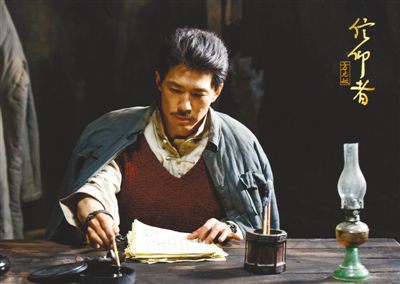
"The walls of this cell have been pasted with white paper. Although it has been out of date for a long time, the paper has turned dark yellow, and there are several places where rain leaks, and large black spots have appeared; but when sunlight comes in, or the strong lights are on, the room still looks white and dazzling......"
In 2018, it was 83 years since Fang Zhimin died bravely. "The Believers", jointly produced by Bayi Film Studio and China Film Co., Ltd., takes us back to the scene of history, into the prison cell, the battlefield of the struggle of faith, and the group of unswerving revolutionaries.
Fang Zhimin's name is familiar to every Chinese. His fearless spirit of sacrifice for revolutionary beliefs, together with the immortal masterpieces "Poverty" and "Lovely China", are recorded in the glorious history of national memory. The hero's name and deeds have been celebrated from generation to generation, but with the passage of time and social changes, how many people today really understand the revolutionary? How many people understand the weight of the word faith? Do their stories and perseverance still have the power to travel through time and space and reach out to people's hearts? The film "The Believer" is a search spanning 83 years and a test for today's film creators and audiences.
The starting point of the search is in the cell. In 1935, in order to cooperate with the Long March of the Central Red Army, Fang Zhimin was ordered to lead the Red Tenth Army to the hinterland of the Kuomintang. Chiang Kai-shek urgently dispatched hundreds of thousands of military horses to chase and intercept. due to difficulties in resupply, they decided to ambush wang yaowu, who was eager for meritorious service, at tanjiaqiao. Liu Chouxi, the commander of the army, was headstrong and let the newly formed 20th Division play the main attack despite opposition. As a result, he suffered heavy losses. In Huaiyushan, Liu Chouxi made another command error and was surrounded by enemy regiments. Fang Zhimin, chairman of the Fujian, Zhejiang and Jiangxi Soviet government, Liu Chouxi, commander of the army, Wang Ranchi, commander of the 19th division, Hu Tiantao, commander of the 21st division, and Cao Yangshan, chief of staff of the army, were captured one after another, and the 10th Red Army was wiped out. "The Believers" focuses on Fang Zhimin's life in prison for the 180 days after his arrest and the final struggle of his life.
"it is easy to die on the battlefield, but difficult to die calmly". In the film, the enemy, Fang Zhimin and other revolutionaries, had four rounds of persuasion to surrender and four degrees of slow killing. There are wonderful arguments, but also human feelings and even human entanglements. Faith, in this process, is stripped of its cocoon, carefully looked at and profoundly interpreted. The most dramatic and exciting part of the film is also this part. During the interrogation, Qian Xiemin, deputy director of the Military Law Division of the Nanchang Camp, persuaded him to surrender: Those who know the times are heroes, and your doctrine will not succeed. Fang Zhimin under the shackles is determined to die: we are temporarily defeated militarily, but we will not fail politically. This is the true character of a believer. The enemy again sought a breakthrough from the Huangpu Phase I birth Liu Chouxi. Gu Zhutong, commander-in-chief of the North Road Army for the fifth "encirclement and suppression" campaign, gave a Hongmen banquet. Liu Chouxi, who was surrounded by Huangpu's younger brothers, did not let up and denounced him loudly. Killing yourself is the fearlessness of the believer. The enemy also used to meet his wife Miao Min as a condition. Fang Zhimin naturally misses Miao Min. He also knows that after this side, the two may separate yin and yang. To see or not to see? In the end, Fang Zhimin chose not to see, and he believed that "Miao Min could understand". The film's treatment of this plot makes people see the softness and true temperament of the revolutionaries, and gives the hard faith a human temperature. Four rounds of persuasion, step by step, as the main line of shaping the character image and unfolding the dramatic contradiction, make the characters plump and three-dimensional, and the contradiction is sharply opposed, so that the belief has texture, temperature, strength, and the spiritual context of the current connection.
The film tells the story of a group of believers. In addition to Fang Zhimin, Liu Chouxi and Wang Ranchi, who were detained together, Xunhuaizhou, who died in the battlefield, and Hu Tiantao, commander of the 21st Division, were all impressive. In prison, Liu Chouxi and Wang Ruci seemed to have an endless game of chess. Liu Chouxi's repentance was in sharp contrast to his military arrogance. In addition to the plot of the "Hongmen Banquet", the audience can not help but sigh when they see a tragic hero who is proud of his talent but ultimately falls on his military judgment and his own personality. At that time, the youngest commander of the Red Army, 22-year-old general Xunhuaizhou, was shot and killed in the battle. Liu Chouxi and the soldiers buried him in tears. The enemy couldn't figure it out: why didn't an open army commander even have a cotton-padded jacket before he died? The broken porcelain bowl Hu Tiantao carried with him aroused Wang Yaowu's curiosity. Why did a division commander carry a foreign porcelain bowl? Hu Tiantao answered: This is the bowl my mother left to beg for food, the revolution is for the world mother no longer to beg for food! The true revolutionaries have a supremely important faith in their hearts, which keeps them in mind all the poor of the world. The "Poverty" written by Fang Zhimin in prison is the best answer: "Poverty, a pure and simple life, is where our revolutionaries can overcome many difficulties!"
The film also shows some people who admire Fang Zhimin and then choose the light. For example, Hu Yimin, the warden of the Kuomintang Central Prison who was detained by Chiang Kai-shek, and the prison staff who delivered news to Fang Zhimin, relaxed his shackles, and sent pen and ink. This confirms from one side that lofty belief is a progressive force, and it has a powerful influence in itself; it is also a broader and more powerful explanation that it is Chinese history and the Chinese people who chose revolution.
"Friend! China is the birth of our mother. Do you think this mother is cute? I think you have the same opinion as me. You all think this mother is pretty cute and cute. "When the familiar" Lovely China "sounded on the screen, Fang Zhimin and his comrades in arms wore heavy shackles, passed on the grass covered with wild flowers, and walked calmly onto the execution ground. When the real photos of believers such as Xunhuaizhou, Liu Chouxi and Fang Zhimin in their youth were presented on the screen, the baton of" Looking for Fang Zhimin "was handed over to the audience, and the heroic sense of loftiness was also left in the audience, this is the reflection and aftertaste left by the film.
"Heroes are the brightest coordinates of a nation". "The believer" restores the final struggle between Fang Zhimin and his comrades in arms with a calm and heavy film language and a creative attitude of great things and small things. It makes the spiritual pointer to find Fang Zhimin finally point to the thinking of the times of "what is faith". It is not only close to the aesthetic taste of the current audience, but also inspires the contemporary people with the heroic sense of lofty in the history of Chinese revolution. What The Believers conveys to the audience and the creation of the film is the power of faith.
Source: People's Daily Online
Previous Page
Previous Page

Address: Buildings 4 and 5, Kechuang Huigu Park, Hongshun Road, Huaming High-tech Zone, Dongli District, Tianjin
Tianjin High-end Equipment Research Institute, Tsinghua University, Copyright
Website Construction: China Enterprise Power Tianjin
sweep
Pay attention to the official WeChat public number