




PARTY BUILDING
party building work
How Mao Zedong Demands the Party's Senior Cadres in Politics
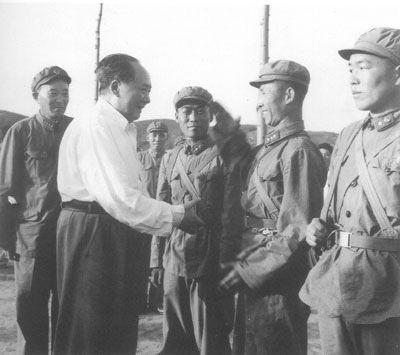
Mao Zedong attached great importance to the construction of the party's senior cadre team, and put forward a series of targeted and higher requirements for senior cadres than ordinary cadres. Among them, the most emphasized are political requirements, such as systematically and practically learning Marxism-Leninism; Maintain the unity of the party as the standard to guide one's words and deeds; strictly implement party discipline; take the lead in adhering to democratic centralism; overcome bureaucracy and guard against specialization and aristocracy. Mao Zedong took measures to manage the party to implement these requirements and gained useful experience.
Senior Party cadres are, in Mao Zedong's words, "leaders of the masses" and, in Xi Jinping's words, "the key minority among the key minorities". Senior cadres are the direct participants in the formulation of the party's line, principles and policies, as well as the organizers and implementers of the implementation. They shoulder important responsibilities in promoting the development of the party and the country, and play an important exemplary and leading role for the cadres and the masses.
Mao Zedong attached great importance to the construction of the party's senior cadres. As early as 1937, he said: "our party's organization should develop to the whole country, consciously train tens of thousands of cadres, and have hundreds of the best mass leaders. These cadres and leaders understand Marxism-Leninism, have political foresight, have the ability to work, are full of sacrifice, can solve problems independently, do not waver in difficulties, and work faithfully for the nation, the class, and the party."
Mao Zedong put forward a series of targeted and higher requirements for senior cadres in terms of politics, ideology, style, and work. Among them, the most emphasis is on political requirements, mainly the following points:
1. senior cadres should systematically and practically learn Marxism-Leninism
Mao Zedong has always believed that Marxism-Leninism theory is a science that every party member and cadre should learn, and his requirements for senior cadres are higher than those of ordinary cadres, that is, to learn Marxism-Leninism more systematically and practically. He once said: "from the point of view of shouldering the main leadership responsibility, if our party has 100 to 200 comrades who have learned Marxism Leninism systematically rather than piecemeal, practically rather than empty, the fighting strength of our party will be greatly improved."
Mao Zedong clearly saw the danger of senior cadres not being able to systematically and practically learn Marxism-Leninism. He pointed out: "he will only one-sidedly quote individual words and sentences of Marx, Engels, Lenin and Stalin, but will not use their positions, viewpoints and methods to specifically study the current situation and history of China, analyze the problems of the Chinese revolution and solve the problems of the Chinese revolution. This attitude towards Marxism-Leninism is very harmful, especially for cadres above the middle level."
In view of the fact that the previous "Left" and Right errors in the party have a lot to do with the inability of senior cadres to correctly grasp and use Marxism-Leninism, Mao Zedong asked senior cadres to earnestly strengthen theoretical study. He hoped that senior cadres will greatly improve their theoretical level while possessing practical work capabilities to meet the requirements of the Chinese revolution and construction.
During the Yan'an period, under the vigorous promotion of Mao Zedong, our party successively established more than a dozen cadre colleges such as the Anti-Japanese Military and Political University, the Northern Shaanxi Public School, and the Central Marxist-Leninist College. Although many senior cadres undertake heavy tasks in the front or rear, they are supported by the Central Committee and Mao Zedong and enter these colleges to study Marxism Leninism. Mao Zedong was very concerned about the study of senior cadres. In addition to giving lectures in these schools, he often visited them to learn about their study and give them encouragement.
In the Yan'an rectification study, Mao Zedong focused on strengthening the theoretical study of senior cadres and getting through the thinking of senior cadres. According to his request, a senior study group composed of about 300 senior cadres was specially set up, with Mao Zedong as the group leader. At the beginning of the establishment of the advanced learning group, he pointed out in a letter to all the members: "the research policy of this group is to link theory with practice. "Under the advocacy of Mao Zedong, through in-depth study of theory and party history, senior cadres have recognized the dangers of subjectivism, sectarianism, and party writing, established a Marxist style of work, and led the party's rectification to achieve practical results.
After the founding of New China, Mao Zedong paid more attention to the theoretical study of cadres, especially the theoretical study of senior cadres. In 1949, he recommend 12 Marxist-Leninist works that cadres must read, and said: "We should have a common understanding of propagating Marxism and improving our level of Marxism, and many of our senior cadres have not yet shared this issue. Understanding. If in the next three years, 30,000 people finish reading these twelve books and 3,000 people can read these twelve books, that will be very good. "In March 1951, according to Mao Zedong's opinion, the Central Committee of the Communist Party of China issued the" Decision on Strengthening Theoretical Education (Draft) ", requiring the whole party to systematically study theory in order to adapt to the complex task of building a new China. In particular, it provides clear provisions for the study of senior cadres.
Mao Zedong pointed out: "For Marxist theory, we must be able to master it and apply it. The purpose of mastery is to apply it. "Mao Zedong asked senior cadres to learn to use Marxist positions, viewpoints, and methods to observe and solve practical problems in revolution and construction. In November 1958, Mao Zedong began to correct the "left" errors that appeared in the "Great Leap Forward. He wrote a letter to the leading comrades of the Central Committee, provinces, prefectures and counties, suggesting that everyone read the two books "socialist economic problems of the Soviet Union" and "Marx's on communism. He said in the letter: "Now many people have a lot of confused ideas, reading these two books is possible to clarify. Some comrades who claim to be Marxist economists have been so in recent months. They were Marxists when they were reading Marxist political economy, and their Marxism was compromised when it came to certain specific problems in current economic practice."
Mao Zedong paid great attention to persistently taking the lead in studying theory. Beginning in December 1959, Mao Zedong spent more than two months leading Chen Boda, Hu Sheng, Tian Jiaying, and Deng Liqun to read the Soviet "Political Economy (Textbook)". While reading, he thought about problems in close connection with China's reality. He not only affirmed the correct things in the book, but also boldly doubted and put forward many original opinions. Mao Zedong's tireless learning attitude and learning method of connecting with reality and independent thinking set an example for the whole party.
Mao Zedong's theoretical study of grasping senior cadres has been persistent and has never been relaxed. In February 1964, he commented on the request report of the Central Propaganda Department on organizing senior cadres to study the works of Marx, Engels, Lenin, and Stalin: "This article has been read, it is very good, and it can be sent immediately. "He also suggested that the 30 books be published in" large print, thread-bound and fascicle ", hoping that this would be completed within the year. In 1970, he appointed more than 250 Central Committee members and alternate Central Committee members to read 9 Marxist-Leninist works, and said that it is not easy to learn Marxism-Leninism well, and it is even more difficult to use Marxism-Leninism well in connection with reality. In 1971, during his inspection tour in other places, Mao Zedong also instructed the local leaders: "I hope you will read more books in the future. Senior cadres don't even know what materialism is and what idealism is, how can they do it? "You are all secretaries, and you have to be students."
Under Mao Zedong's vigorous advocacy, the theoretical study of senior cadres within the party has become a common practice, and the level of Marxist theory has been greatly improved.
2. senior cadres should take safeguarding the unity of the party as the standard to guide their words and deeds
The unity and unity of the party is the basic condition for the victory of revolution and construction, and senior cadres are the key factor to maintain the unity and unity of the party. Mao Zedong had a profound understanding of this. He pointed out: "As long as the central government and senior cadres are united, the whole party will be united. As long as the Communist Party is united, it is bound to be unbreakable."
During the revolutionary war, in order to meet the needs of the revolution, our party led and founded XuMany rural revolutionary bases. Under the circumstances of dispersion and no contact with each other, the various revolutionary base areas have carried out relatively independent guerrilla warfare for a long time, which objectively formed a "mountain top", and there has also been a wrong tendency with the nature of small groupism and sectarianism, that is, "mountain-topism". Mao Zedong clearly saw the harm of mountainism: if this situation persists and develops for a long time, it will develop into sectarianism. People who come down from the mountain huddle with each other and form gangs, which "seriously hinders the unity of the party and the enhancement of the party's combat effectiveness"
In the selection and appointment of senior cadres, Mao Zedong advocated proceeding from reality, first recognizing and taking care of the mountain, but resolutely opposing the mountain doctrine in order to maintain the unity of the party. During the Seventh National Congress of the Communist Party of China, there was a debate on whether the election of the Central Committee should take care of all aspects. Mao Zedong pointed out in a clear-cut manner: "If we want to eliminate mountainism, we must recognize and take care of the mountain. Only in this way can we narrow and eliminate the mountain. Therefore, we have to admit that there are mountains, and we can't do it if we don't admit it. In the future, we have to take care of all parts, groups, different parts of history, and different problems. "The ultimate goal of taking care of the mountain in a specific period is to eliminate mountain-topism and achieve unity and unity of the whole Party.
Mao Zedong demanded that senior cadres must unite closely around the Central Committee and resolutely implement the line and guidelines formulated by the Central Committee. He pointed out at the Seventh National Congress of the Communist Party of China: "You must know that a team is often not very neat, so you must always shout for alignment, to the left, to the right, and to the middle. We need to align ourselves with the central benchmarks and with the General Assembly benchmarks. Alignment is the principle, deviation is the real life, if there is deviation, it is called alignment. "Of course, what Mao Zedong advocated was unity on the basis of Marxism-Leninism, unity with principles, not unprincipled harmony. He said: "To unite under one principle and on the basis of the correct line is to unite with a clear mind, not blind unity."
In his speeches and talks, Mao Zedong often educated senior cadres to safeguard the unity of the Party. He is very impressive, lively and funny. Mao Zedong once explained the relationship between common belief and unity with Journey to the West. He said: we should see that they have a strong belief. Tang Priest, Sun Wukong, Zhu Bajie and Sha Monk went to the Western Heaven to learn scriptures together. Although they were not united in the middle, they finally overcame difficulties and obstacles, defeated monsters and ghosts, reached the Western Heaven, got scriptures and became Buddha after helping each other and uniting. Mao Zedong also used "The Romance of the Three Kingdoms" to inspire senior cadres to stress unity and overcome mountainism and sectarianism. He said: To read this book, you should not only look at war, diplomacy, but also organization. You northerners-Liu Bei, Guan Yu, Zhang Fei, Zhao Yun and Zhuge Liang-organized a team to go south to Sichuan and set up a good base area together with "local cadres.
Mao Zedong always affirmed and valued senior cadres who had a sense of the overall situation and talked about unity. Mao Zedong had a high evaluation of Luo Ronghuan: "This comrade has one advantage, he is very principled, and he is ruthless to the enemy; if he has opinions about comrades, he will talk less behind his back, talk more face to face, and talk about people without back. It is not easy for a person to spend decades like a day. Strong principle, loyal to the party. It played a big role in the unity of the party. "It can be seen that Mao Zedong's most respected quality of Luo Ronghuan is that he is principled and stresses unity.
As for acts such as undermining unity, splitting the party, and engaging in mountainism and sectarianism, Mao Zedong had a clear attitude, resolutely cracked down on them, and never condoned them. In 1953, when Mao Zedong discovered that Gao Gang and Jao Shushi were secretly carrying out activities to split the party and usurp the supreme power of the party and the state, they took decisive measures to deal with them seriously.
According to Mao Zedong's suggestion, in February 1954, the Fourth Plenary Session of the Seventh Central Committee of the Communist Party of China passed the "Resolution on Strengthening the Unity of the Party", which made a series of regulations on the unity of senior cadres. The resolution points out that senior cadres should take the maintenance and consolidation of party unity as the standard to guide their speech and action, that is, "say what is conducive to the unity of the party, say what is not conducive to the unity of the party, do what is conducive to the unity of the party, and do not do what is not conducive to the unity of the party". The latter sentence was added by Mao Zedong when he reviewed the draft resolution.
During the "Cultural Revolution", when Mao Zedong found that Lin Biao, Jiang Qing and others showed signs of factions, conspiracies and splits, he did not tolerate them and gave them very severe criticism and treatment. In his later years, Mao Zedong repeatedly emphasized: "We must practice Marxism, not revisionism; we must unite, not split; we must be fair and square, and we must not engage in conspiracy. "it is precisely under this principle that many revolutionaries of the older generation among the high-ranking cadres were protected.
3. Senior Cadres Should Strictly Implement the Party's Discipline
Party discipline is an important guarantee for implementing the party's line and strengthening the party's unity and unity. Mao Zedong has always paid attention to grasping party discipline. He believes that the key to strengthening party discipline lies in senior cadres.
During the revolutionary struggle in Jinggangshan, Mao Zedong stipulated "three major disciplines" and "six points of attention" for the Red Army of workers and peasants, which later developed into "three major disciplines" and "eight points of attention". in enforcing party and army discipline, mao zedong did not allow senior cadres to have any special features. In October 1937, Huang Kegong, a Red Army cadre, shot and killed a female student of Shanbei Public School for attempted forced marriage. Huang Kegong was sentenced to death after being tried by the Shaanxi-Gansu-Ningxia Border Region High Court. Huang Kegong wrote a letter to the Party Central Committee and the Central Military Commission, demanding a lighter punishment and meritorious service. Some people have also suggested that talent is rare in the face of national disaster, so that he can be guilty of killing the enemy. Mao Zedong's attitude was clear and supported the court's decision. In a letter to Lei Jingtian, president of the Border region Court, he said: "precisely because Huang Kegong is different from an ordinary person, and precisely because he has been a member of the Communist Party for many years and a Red Army for many years, he has to do so. The Communist Party and the Red Army cannot but enforce stricter disciplines on their own members and members of the Red Army than those of ordinary civilians. 'huang kegong was executed and executed in accordance with the law, and since then the idea that 'no one in the party is special in the face of discipline has been deeply rooted in the hearts of the people.
Since our party and army have been in a rural environment divided by the enemy and guerrilla warfare for a long time in the past, the leading organs of the party and military in various places have been allowed to maintain a great deal of autonomy in order to give full play to their enthusiasm, but at the same time, there has also been some lack of organization and discipline. Mao Zedong repeatedly exhorted senior cadres to overcome liberal tendencies and strictly abide by the party's organizational discipline. During the Long March, Zhang Guotao did not listen to the central government's order to go north, insisted on going south, and openly established another central government. After arriving in northern Shaanxi, he was severely criticized and dealt. In October 1938, Mao Zedong pointed out at the Sixth Plenary Session of the Sixth Central Committee: "In view of Zhang Guotao's serious violation of discipline, the party's discipline must be reiterated: (1) the individual obeys the organization; the (II) minority obeys the majority; the lower level of the (III) obeys the higher level; (IV) the whole Party obeys the Central Committee. Whoever violates these disciplines destroys the unity of the Party."
During the War of Liberation, with the development of the situation, Mao Zedong found that there was an unorganized and undisciplined state in many places, which seriously affected the development of the party's work. Mao Zedong took the improvement of the reporting system as an important means to strengthen the discipline of senior cadres. He drafted instructions for the Central Committee of the Communist Party of China, requiring "all central bureaus and sub-bureaus to be under the responsibility of the secretary (do it yourself, not the secretary), and to make a comprehensive report to the Central Committee and the Chairman of the Central Committee every two months". When he found that some places did not implement it properly, he severely criticized: "It is necessary to resolutely overcome certain conditions of lack of discipline or anarchy that exist in many places, that is, to revise the policies and tactics of the central or higher party committees without authorization, and to implement the extremely harmful policies and tactics that they think they are against the unified will and discipline, adopt the wrong attitude of not asking for instructions beforehand and not reporting afterwards, and regard the place under their management as if it were an independent country. The damage done by this state to the interests of the revolution is enormous. "Later, Mao Zedong reiterated on many occasions the strict implementation of the system of requesting instructions and reporting.
after the founding of new china, mao zedong still did not relax the discipline requirements for senior cadres. During the "three evils" movement, Mao Zedong did not agree to leniency for Liu Qingshan and Zhang Zishan because of their high status, great merit and wide influence, and the two major embezzlers were executed in accordance with the law. Bo Yibo, who handled the case under the direct leadership of Mao Zedong, later said: "I think one of the most valuable experiences in the struggle against the three evils is that the Party Central Committee headed by Chairman Mao has shown a high degree of self-consciousness and great determination and courage to eliminate corruption in the party's body. He has truly started with senior cadres, dared to face tough problems, and strictly governed the party."
In August 1954, Mao Zedong learned that a small number of senior military cadres were corrupt and degenerate, ignoring party discipline and state laws. With his approval, the Central Military Commission issued the ''Instructions on Stopping the Degeneracy and Violation of Law and Disciplinary Acts of Certain Senior Cadres'', naming and criticizing some senior and middle-level cadres. He pointed out: Those who knowingly commit repeated convictions, no matter how high their positions, must be given disciplinary sanctions, and those organizations and individuals who harbor cadres, necessary research should also be carried out. This instruction was later effectively implemented, which caused a great shock in the whole army, and played an educational and warning role for the officers and soldiers of the whole army, especially the senior and middle-level cadres.
When Mao Zedong met with senior cadres, he personally directed and sang the "Three Disciplines and Eight Attention Songs" many times, and his intention to strengthen the discipline of senior cadres was very obvious. Under his promotion, strict discipline has become our party's fine tradition and political advantage. Whether we can inherit and carry forward this fine tradition under the new historical conditions is an important issue related to the success or failure of the construction of socialism with Chinese characteristics.
4. Senior Cadres Should Take the Lead in Adhering to Democratic Centralism
Democratic centralism is the fundamental organizational system of the Party and the fundamental guarantee for its strength. The key to the implementation of this system lies in senior cadres. Mao Zedong regarded adherence to democratic centralism as a basic requirement for senior cadres, and repeatedly emphasized it in different periods and on different occasions.
Historically, our country has been a patriarchal society for a long time, and its influence is far-reaching, which reflects the phenomenon of insufficient democratic life within the party. From the early days of the founding of the party to the period of the agrarian revolution, because many party members and cadres, including senior cadres, had a vague understanding of "democratic life" and "the relationship between democracy and concentration", the implementation of democratic centralism was not very good. Either it's a lack of democracy, manifested in paternalism,
Either there is not enough concentration and extreme democratization.
Mao Zedong summed up the lessons of history and scientifically expounded the connotation of democratic centralism, that is, "centralization on the basis of democracy, democracy under the guidance of centralization". he asked the party's senior cadres to uphold democratic centralism in two aspects:
(I) promote democracy, "let people speak"
On the premise of observing party discipline, party organizations and senior cadres must allow party members and other comrades to fully express different opinions and treat different opinions correctly. Mao Zedong made great efforts to create a democratic atmosphere within the Party in which "he knows everything, he says nothing, he says nothing, and he hears nothing. He said: "the leading comrades of the Central Committee and leading organs at all levels should pay attention to what others say, that is, like a house, often open the windows to let in fresh air."
Mao Zedong believed that the leadership of the party committee is collective leadership, not the first secretary's individual arbitrariness. He pointed out: "Only democratic centralism should be practiced within the Party committee. The relationship between the first secretary and the other secretaries and members is that the minority is subordinate to the majority. "He also cited the Standing Committee of the Central Committee and the Politburo as an example:" There are often such things. Whether I say something right or wrong, as long as everyone disagrees, I have to obey their opinions, because they are the majority. "He used humorous language to criticize those senior cadres who did not let people speak:" We now have some first secretaries who are not as good as Liu Bang in the feudal era, but are a bit like Xiang Yu. If these comrades do not change, they will eventually collapse. Isn't there a play called "Farewell My Concubine"? If these comrades don't change all the time, they will inevitably have to "Farewell My Concubine" one day."
Mao Zedong asked senior cadres to treat criticism correctly and to be brave in carrying out self-criticism. He said: "We are not afraid of criticism from others. We cannot be criticized. Even those who have made mistakes in line are not afraid of criticism, and we cannot be criticized. As long as there is a correction of mistakes. The more you are not afraid of criticism from others, the more you dare to let others speak and give them the opportunity to speak, the less criticism you may have. "In the past, people told Luo Binghui two things, and I told Luo Binghui two things: one is that people should listen to you if they have opinions about you, and be prepared to listen to it for ten or eight years, so that people can talk enough, and he will not talk about it; second, you speak yourself, if you speak, people will not talk about it, or they will talk less. In short, it is impossible not to listen or speak."
(II) opposes extreme democratization and adheres to the "four obediences"
Mao Zedong recognized early on the dangers of extreme democratization. In December 1929, he talked about the issue of democratic centralism in the Secondary specialized school door of the resolution of the Gutian Conference, proposed to strictly implement democratic life under centralized guidance in the organization, and emphasized: "One of the party's disciplines is that the minority is subordinate to the majority. The minority, after their opinions have been rejected, must support the resolution adopted by the majority. No objection shall be made to the action, except that it may, if necessary, be brought up for discussion at the next meeting."
Mao Zedong severely criticized those party members and cadres, especially senior cadres, who did not see the overall situation and did not focus on concentration. He said: "Some comrades only see local interests and do not see the interests of the whole. They always inappropriately place special emphasis on the local work under their own control, and always hope that the interests of the whole will be subordinated to their local interests. They do not understand the Party's democratic centralism; they do not know that the Communist Party not only wants democracy, but especially wants centralization. They have forgotten that the minority is subordinate to the majority, the lower level is subordinate to the higher level, the part is subordinate to the whole, and the whole Party is subordinate to the democratic centralism of the Central Committee."
In order to implement the requirement of adhering to democratic centralism for leading cadres, Mao Zedong made clear the principle of combining "collective leadership" with "individual responsibility. He pointed out: "Collective leadership and individual responsibility, the two should not be neglected. 'he stressed that in order to prevent individual dictatorship and decentralism, the two tendencies that are most likely to deviate from the principle of collective leadership, 'the central committee and party committees at all levels must uphold the principle of collective leadership and continue to oppose the two tendencies of individual dictatorship and decentralism. 'for this reason, he further explicitly proposed the' party committee meeting system 'in the design of the system, 'whereby 'all important issues (of course, not trivial issues that are irrelevant or issues that have already been discussed and resolved at the meeting and only need to be implemented) must be referred to the committee for discussion, and the members present at the meeting will fully express their opinions, make clear decisions, and then implement them separately ". History has proved that whether senior cadres can take the lead in upholding democratic centralism has a direct bearing on the success or failure of the party's cause.
5. Senior Cadres to Overcome Bureaucracy and Be Aware of Specialization and Aristocracy
Mao Zedong always resolutely opposed bureaucracy and was wary of special cadres. He believes that the breeding of grassroots bureaucracy, commandalism, and violations of law and discipline is inseparable from the bureaucracy of leading agencies and leading cadres. Therefore, to oppose bureaucracy and prevent the specialization and aristocracy of cadres, we must start with senior cadres.
After the founding of New China, Mao Zedong severely pointed out the bureaucratic phenomenon among senior cadres: "That is to say, in the case of organs at the central level, many leading cadres in many departments are only satisfied with sitting in the organs to write resolutions and issue instructions, and only pay attention to the arrangement of work, rather than going to the lower levels to understand the situation and inspect the work, so that their leadership is often divorced from the masses and from reality, as a result, many serious problems have occurred in the work."
Mao Zedong was deeply worried about the bureaucratic style of senior cadres. He warned senior cadres earnestly: "There are hundreds of thousands of cadres above the county party committee, and the destiny of the country is in their hands. If we do not do a good job, divorce ourselves from the masses and do not struggle hard, then the workers, peasants and students will have reason to disapprove of them. We must be on guard against the growth of bureaucracy and the formation of an aristocratic class divorced from the people. "Mao Zedong's anti-bureaucratic attitude is very firm:" Whoever commits bureaucracy, does not solve the problems of the masses, scolds the masses, oppresses the masses, and always does not change, the masses have reason to remove him. I said it was good to remove it and it should be removed."
How to destroy the official spirit of leading cadres? The method given by Mao Zedong was to "appear as an ordinary worker". He asked senior cadres to take time to go to the grass-roots level and take part in productive labor: "the main cadres of the party, government and army at and above the county level (not ordinary cadres), who can work, should also do the same, and spend part of the year to go to the fields, factories, mines, construction sites or other places, and work with workers and peasants to engage in a small part of manual labor (even a little) that may be competent. In this way, the party and the masses will become one, subjectivism, bureaucracy, and the style of the master can be greatly reduced and changed."
Mao Zedong also regarded investigation and research as an important working method to get rid of official spirit, and asked senior cadres to do investigation and research in person. He said: "The truth is the result of research. We eat by truth and right, not by official positions. "We do not rely on statements or level-by-level reports to understand the situation, but rather on the situation at the grass-roots level. "In 1961, in the face of serious economic difficulties, Mao Zedong proposed that the whole Party should vigorously carry out investigation and research. At the Guangzhou Central Work Conference, he made arrangements for the investigation and research of senior cadres: "To do a systematic investigation and research from history to the current situation. The first secretary of the provincial party Committee should do investigation and research in person. I am also the first secretary. I only catch the first secretary. Other secretaries will also do investigation and research, and you will be responsible for catching them. "After the meeting, Mao Zedong personally organized three investigation teams to go down to the grassroots level. Central leaders such as Zhou Enlai, Liu Shaoqi, Zhu De, Deng Xiaoping, and Chen Yun also went to the countryside to conduct investigations and studies on the management system of the people's commune. Driven by Mao Zedong and senior cadres, 1961 really became the year of investigation and research, and the "left" rectification achieved results, and the economic situation gradually improved.
In order to get rid of the official spirit, Mao Zedong also asked senior cadres to maintain the style of hard struggle and not engage in special practices. He took the lead and put it into practice. He always regarded himself as an ordinary member of the people, never asked for any special treatment, and never used his position and power to seek any personal gain for his relatives and friends. Mao Zedong was particularly wary of the special treatment enjoyed by some senior cadres and gave instructions many times. In 1951, he learned that some cadres of the central government used public cars to transport their children to school, and instructed Yang Shangkun, director of the Central General Office, to find out and stop it. In 1952, he gave instructions on the issue of schools for the children of cadres: "The first step in schools for the children of cadres should be uniform and no more grades should be allowed; the second step is to abolish this kind of noble school and integrate with the children of the people. "In 1964, he severely criticized the health care work of senior cadres, and wrote two more comments on the rectification report of the Ministry of Health:" The Health Care Bureau should be canceled "and" Beijing Hospital has many doctors and few patients. It is a master hospital and should be opened ".
Mao Zedong made unremitting efforts to oppose bureaucracy and strengthen the close ties between the party and the people. Under the new historical conditions, our party is facing severe tests of governance, reform and opening up, market economy and external environment. It is undeniable that there is still a danger of separating from the masses. At any time and under any circumstances, the position of party members and cadres, especially senior cadres, who share the same fate with the people cannot be changed, and the purpose of serving the people wholeheartedly must not be forgotten. This is also the meaning of General Secretary Xi Jinping's question of "Do not forget your initiative mind, keep in mind the mission.
To sum up, Mao Zedong paid special attention to the construction of senior cadres in strengthening the party's construction, and promoted the political construction of the whole party with the improvement of the political quality of senior cadres. At the same time, we should strengthen the building of the contingent of senior cadres, always implement the principle that the party should manage the party, and adopt a series of measures to manage the party and strictly set political requirements for senior cadres. This is of great significance for strengthening the construction of senior cadres and strengthening the party's political construction under the new historical conditions.
Source: People's Daily Online
Previous Page
Next Page
Previous Page
Next Page

Address: Buildings 4 and 5, Kechuang Huigu Park, Hongshun Road, Huaming High-tech Zone, Dongli District, Tianjin
Tianjin High-end Equipment Research Institute, Tsinghua University, Copyright
Website Construction: China Enterprise Power Tianjin
sweep
Pay attention to the official WeChat public number