




PARTY BUILDING
party building work
From Mao Zedong Borrowing Money from Xu Haidong to See the "Party Spirit" of Communists"
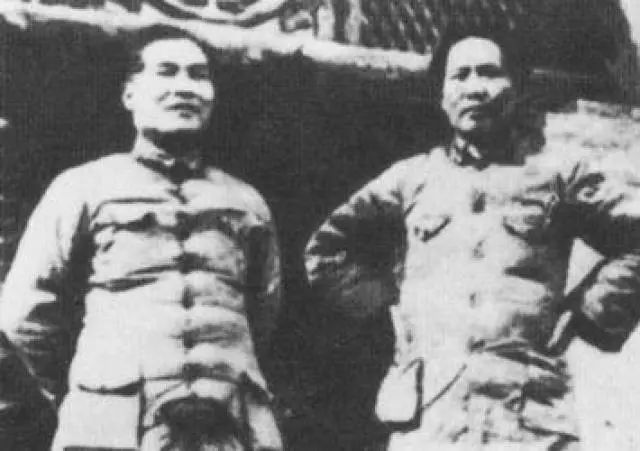
Recently read the history of the Long March of the Chinese Workers' and Peasants' Red Army and read the story of Mao Zedong borrowing money from Xu Haidong.
This story is not long, but it gives us a deeper understanding of the word "party spirit.
1
Mao Zedong asked Xu Haidong to borrow money when the Central Red Army arrived in northern Shaanxi in November 1935. After the arduous Long March in these 25,000, the Central Red Army was ragged and destitute, and life was impossible. So Mao Zedong wrote an IOU and asked Yang Zhicheng (then director of the Military Commission's Procurement Department and head of the Red Army's Logistics Department) to borrow money from Xu Haidong. The latter led the Red Army's 25th Army to northern Shaanxi on September 18, 1935, and successfully joined forces with the Red Army's 26th and 27th Army led by Liu Zhidan, becoming the first of several Long March teams to reach northern Shaanxi.
There are several versions of Mao Zedong's record of borrowing money from Xu Haidong. The famous scholar Jin Yinan wrote in the book "Bloody Glory:
"Mao Zedong was really not sure. He tentatively wrote a letter to Xu Haidong. This letter talked about the extreme difficulties of the Central Red Army and borrowed 1,000 oceans from the Red 25th Army. Of course, this letter of borrowing money, on the one hand, the Central Red Army really needs help, on the other hand, it is a kind of temptation.
"After receiving Mao Zedong's letter, Xu Haidong did not consider it. He immediately called the Minister of the Supply Department and said that he did not borrow it, but gave it to the Central Red Army. At the same time, the reply said that the 25 Red Army was fully subordinate to the leadership of the Central Red Army. Mao Zedong and other central leaders wept together after receiving the 5,000 ocean and Xu Haidong's letter......"
In the series of "Biography of Characters in the History of the Communist Party of China" published by the Central Literature Publishing House, there is a paragraph about Xu Haidong:
"After the Battle of Zhiluo Town, the weather suddenly turned cold. Xu Haidong considered that soldiers, especially those from the south, should be given some cotton-padded clothes and yam eggs so that everyone could have a winter of food and clothing. One day, he came to the management department and asked them how much cash they had. The answer was seven thousand yuan, and he reported: how much do you need to add winter clothes, how much do you need to buy medicine, buy salt, buy oil... If you have 3. five thousand yuan, this winter will be better. Xu Haidong instructed the management department to send money to the regiments as soon as possible to improve their food and add winter clothes. After winning the battle, they seized money from the enemy and resupplied you.
"The next day, Yang Zhicheng of the Central Red Army came to see Xu Haidong and took out from his pocket a piece of paper written by Mao Zedong asking for 2,000 yuan to solve the problem of eating and dressing. Xu Haidong immediately called the manager and asked them to leave 2,000 yuan and send 5,000 yuan to the central government. The management department resolutely followed suit.
"One day, Peng Dehuai saw Xu Haidong and said," That money is really a 'timely help', and I should thank you a lot, the God of Wealth! Xu Haidong said embarrassedly: "Commander Peng is so polite. He should have given more, but we are poor and can't take it out......"
This record is very interesting. It can be seen that the Red Twenty-Five Army under Xu Haidong had a hard time at that time, especially when winter came and money was in urgent need.
The Red Army was disciplined and emphasized fair trade. Money is very different. The ocean saved the Red Twenty-Five Army: In early September 1935, the Red Twenty-Five Army entered the Shaoshan area on the edge of the Shaanxi-Gansu base area. All the food was eaten, and the area was deserted. It was almost desperate. Fortunately, the hungry 25th army met a sheep dealer driving more than 500 sheep and immediately spent money to buy all the more than 500 sheep. Xu Haidong recalled: "Our troops ate mutton without salt and few pots. Those with washbasins were boiled in washbasins, while those without washbasins were cut into thin slices and baked on slate. Some took the leg of lamb and baked it on the fire. "Fortunately, this group of sheep rescued the car, so that the 25th Army commanders and fighters to fill their stomachs, insist on walking to the Shaanxi-Gansu base.
General Xu Haidong's autobiography "Life Statement" written in 1965 recalls this:
"I sincerely support and love Chairman Mao. When Comrade Yang Zhicheng took the note approved by Chairman Mao and asked for 2,500 yuan, I called the supply minister and asked him how much money he still had. He said all 7,000 yuan. I said leave 2,000 yuan and send all the other 5,000 yuan to the central government. At that time, I believed that a Communist Party member should serve the Central Committee unconditionally."
Mao Zedong asked Xu Haidong to borrow money. There were three figures of 1,000, 2,000 and 2,500 pieces of ocean, but what is certain is that Xu Haidong did not hesitate to send 5,000 pieces of ocean to the Central Red Army. Many years later, Mao Zedong still remembered these 5,000 pieces of ocean. He often said: "Xu Haidong is a man who has made great contributions to the revolution. "Those who had experienced this period of history at that time were full of respect for Xu Haidong. After the establishment of the the People's Republic of China, Premier Zhou Enlai once had a haircut in Beidaihe barber's office. When he heard that General Xu Haidong was visiting, he immediately stopped the barber, left half his head, hurried out to greet him, held Xu Haidong's hand tightly, and had a good talk.
2
Mao Zedong said that "Xu Haidong is a man who has made great contributions to the revolution", of course, he is far more than just sending 5,000 dollars to the Central Red Army. To understand Mao Zedong's evaluation of Xu Haidong, we must understand the background at that time.
"On September 9, 1935, the 1. Fourth Front Army split. Mao Zedong said it was the darkest day of his life. "Jin Yinan wrote this in his famous work" The Splendor of Suffering. The first and fourth red armies joined forces in June of that year in Maogong, Sichuan (now Xiaojin County). Historical records: Zhang Guotao, the head of the Fourth Front Army, rode a white horse, surrounded by more than 10 guards, speeding through the two estuaries. From a distance, he saw that Mao Zedong led all the members of the Politburo and stood waiting in the drizzle.
At that time, both sides of the meeting were very excited, including Zhang Guotao. But when Zhang Guotao joined forces, he began to think too much. The People's Liberation Army Literature and Art Publishing House once published a book, "The Long March: Details Determine History", which was compiled based on the details in authoritative historical materials. There are some details about Zhang Guotao's split:
First, the first and fourth front armies of the Red Army met in June 1935. At the grand ceremony of the celebration, all the superficial ostentatious ostentatious ostentatious ostentatious ostentatious ostentatious ostentatious ostentatious ostentatious ostentatious ostentatious ostentatious ostentatious ostentatious ostentatious ostentatious ostentatious ostentatious ostentatious ostentatious ostentatious ostentatious ostentatious ostentatious ostenta. But both sides have raised questions about the strength of the other's troops. Zhang Guotao once walked up to Zhou Enlai and said, "How many people are there in you?" Zhou asked, "How many people are there in you?" Zhang said, "We have 100,000. "Zhou replied," We have 30,000."
Second, after the first and fourth front armies of the Red Army joined forces, we can see the obvious difference between the two leaders: Zhang Guotao's face is plump and ruddy, although he is not obese, but his flesh is rolling, and there is no color of suffering on his face. Mao Zedong was very thin, his face was haggard, his wrinkles were deep, and his manner was very formal. Zhang's gray military uniform fits perfectly, while Mao is still wearing his old military uniform from the Long March, torn and old, and full of patches.
Third, as soon as the Red Army was stationed in Maoergai, Zhou Enlai drew up a battle plan for attacking Songpan. He gave the plan to Zhang Guotao, but Zhang changed the plan. Instead of immediately organizing the attack on Songpan, he sent his 30th army to feint. The 30th army surrounded Songpan but did not launch an attack. During the cooperation between the Kuomintang and the Communist Party in 1943, Hu Zongnan revealed in a conversation in Chongqing: "There were very few of us at that time. My headquarters is in a courtyard in the city. I remember thinking about what I would do if the Red Army surrounded Songpan and if I was caught? "Hu Zongnan still remembered that Zhou Enlai was his teacher when he was in Huangpu Military Academy, and he thought," He will take care of me. "However, Hu Zongnan did not need to ask his teacher for help. As soon as the reinforcements arrived, the Thirty Armies withdrew. Because Chang doesn't want to go north. He believed that the Kuomintang was too strong and that the Red Army should go west and south.
These details reflect the situation at that time in a very rich and detailed way: when Zhang Guotao saw that his troops were strong and Ma Zhuang (at that time, there were more than 80,000 people in the fourth front army and less than 10,000 in the Central Red Army), the evil idea of "whoever has the most guns will be the boss" arises spontaneously. This kind of thinking was the mainstream value of the warlords at that time, but Zhang Guotao forgot: he was not a warlord, he was a communist.
"Xu Xiangqian Biography" records: After the Lianghekou Conference, Zhang Guotao, in order to replace Mao Zedong's leadership, instructed some people to submit reports to the central government. For example, Chen Changhao telephoned the Central Committee during the march: "Please appoint Dao as Chairman of the Military Committee, Zhu De as commander of the former enemy, Vice Chairman Zhou and Chief of Staff. After the Central Political Bureau decided on a major policy, it gave the Military Commission arbitrary decisions. "Zhang Guotao also instigated and incited" in public and private conversations, spreading that "there is a problem with the central political line" on the one hand, the central government should be responsible for the loss and downsizing of the army, "the Zunyi meeting is illegal," the military command is not unified "and so on. Zhang Guotao is a veteran member of the Political Bureau of the Central Committee. Only he can attend the meeting of the Political Bureau of the Central Committee. He is also the top leader of the Fourth Red Army. His words can easily confuse and deceive people.
Mao Zedong, Zhou Enlai, Zhu De and others failed in their efforts to maintain the unity of the Red Army, which eventually 1. to the split of the four fronts. Mao Zedong led only 7000 of the Red Army northward, and Zhang Guotao led more than 83000 Red Army southward. On October 5, 1935, Zhang Guotao held a meeting of senior cadres in Zhuomu Diao, Songgang, Sichuan, and announced the establishment of the "Provisional Central Committee" Central Committee, the Central Political Bureau, the Central Secretariat, the "Central Military Commission" and the "Standing Committee". "Chairman", and passed an "organizational resolution", deciding that "Mao Zedong, Zhou Enlai, Bogu, and Luofu should cancel their work, expel the Central Committee members and party membership, and order wanted. yang shangkun and ye jianying should be removed from their posts for investigation ".
The split of the Red Army caused many officers and men to grieve. Zhu De, who was coerced by Zhang Guotao to the south, recalled the situation at that time and said: "How many ups and downs and difficulties the revolutionary career has experienced have never been so heavy-hearted as this time. His own people are divided. When the Red Army forces are most needed to unite, the Red Army forces are divided. "Long March: Details Decide History" records a detail: one day when Xu Xiangqian crossed the grassland south, he and Li Xiannian, political commissar of the 30th army, sat side by side on a mountain bag to rest. Xu sighed, "I don't understand either. What's the trouble between the Red Army and the Red Army! "Smoke and smoke.
It was under such difficult circumstances that the Central Red Army arrived in northern Shaanxi and learned that Xu Haidong had led the Red Twenty-Five Army to arrive early, and the military was at its height. Before that, Mao Zedong and Xu Xiangqian had never met. In terms of battle sequence, the Red 25 army was the army of the Fourth Front Army, that is, the army under the leadership of Zhang Guotao. Xu Haidong was an old subordinate of Zhang Guotao. Zhang Guotao had already set up a separate central government at that time. Did Xu Haidong listen to the central government or Zhang Guotao?
At the critical moment, Xu Haidong showed his firm party spirit, "A Communist Party member should serve the Central Committee unconditionally". Under the circumstances at that time, Mao Zedong's excitement was fully understandable.
3
The Red Twenty-Five Army, which fought directly from the Hubei, Henan, Anhui and Soviet areas to northern Shaanxi, is a legendary team:
Among the several Long March teams, the Red 25 has the least number of soldiers, the youngest average age, and the latest departure, but they arrived in northern Shaanxi as early as possible. This is not counting. They are still the only Red Army that has increased its personnel in the Long March. The other Red Army set out in a mighty force and sacrificed heavily along the way. Many soldiers fell on the Long March and failed to reach the end. However, the Red 25 Army fought more than 30 enemy's siege, not only was there no reduction in staff, but the army also increased by more than 800 people when it arrived in northern Shaanxi. The Red 25 Army was the only Chinese Workers' and Peasants' Red Army that established a base area (more than ten counties in the Henan-Shaanxi and Hubei-Shaanxi border regions) and the only Red Army to develop local guerrilla divisions. The Red Twenty-Five eventually forged 97 Republic generals.
When the Red Twenty-Five Army entered Shaanxi, its soldiers were strong and Ma Zhuang, extremely proud, and a folk song of "Xintianyou" in northern Shaanxi sang:
A red flag floating in the air,
the red 25 army has come up;
Long gun, short gun, horse, turn gun,
Pairs of horns are paired;
Number one box, red rope,
The bugle ticked.
A red flag floating in the air,
The Red Twenty-Five came up.
Came to Shaanxi-Gansu-Luo River,
Working people like it.
Xu Haidong is also very legendary. He is a native of Dawu County, Hubei Province. He was born in poverty. His parents and brothers made a living by doing kiln workers. Since he was 14 years old, he also began to work as a kiln worker. "Xu Haidong: life statement" wrote: "one winter, I wore broken pants and sold several villages. I didn't sell a small basin. I fell in front of a farmer's door with cold hunger and couldn't walk any more. Fortunately, the peasant woman gave a bowl of hot porridge to live."
In April 1925, Xu Haidong joined the Communist Party of China in Wuchang. At that time, he was carrying water in the city and earning a string of 600 yuan a day. The first time he paid a party fee, it was the money he got from selling water. In the summer of 1926, he joined the National Revolutionary Army and took part in the Northern Expedition. He participated in the Jute Uprising in 1927. In the struggle to create the Hubei, Henan, Anhui and Soviet areas, he grew from the commander of the Red Guard and the battalion commander of the Red Army to the commander of the Red 25th Army step by step.
In September 1934, the central government sent Cheng Zihua from Jiangxi to the Dabie Mountains, and Xu Haidong took the initiative to suggest Cheng as the commander, Wu Huan as the political commissar, and himself as the deputy commander. known as the "old army commander". He often said to himself, "I am addicted to war, walking and drinking, but I have no official addiction."
The book "Long March: Details Determine History" wrote: During the Long March, after each big war, Xu Haidong fell asleep immediately, and the thunder could not move. The short one day and night, the elderly 2 to 3 days. After Xu slept, his subordinates were all uneasy, worrying about his awakening and not waking up. When Xu Haidong woke up, he was overjoyed and rushed to tell each other.
In August 1935, Wu Huanxian, political commissar of the Red 25th Army, died bravely in the battle in Sipo Village, Jingchuan, Gansu Province. The Red 25th Army also became the only Red Army team among the four Long March teams that sacrificed its main leader. Xu Haidong also passed by the god of death. In the battle of Yujiahe, a bullet entered Xu Haidong's left eye and went out from the back of his neck. His throat was blocked by congestion, he had difficulty breathing and was dying. In an emergency, nurse Zhou Shaolan fell down and sucked out the congestion in his throat one by one. He stayed day and night and took good care of it. After four days and nights in a coma, he miraculously survived.
After arriving in northern Shaanxi, Zhou Shaolan married Xu Haidong. Her husband thought that his wife's name had a blue character, unlike the name of a Red Army soldier, so she changed her name to Zhou Dongping-as Xu Haidong's life barrier.
4
After the outbreak of the all-out Anti-Japanese War, the Chinese Workers' and Peasants' Red Army was reorganized into the New Eighth Route Army of the National Revolutionary Army. The brigade commander of the 344th Brigade of the 155th Division of Xu Haidong went to the front line of North China, participated in the famous Pingxingguan battle, and went back to Yan'an to recuperate after the recurrence of injuries. He went to central China to command the New Fourth Army. In 1955, Xu Haidong said that he had not commanded the battle for a long time due to injury or illness, so he could do without rating. However, Mao Zedong directly instructed that Xu Haidong should not only judge the general, but also rank second among the general, second only to Su Yu.
Jin Yinan wrote in the book "Blood Glory" that during the most difficult time of the Central Red Army, "Xu Haidong and Mao Zedong have never met, and the command sequence is not the Central Red Army. But after the Central Committee came, he resolutely obeyed the leadership of the Central Committee, loyal to doctrine and faith. I think this is a major reason for the victory of our revolution. The existence of such a group of people is as important to the Chinese revolution as the correct line, principles and policies of our party. "The victory of the Chinese revolution is not only due to the correct doctrine, correct line, correct policy and program, but also a large number of soldiers like Xu Haidong who are loyal to doctrine and faith."
Chang Kuo-tao was delusional about "directing the party with guns", but he failed. "For whom to fight" has always been a major problem for China's old army. The "X Family Army" has a long history, and its troops are often the capital or even private property of warlords. However, the Workers' and Peasants' Red Army under the leadership of the Communist Party of China is destined to be a brand new armed force: in September 1927, when the Autumn Harvest uprising troops were reorganized in Sanwan, Mao Zedong creatively put forward the principle that the branch should be built on the company, which laid an important organizational foundation for realizing the party's leadership over the army. Marshal Luo Ronghuan recalled: "the reorganization of Sanwan is actually a new life of our army. It was from this time that the party's leadership over the army was established. If this is not the case, the Red Army will only become a roving bandits, even if it is not destroyed by a powerful enemy. "In December 1929, Mao Zedong presided over the formulation of the Gutian Conference resolution, which theoretically clarified the principle of the party's leadership over the army, and established some basic systems and measures for the party to lead the army politically, ideologically, and organizationally. On September 12, 1932, in the "Instructions of the General Political Department of the Chinese Workers' and Peasants' Red Army on the Work of the Party in the Red Army", the words "guarantee the absolute leadership of the Party in the Red Army" appeared for the first time.
Many senior leaders of the Party and the army have resolutely upheld the Party's decision.
After the split of the First and Fourth Front Army of the Red Army, Zhu De was coerced to the south and fought resolutely with Zhang Guotao along the way. In the history, during an argument, Zhu De slapped the table: "The Party Central Committee's policy of going north is correct. I raised my hand at the Politburo meeting. I'm not against going north, I'm for going north. I am a member of the Communist Party and my duty is to carry out the decisions of the Party."
Xu Xiangqian, a senior general of the Fourth Red Front Army, recalled: "Comrade Zhu De's firm opposition to the establishment of a separate" Central Committee "also played a powerful role in restricting Zhang Guotao. The great popularity of Commander-in-Chief Zhu De in the Party and the Red Army is well known. Only he can be on an equal footing with Zhang Guotao and make Zhang dare not do whatever he wants. Since Chang Kuo-tao set up a separate "Central Committee", Comrade Zhu De has been singing against him. His struggle against Zhang Guotao was by no means like the'Left' dogmatists, who showed their teeth as long as possible. Instead, he was calm and persuaded by reason, talking about struggle with one hand and unity with the other. When I went to the headquarters of the Red Army to report, I saw him more than once talking with Zhang Guotao about the establishment of a separate "central. He always patiently advised Zhang Guotao, saying that you, the "Central Committee", are not the Central Committee, and that you should obey the leadership of the Party Central Committee and should not start anew and make independence. Zhang Guotao urged Comrade Zhu De to come forward and help him with the work of the Party Central Committee, and asked the Central Committee to recognize that his "Central Committee" is legal and the only leader of the whole party. The opinions of the two men were tit-for-tat, and no one said they would not accept the other, but they did not hinder the discussion of other military operations. Zhang Guotao is not straight, he is not strong, and he is short. There is nothing he can do about it. The status and weight of Commander-in-Chief Zhu had been weighed by Zhang Guotao. Without Zhu De's support, neither his "Central Committee" nor his "Military Commission" would have become a climate change. Chang Kuo-tao is an old opportunist who has no definite principle, no definite direction......"
The book "Long March: Details Decide History" contains two details:
In June 1936, the Red 2. Sixth Army arrived in Ganzi to join the Red Fourth Army. Chang Kuo-tao sent a task force to the 2. Sixth Army under the name of "headquarters. One day, Zhu Jiasheng, then secretary of the 51st Regiment General Branch of the Sixth Army of the Red 2. Army, received several pamphlets of "Must Read for Cadres" sent by the task force, and was shocked. There are eye-catching headlines in the book: "Against Mao (Mao Zedong), Zhou (Zhou Enlai), Zhang (Zhang Wentian), Bo (Bogu) escape route" and so on. Zhu Jiasheng recalled: "When I looked at the content, I was so scared that I didn't dare not accept it, and I didn't dare to distribute it. I had to hide the book in the firewood of the fellow villagers. "After that, he urgently reported the matter to Wang Zhen, who had a clear attitude and ordered:" Burn it all, and I will punish whoever dares to send a copy."
Zhang Guotao tried to persuade other troops to go with him-including the Second Front Army and the First Front Army. One afternoon, in a small grassy house beside the dry lake, the American doctor Ma Haide was beside Zhang. He saw many maps spread out in the room with his own eyes. Zhang Zheng tried to persuade He Long to lead the second army to cross the Yellow River. He Long refused, and he said to Zhang, "Fuck you."
In April 1938, Zhang Guotao rebelled against the party; on November 6 of that year, at the Sixth Plenary Session of the Sixth Central Committee of the Communist Party of China, Mao Zedong, in view of the historical lessons of Zhang Guotao's struggle for power with the party, proposed that the Communist Party should not fight for personal military power and should not learn from Zhang Guotao. However, it is necessary to fight for the Party's military power and the people's military power, and to vividly express the principle of the Party's absolute leadership over the army as "our principle is that the Party commands the gun, and we will never allow the gun to command the Party".
5
At the end of "Life Report", Xu Haidong wrote:
"The path I have taken in my life has been glorious and tortuous. The party has trained me as a high-ranking general, a handicraft worker who has no culture, has suffered from the pain of the old society and does not understand Pepsi. What makes me uneasy is that I have done too little work for the party and the people, and I have been ill for too long. In the future, I will be like the past. Although I can no longer work for the party, I will always be loyal to the party, the people, and The Communist Party member who is loyal to the cause of communism."
This is a text that all communists are worth studying seriously!
Source: Party Building Network
Previous Page
Previous Page

Address: Buildings 4 and 5, Kechuang Huigu Park, Hongshun Road, Huaming High-tech Zone, Dongli District, Tianjin
Tianjin High-end Equipment Research Institute, Tsinghua University, Copyright
Website Construction: China Enterprise Power Tianjin
sweep
Pay attention to the official WeChat public number