




PARTY BUILDING
party building work
The New Fourth Army treats intellectuals well.
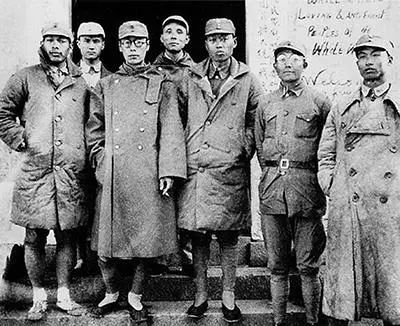
Deng Zihui (fourth from left) took a group photo with non-party intellectuals and Minister of Enemy Work Lin Zhifu (third from left) in southern Anhui.
Yunling, Jingxian County, is located in the hinterland of the deep mountains in southern Anhui. On August 2, 1938, the New Fourth Army was stationed here, opening up the center of the Central China Anti-Japanese Base. Until January 4, 1941, the military headquarters of the New Fourth Army withdrew northward. For two years and five months, Yunling was like a huge magnetic field, attracting and gathering batch after batch of educated young people from home and abroad.
Life from the best
The economic conditions of the New Fourth Army are meager. The salary paid by the National Government to the New Fourth Army is only enough for a Class C division, and the monthly gap is serious. Ye Ting and Xiang Ying were often anxious that their salaries and ammunition could not be received in time. For this reason, Ye Ting traveled across mountains and rivers, risking many dangers, rushing between Yunling and Chongqing, and even in order to increase military pay, he did not hesitate to request Chiang Kai-shek to resign as the army commander.
It was under such difficult circumstances that the military ministry stipulated that the allowances for intellectuals were higher than those for other military and political personnel. For the New Fourth Army commanders and fighters, the allowance is only 4 yuan per person for cadres above the regiment level, 3 yuan for battalion and company cadres, and only 4 yuan for military leaders such as Xiang Ying, while experts and scholars are more than 10 to dozens of yuan per month, and a few are more than 100 yuan per month. In addition to a fixed monthly allowance, the instructors of the teaching team also have a lecture allowance. Young intellectuals working in the field service regiment enjoy the treatment of platoon-level cadres, with a subsidy of 3 yuan per person. Senior intellectuals enjoy the treatment of cadres at or above the regiment level, and they are equipped with attendants, horses, etc. The military medical department has the highest allowance for technicians, with 140 yuan per month for senior experts, 70 yuan per month for regular medical university graduates, 30 yuan per month for regular senior nursing school graduates, and 8 yuan per month for students trained by the military medical department itself after graduation. These regulations deeply moved the intellectuals who came to Yunling.
Trust at work
Before joining the New Fourth Army, many young intellectuals and intellectuals were not members of the Communist Party and had not undergone strict military life experience. Therefore, after joining the New Fourth Army, they were not used to the tense life of the army. Even so, the leaders of the military department adopt a tolerant attitude towards them, look at the mainstream, do not stick to small measures, tolerate in life, trust in politics, and let go in work.
Xiang Ying's trust in the famous cultural man Nie Gannu and Chen Yi's concern for the eccentric poet Ye Fangyan are good stories for the New Fourth Army to understand and love intellectuals. Nie Gannu joined the Party in 1934 and was loyal to the Party, but he had a strong personality and a loose life, which was out of step with the strict military life. After arriving in Yunling, he was appointed as a member of the Cultural Committee of the New Fourth Army and editor of the magazine Anti-Enemy. Leaders at all levels of the New Fourth Army treated him with leniency, sincerely helped him progress, and used his strengths to make him feel at ease in writing. Later, he became a literary masterpiece and became well-known at home and abroad. Ye Fangyan is a close disciple of Zhang Taiyan, a master of Chinese studies. He has a deep foundation in Chinese studies and high self-regard. He does not get along with some comrades. The New Fourth Army knew that he was good at his work and transferred him from the Field Service Corps to the position of Director of the Secretary of the Staff Office of the Military Headquarters. Chen Yi is elegant and courteous. After getting to know Ye Fangyan, he often gives each other poems and becomes a bosom friend.
For professional intellectuals, military leaders are even more free to use them, allowing them to have positions and powers. The Military Medical Department has gathered more than 50 professional and technical personnel who understand medical skills and nursing. These doctors and nurses who graduated from regular schools served as leaders at all levels in a short time. Famous medical experts Gong Naiquan, Qi Zhonghuan, and Wu Zhili served as the heads of the medical reform, health care, and materials departments of the Military Medical Department.
politically concerned
The New Fourth Army respects talents, values intellectuals, and pays attention to the political life of intellectuals. For some famous intellectuals who were once members of the Communist Party and later lost contact with the party organization for various reasons, the military headquarters actively and prudently helped them restore their party membership.
Zhu Kejing, a native of Liling, Hunan, joined the Communist Party of China in 1922, went to Moscow Oriental University to study in 1923, and returned to China in the summer of 1925. He served as the party representative and director of the Political Department of the Third Army of Zhu Peide of the National Revolutionary Army. He participated in the Northern Expedition and created a political work system. Great achievements. After the Nanchang Uprising, he served as a party representative of the Ninth Army. When he went south to Guangdong Chaoshan to break through, he lost contact with the party organization. After the outbreak of the Anti-Japanese War, Zhu Kejing resolutely accepted the invitation of Ye Ting, commander of the New fourth Army, to serve as the head of the field service regiment of the military headquarters and as an adviser to the military political department. A cadre who had lost contact with the party and had not yet resolved his party membership served as an adviser to the military political department, demonstrating the military's trust in him.
In order to restore Zhu Kejing's party membership, Xiang Ying not only asked the party organization of the Field Service Corps to investigate and understand Zhu Kejing, but also personally talked to him. In 1939, Zhu Kejing, who had been tested by the party organization, got his wish and joined the party again. After the victory of the Anti-Japanese War, Zhu Kejing was arrested and imprisoned for betrayal by traitors. Chiang Kai-shek personally came forward to persuade him to surrender and lure him with high officials. Zhu Kejing would rather die unyielding and sacrifice heroically.
The leaders of the New Fourth Army's military headquarters attached great importance to knowledge and talents, which played an excellent exemplary role in the society. Therefore, Yunling of the New Fourth Army at that time gathered a large number of active intellectual youth, literary and artistic personnel. They formed the New Fourth Army Field Service Corps and the Cultural Team of the Teaching Corps. There are more than 400 members of the Field Service Corps of the military headquarters alone, and they are known as the "cultural light cavalry". The Battlefield Service Corps and the Cultural Team have trained a large number of literary and artistic talents. Composers He Shide, Zhang Mei, Shen Yawei, playwrights Wu Qiang, Shen Simon, artists Shen Roujian, Tu Ke, Lai Shaoqi, Wu Xiaobang, etc. all emerged in Yunling and later became influential artists in New China.
Source: Party Building Network
Previous Page
Previous Page

Address: Buildings 4 and 5, Kechuang Huigu Park, Hongshun Road, Huaming High-tech Zone, Dongli District, Tianjin
Tianjin High-end Equipment Research Institute, Tsinghua University, Copyright
Website Construction: China Enterprise Power Tianjin
sweep
Pay attention to the official WeChat public number