




PARTY BUILDING
party building work
Zhou Shidi took part in the Nanchang Uprising
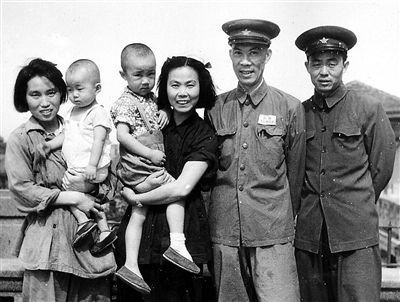
In 1950, General Zhou Shidi and his family were photographed in Hankou. From left: wife Zhang Jian holds Zhou Qiang (Zhou Shidi's second son), eldest daughter Zhou Boya holds Zhou Jian (Zhou Shidi's eldest son), Zhou Shidi and son-in-law Peng Fujiu.
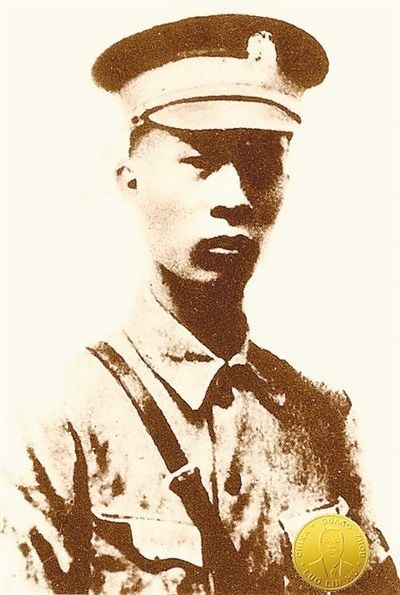
Zhou Shidi
My grandfather Zhou Shi died in 1979. There was a sentence in the eulogy: "Comrade Zhou Shidi was the first veteran of our party to engage in revolutionary armed activities. "This assessment gave me a big shock. This year is the 90th anniversary of the founding of the army, and I have sorted out the relevant information about his participation in the Nanchang Uprising.
The 73rd regiment led by them constituted an important force in the uprising.
After the "April 12" Incident in 1927, there were constant calls to jointly fight against Chiang Kai-shek. Wang Jingwei fought against Chiang Kai-shek in Nanjing in Wuhan, but the situation was unpredictable. On July 15, Wang Jingwei suddenly announced the "division of the Communist Party", which means that the first cooperation between the Kuomintang and the Communist Party has completely broken down. The Central Committee of the Communist Party of China was forced to decide to hold an armed uprising in Nanchang. The main participants in the decision-making were Zhou Enlai, Li Lisan, Tan Pingshan, Zhang Guotao, Yun Daiying and Peng Pai.
Time was running out, and the party decided to play the banner of the "Kuomintang Revolutionary Committee", the leftist of the Kuomintang; because the military relied on the troops controlled by our party in the second front army, the uprising army still used the name of "the second front army of the National Revolutionary Army", and listed Zhang Fakui, commander-in-chief of the second front army, as the commander-in-chief of the uprising army, and Huang Qixiang, commander of the fourth army as the former enemy. In fact, the commander-in-chief of the former enemy was Ye Ting, commander of the 11th Army (commander of the 24th Division before the uprising), and the commander-in-chief was He Long, commander of the 20th Army. Therefore, when the Kuomintang and the Communist Party mentioned the Nanchang Uprising troops, they both used the word "Ye He.
The Second Front Army was expanded by the Fourth Army of the National Revolutionary Army. The Fourth Army enjoyed the reputation of "Iron Army" during the Northern Expedition, which was inseparable from the support of the Communists and the brave and good fighting of Ye Ting's independent regiment. Because of this, Zhang Fakui has always been quite tolerant to the communists in the army. In his later years, when he mentioned Ye Ting, Zhou Shidi, Jiang Xianyun and other communists, he still praised them for their "bravery and good fighting" and their "enthusiasm and fighting spirit".
More than 70 years ago, Comrade Zhu De said of the Ye Ting Independent Regiment: "During the Nanchang Uprising, the regiment had developed into six regiments and was organized into the Eleventh Army. There is also the Wuhan National Government Guard Corps led by Lu Deming and other comrades, which was also organized by cadres sent from the independent regiment. This team was later led by Chairman Mao, participated in the Autumn Harvest Uprising, and went to Jinggangshan."
Grandpa Zhou Shidi was the earliest member of Ye Ting's independent regiment. In November 1924, he graduated from the first phase of the Whampoa Military Academy and was sent to the "Army and Navy General Marshal's Mansion Iron Convoy". After the captain Xu Chengzhang was transferred, he took over as the captain. In 1926, after Ye Ting's independent regiment was formed with the iron-clad motorcade as the backbone, Zhou Shi was the first battalion commander. Although the armored motorcade belonged to the Generalissimo's Mansion and the Ye Ting Independent Regiment was organized in the National Revolutionary Army sequence, they were all directly led by our party and were personally organized by Zhou Enlai. When Ye Ting's independent regiment started the Northern Expedition in May 1926, Zhou Shi was the chief of staff of the regiment. In January 1927, the independent regiment was renamed the 73rd regiment of the 25th division, Ye Ting was promoted to deputy commander of the 25th division, and Zhou Shidi took over as commander. In July, the 25th division moved from Wuhan to Jiujiang, and he led his troops to Mahuiling, about 100 kilometers north of Nanchang. At this time, the 73rd regiment, the Communist Party branch has been built on the battalion, which is an important factor in constituting combat effectiveness.
Led the 25th Division as the main force in the Huichang battle
At the end of July 1927, Zhang Fakui summoned officers above the division level to hold a meeting of the "Qing Communist Party" in Lushan. Zhou Shidi heard about it and was very anxious because he did not receive the party's instructions. On the morning of August 1, when Zhou Shidi set off for a meeting at the division headquarters, he did not know that Nanchang had fired the first shot of the uprising a few hours ago. After arriving at the division headquarters, he first went to see Comrade Zhang Yunyi, chief of staff. Zhang's party membership has not yet been made public. As soon as they met, Zhang Yunyi reminded them in a low voice: "Pay attention to today..." Before the words were finished, the commander Li Hanhun came in. Li said to Zhou Shidi: "The commander-in-chief (referring to Zhang Fakui) praised you very much and wanted to reuse you. I hope you will not follow the Communist Party, but follow us. "Zhou Shidi rejected it in a clear-cut manner:" The Fourth Army was able to win the Northern Expedition, and Zhang Fakui's position today is due to the help of the Communist Party and the heroic sacrifice of the Communist Party members. Today, if you "divide the Communist Party" and "oppose the Communist Party" with Wang Jingwei, you will die!"
At this moment, a train came from Nanchang. Zhou Shidi hurried to inquire about the news, and he happened to meet Comrade Xu Jishen, who was the chief of staff of the 73rd Regiment. Zhou Shidi recalled: "When he saw me, he was taken aback and said to me secretly: Nanchang has revolted, you go back quickly!"
Zhou Shidi hurried back to the 73rd regiment headquarters. Nie Rongzhen, who came to arrange the uprising, was already waiting for him. The two agreed to hold an uprising immediately and pull all the troops they could control to Nanchang. The specific deployment is:
The operation began during the nap, and the uprising ministries pulled out of the station in the name of fighting in the wild. The three battalions of the 75th regiment stationed near the division headquarters left first, the 74th regiment heavy machine gun company followed up, and after the 73rd regiment hall, they gathered near De 'an Station before 6 pm. In case of obstruction and destruction, the insurgents will be resolutely suppressed, and in case of pursuit and obstruction, the enemy will be resolutely eliminated. At the same time, Zhou Shidi ordered Zhou Tingen to go to the division to get back the funds of the 73rd regiment in August.
On the afternoon of August 1, the uprising departments of the 25th division marched towards de 'an as planned, with the 1st battalion of the 73rd regiment serving as a guard. When the troops reached the north of De 'an Station, Zhang Fakui, Li Hanhun and others chased them from Jiujiang by train and were immediately shot at by the 1st Battalion. Zhang Fakui and Li Hanhun knew the strength of the Communists in the army and jumped out of the car and fled. The train continued to move forward. After arriving at De 'an Station, it was surrounded by the 75th regiment. All the 500 or 600 members of Zhang Fakui's guard battalion on board were equipped with hand-held machine guns and refused to hand in their guns. Zhou Shidi put pressure on the battalion commander and all disarmed. These advanced weapons of the year later played an important role in the Battle of Qixiling in Jinggangshan and the Battle of Tucheng in the Long March.
After Nie Rongzhen and Zhou Shidi led their teams to Nanchang, the 25th Division was assigned to the 11th Army. Zhou Shidi was appointed as the division commander, and Li Shuoxun, the former director of the Political Department of the 25th Division, served as the party representative. Since the 74th regiment only pulled out one heavy machine gun company, the uprising headquarters assigned 800 Nanchang recruits to the regiment.
According to the statistics of Liu Bocheng, Chief of Staff of the Rebellion, the Nanchang Uprising actually had more than 20000 troops, including three divisions of the 20th Army of He Long, three divisions of the 11th Army of Ye Ting (including the 24th Division, the 25th Division and the 10th Division of Cai Tingkai), the 9th Army Officer Education Corps led by Zhu De and some Nanchang police. Some of the peasant troops and Party members who came from all over the country to take part in the uprising were also incorporated into the army.
Since August 3, the insurgents have moved south one after another, with the 25th Division as the full-army guard, leaving Nanchang on the 7th. The insurrectionary army occupied Ruijin on August 19 through Jinxian, Fuzhou, Yihuang, Guangchang and Ningdu, and launched an attack on more than a dozen enemy regiments assembled in Huichang on August 24. The 25th Division assumed the task of capturing the enemy's main position, and the battle was extremely fierce. Zhou Shidi recalled the Huichang battle and said: "(I) ordered the division chief to play the 25th division charge. With the bugle of the division headquarters, the charge bugle of each regiment, battalion and company resounded throughout the hill ". "Several soldiers fell down, and several more fell, but the troops still rushed up in the rain of bullets and approached the enemy step by step. This scene can't help but remind people of the situation that this team, Ye Ting Independent Regiment, fought bravely at Tingsi Bridge and Hesheng Bridge under Wuchang City a year ago."
On September 18, the rebels invaded Dapu, Guangdong, and on the 19th, they divided their forces in Sanheba: the headquarters Zhou Enlai, He Long, Ye Ting, Liu Bocheng, etc. led the main force to go straight to Chaoshan, and the 9th army deputy commander Zhu De and Zhou Shidi led the main force to the 25th division to garrison Sanheba.
Hard time to leave the army to find the party organization
From October 1, ten regiments of the enemy Qian Dajun launched attacks on Sanheba in turn, day and night. The officers and men of the 25th Division fought the enemy with blood, and the Dapu County Party Committee of the Communist Party of China also sent agricultural troops to help the war and sent the masses to rescue the wounded. After three days and nights of bloody battles, the 25th Division suffered more than 900 casualties. Although more than 3000 enemy troops were wiped out, more enemy troops poured in, forming a three-sided attack. On October 3, Zhu De and Zhou Shidi decided to "step by step cover and withdraw gradually" and left Sanheba safely.
In December 2016, I went to Sanheba to pay tribute to the former battlefield. he saw the inscription of the monument inscribed by comrade zhu de: "monument to the martyrs of sanheba of the August 1st uprising army". There is an inscription written by Zhou Shidi on the stele seat. In this battle, Comrade You Buren, Chief of Staff of the 25th Division of the Rebel Army, Comrade Cai Qingchuan, commander of the third battalion of the 75th Regiment, and hundreds of outstanding sons and daughters of the Chinese people died gloriously. It has been 36 years and two months since we bid farewell to the martyrs, but the strong will and brave fighting spirit of the martyrs have inspired us to move forward and spurred us forward all the time ".
On the way to find the headquarters, the 25th Division of the Resurging Army met hundreds of people who had retired from Chaoshan. Only then did they know that the main force had failed. They immediately sent the 25th Division Wang Jingyun to Hong Kong to ask the Party for instructions. In the subsequent transfer process, the 25th Division was seriously downsized and went to Tianxin Village, Xinfeng County, Jiangxi Province. The party organization decided that Zhou Shidi and Li Shuoxun would leave the team to ask the party for instructions on the next step. Regarding this matter, Zhou Shidi recorded in "Autobiography": "When I went to Tianxin Village, Xinfeng County, the Party Committee decided that Comrade Zhu De would lead the team. I and the party representative Li Shuoxun went to the party separately. At that time, the Guangdong area was full of Zhang Fakui's troops. In order to avoid being recognized, I decided to go to Hong Kong via Jiujiang and Shanghai ". Comrade Chen Yi, who was then the instructor of the 73rd Regiment (equivalent to a party representative), found an adjutant named Yi whose family was in the capital and sent him to lead the way to escort Zhou and Li to Shanghai to find the party via Yudu and Jiujiang. In this way, Zhou Shidi left the army.
The rest of the Nanchang Uprising, led by Comrades Zhu De and Chen Yi, finally joined the rest of the Autumn Harvest Uprising led by Mao Zedong in Jinggangshan, forming the core of the Chinese Workers' and Peasants' Red Army. The time from the "Ye He Department" to the "Zhu Mao Red Army" is not very long, but it is an important stage for the Communists to explore the revolutionary road.
My grandfather Zhou Shidi participated in and witnessed the process of the armed struggle led by the Communist Party of China and made his own contribution.
July 31, 2017 Source: Hainan Daily
Previous Page
Previous Page

Address: Buildings 4 and 5, Kechuang Huigu Park, Hongshun Road, Huaming High-tech Zone, Dongli District, Tianjin
Tianjin High-end Equipment Research Institute, Tsinghua University, Copyright
Website Construction: China Enterprise Power Tianjin
sweep
Pay attention to the official WeChat public number