




PARTY BUILDING
party building work
He Jiesheng: Father's Sabre
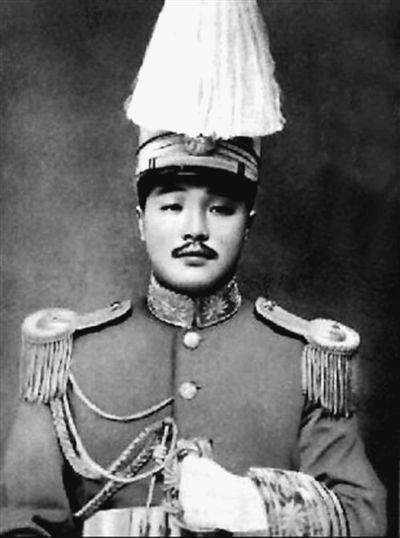
He Long in the 1920 s.
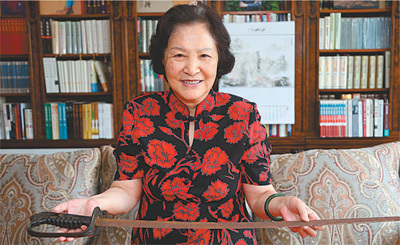
The author of his father's saber in hand.
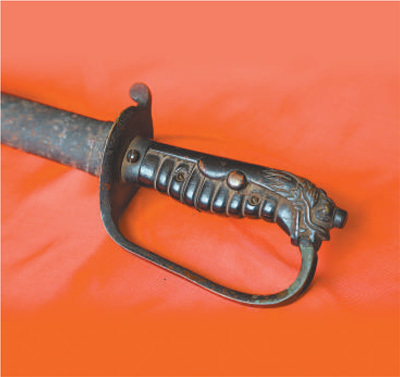
Open a beautiful camphor wood box like the erhu piano box, and a slender hard object wrapped in red cloth lies quietly in the orange silk; then lift the red cloth layer by layer, a two-finger wide, nearly One meter long command knife suddenly appeared in front of everyone. The knife is arc-shaped, and the part as the knife protrudes from the handle of the faucet protected by the copper strip, and is long and slightly warped like a hairtail. The blade was black, not artificially painted black, but was gradually growing out of the rust covered with the original light. To put it another way, the speckled rust was a long, wet and silent time slowly in the south, year after year, day after day, solidifying on the blade and blade.
In May, when red rhododendrons were in full bloom all over the mountains, the above picture appeared at the donation ceremony specially held for me by the people's Government of Yuanling County, Hunan Province. A few days later, the county party Committee Qin Dai Shou secretary carefully picked up the knife and solemnly handed it to me. There was a warm applause in the hall, like a storm through the long time. I'm a little lost and a little dizzy. But I know that I will not fall, because at this moment I am being gently lifted by a sudden great surprise. Because at this moment, I have become a happy person. Also because at this moment, I returned from the capital of the motherland, Beijing, to the hometown of my parents, representing the blood of Xiangxi, and bearing the glory granted to me by history.
A typical dragon head handle of the late Qing Dynasty new army saber, I feel as if I have seen it somewhere. Searching repeatedly in memory, I feel that I should be in a certain photo of my father collected in childhood or when I grow up. If I think further, childhood, although possible, would not have left such a deep impression, because I came to this world at that time not yet full term, and I felt nothing but instinctively hungry. The rest is an old photo of my father. Yes, there is no doubt that among the old photos kept by my father himself, or by the archives of the enemy, or by the newspapers and periodicals in the library, there is indeed one of him in his coat and hat with many ears hanging down. The military uniform with ears, sitting there firmly, holding such a command knife in both hands.
I held the knife and looked at it carefully. Secretary Qin of the county party Committee and Director Zhang of the Standing Committee of the county people's Congress leaned over from both sides, one holding the handle and the other holding the tip of the knife. They told me in turn that the knife was 90.5cm long and 12.8cm wide. It weighs 1.42kg. The knife body is forged in bronze and steel. According to research, on February 16, 1925, my father He Long became the commander of the First Division of the Jianguo Sichuan Army. Since I have been living among the people for 82 years, I am the same age as me. Moreover, it has been buried in the ground for a long time, so the scabbard, which is made of iron sheet outside and camphor wood inside, has been eroded by most of the scabbard, leaving only a section about a foot long at one end of the handle. Fortunately, the remaining scabbard was not adhered to the rust and mud from the burial, and could be pulled off. A smell, a strong camphor wood fragrance. What is amazing is that although this knife, which has been among the people for more than 80 years, has never been sharpened, and its body looks black and dark due to the speckled rust, the tip and blade are still very sharp, and the long blade sparkles with yesterday's light. Holding it in his hand and waving it gently, he could still hear the buzzing.
I held the faucet handle of the knife with a hand smaller than my father's, but I still couldn't hold it. I thought that it had been inseparable from my father for ten long years, and the texture of the tap handle had been polished by his thick hand. The oil and sweat on his hands plated a transparent protective layer like chrome on the handle of the knife that he had held for many years. This is what the cultural relics call the paste. This is the only place where the whole knife is not rusty. Holding it in his hand, it seems that he can still touch the residual temperature in his father's hand.
The question arises, why did my father, who followed him for ten years after he became commander of the First Division of the Jianguo Sichuan Army, live in Yuanling? Think about what happened to Yuanling more than 80 years ago, or what kind of origin and intersection my father and Yuanling had more than 80 years ago, and this problem is solved.
According to historical records, the biggest thing that happened in Yuanling more than 80 years ago was that my father He Long led the Long March of the Sixth Red 2. Army to cross here. It was November 19, 1935, and the mighty Red 2. Sixth Army set out from his father's hometown of Sangzhi and Liujiaping. On the 21st, the two-way Red Army crossed the Yuan River from Dongting River and Xiaoyan River respectively. Among them, the Red Second Army reached Qiaoziping via Gaoping, Paddy Field and Shanxi. The Red Sixth Army reached Qiaoziping from Grape Creek via Maoya. This is Yuanling's dependency. It used to be called Qiaoziping, but now it is called Qinglang Township. On the 22nd, the troops held a brief celebration ceremony here to celebrate the smooth crossing of the Yuan River and break through the first blockade of the Kuomintang army. After the founding of New China, I heard from my parents and several uncles that after the Kuomintang army discovered the Red Army's intention to march, it deployed heavy troops on both sides of the Yuan River. When the Red Army captured the ferry crossing, several planes sent in bombarded indiscriminately. At that time, my mother Jian Xianren put me, who had just been born for 20 days, in a cradle carried by a small mule and horse and followed the Ministry of Health of the Red Second Army. The bomb dropped by the enemy plane surprised the small mule and horse and almost threw me out of the cradle. My mother grabbed the reins of the mules and horses, but she couldn't pull them. At this moment, Uncle He Biao, the health minister of the Red Second Army Corps, propped up a wooden boat from the other side and saved our mother and daughter's lives.
The Sixth Army of the Red 2. Army stayed in Qiaoziping for four days, mainly to rest the team, restore physical strength and raise supplies. Qiaoziping is a large village with several natural villages. The Second Red Army is stationed in a village called Gangzhuyan in those days and Bafang Village today. The headquarters was set up in the home of a poor peasant named Chen Dingxiang. Needless to say, my mother and I also followed my father in Chen Dingxiang's house. Because my father was not only the commander-in-chief of the Sixth Army of the Red 2. Army, but also the commander of the Second Army of the Red Army. During these four days, the Red Army fought local tyrants, divided the fields, helped the local people to establish a red regime, and delivered food, goods, medicine and medicine to the masses. All orders were issued from the old and decaying old house of Chen Dingxiang's house, so it became a place for the people in Qiaoziping to support and respect. At this time, my father gave the command knife he had treasured for ten years and wore in the new army at the end of the Qing Dynasty to the landlord Chen Dingxiang, indicating that in just a few days, the Chen family left in my parents in their minds. Memories that will never be erased, or stories that will be unforgettable to each other.
Through the word of mouth of the Chen family for more than 80 years, according to the local people's name for seniority, the story goes like this from the hands of Taigong (grandpa) Chen Dingxiang, through the hands of her husband (grandpa), Gong (grandpa) and father, and finally to the fifth generation of Sun Chenfei--
On November 21, 1935, after my father led dozens of powerful and majestic people in the legion headquarters to live in the Chen family, Chen Dingxiang experienced the process from trembling to smiling, and from smiling to being convinced. At first, when he saw my father's order, he could kill the bully who did all kinds of evil to the common people. He was frightened and his feet were weak. Later, when he saw the Red Army open the granary of the landlord's old rich family and send bags to the poor families, he believed that the Red Army was a poor team. They bled and sweated and fought for the people. Also, their officers and soldiers were dressed in homespun and earth clothes. They used to be ordinary farmers like themselves. Especially when I saw that my mother was still a lying-in woman and gave birth to me without a full moon, she carried me all the way through the mountains and rivers, ate the same single clothes and ate the same brown rice as everyone else. Because she had no milk, I often cried with hunger, and sometimes I couldn't stop it all night long. In our rural areas of Hunan, we should take special care of the women who are sitting on the moon. No matter how poor the family is, they should leave their only mouthful to her. We should not let the parturient blow, go into the water, get angry, and do any physical work, so as not to be tired and hungry, owe the body, and leave a lifelong disease. Just because he thought of this, he tried every means to find an old hen that laid eggs, stewed it, and gave it to my mother to lay milk. My father knew that sending an old hen for stew was nothing, but for an honest landlord, it was the greatest thing he could think of and do. So my father gave him a sum of money, but he wouldn't take it anyway, and finally thought of giving him the knife. My father said to him, Mr. Chen, you must take this knife well and the red army will come back.
The story has a strong suspense, but it is simple, cliche and not very convincing. But I believe it, because the time, place, events, including my parents and me, are all real, and there is no loophole. The only thing that can't convince these readers today is that a stew hen and the command knife that accompanied my father for ten years do not constitute the weight and reason of giving each other. What I want to point out is that in terms of my father's process from a general in the late Qing Dynasty to a leader of the Red Army in the past ten years, this knife was not only his favorite object, but also his burden. Because in the second year when he became the commander of the First Division of the Jianguo Sichuan Army, that is, in 1926, he returned to Tongren and spent the Northern Expedition in the name of the National Revolutionary Army. In 1927, the Northern Expedition reached Kaifeng, Henan. Because Chiang Kai-shek and Wang Jingwei successively rebelled against the revolution, he led the expanded 20th Army of the National Revolutionary Army to fight in Jiangxi. As the commander-in-chief, he launched the Nanchang Uprising under the leadership of the Communists. After the troops of the Nanchang Uprising were scattered on the way south, he went to Shanghai, where the Party Central Committee was located, via Hong Kong. Then he returned to his hometown Sangzhi with Zhou Yiqun, Lu Dongsheng and others via Honghu Lake, launched a New Year's riot and re-established a team. In other words, as a symbol of military command, this sword of the new army in the late Qing Dynasty belongs to another era for my father. Even in the era when my father launched the Nanchang Uprising and returned to western Hunan to form the Red Army, it was likely to be deposited somewhere, or asked an acquaintance or friend to take care of it. The Red Army's Long March was a strategic shift, a big move, and naturally brought everything it could bring. However, when my father led a huge team like the Sixth Army of the Red 2. Army, as well as my father's relatives of the He family and more than a dozen relatives of the Jian family on the road, he soon found that it was an untimely thing to carry this command knife of the old army. After all, this is a cold weapon that can only be used for fighting. It is of little practical significance for a commander at the level of a large army regiment like my father to fight or defend himself with such a weapon. Therefore, when the Red Army crossed the Yuan River on the Long March and was preparing to continue on the road from Qiaoziping, he gave the knife to the landlord Chen Dingxiang as a kind of considerate reward for my mother, which was reasonable. Besides, my father also told Chen Dingxiang that the Red Army would come back. The subtext is that the Red Army does not take a single stitch from the masses, and you stew an old hen with milk for my wife, and you do not charge any money for death. Then I will give you this knife, and when we triumph, we will return to one yard after another, and our brothers will settle accounts clearly.
On November 24, 1935, the Sixth Army of the Red 2. left Qiaoziping in three ways and moved towards the Yunnan-Guizhou Plateau. The right road was led by my father He Long and went straight into Chenxi through Banxi, Dazhuangping, Tuozikou and Chaxiping to Yuanling County. The middle route, led by Ren Bishi, passed through Maoping, Nanmupu, Furong Pass and Madiyi, and went up along Yixi to Xupu. The left route, led by Xiao Ke and Wang Zhenxi, crossed the Hunan-Guizhou Highway and entered Anhua.
When the Red Army left and the dark forces made a comeback, Chen Dingxiang dug three feet and buried the command knife my father gave him quietly. He dared not tell anyone about it, let alone show it to anyone. Because his family as He Long's headquarters is well known to passers-by, this is a great sin for the enemy. If people know that He Long also gave him a command knife of the new army in the late Qing Dynasty, it will not only lead to death, but also be worried and harassed by robbers, gangsters and three people. After the founding of New China, my father became the marshal of the Republic, and the family was overjoyed, so he dug out the knife and regarded it as a family heirloom. Whenever the old man passes away, he must solemnly give it to the next generation: this is a priceless treasure given to our Chen family by Marshal He Longhe. It must be passed on from generation to generation. No matter how difficult or poor the family is, it cannot be thought. In this way, after more than 80 years of inheritance of a family, it finally passed to the hands of the fifth generation of the Chen family, Sun Chenfei, whose place name was changed to Bafang Village, Qinglang Township.
On October 22, 2015, the 80th anniversary of the Red Army's Long March came. During the investigation and verification of the Red Army's Long March route, the relevant departments of the county came to the home of Chen Fei, the head of the party branch of Bafang Village, Qinglang Township. Knowing that the county cadre's intention was an ordinary farmer, Chen Fei, the head of the grassroots party organization with considerable political consciousness, said tentatively, I don't know if you believe it or not, my family was the headquarters of He Long back then, and there was a gift from Marshal He Long. A command knife given to my father Chen Dingxiang is evidence. The cadres in the county got a fright, really? Might as well take a look. When they saw Chen Fei holding out rusty objects that ordinary people could not have, everyone's eyes were wide open. Chen Fei went on to say that his grandfather (grandfather) Chen Dingxiang and her husband (grandfather) died before the founding of New China, and he had never seen them. But when he was born, Gong (grandfather) Chen Yanxiang was still there, and he often told him the story of He Long's command knife handed down from his ancestors. Later, he accidentally saw the knife while playing. His father Chen Wanxiang told him, "Baby, don't move. This was given to you by Marshal He Long as a gift. In July 2012, my father was suffering from cancer and had no money for medical treatment. Some relatives hinted that he had sold the knife, but his father died and did not let go. On his deathbed, he solemnly told his son, like his predecessors, to collect the command knife of Marshal he long and pass it on from generation to generation.
After extensive investigation and questioning of relevant experts, the county historical records office and the cultural relics department found that the cause and effect of this knife was clear and the inheritance was orderly. They determined that it was the command knife that my father He Long carried as the commander of the First Division of the Jianguo Sichuan Army in 1925 and proposed to be a revolutionary cultural relic. Chen Fei generously agreed, saying that the five generations of his family treasured this knife out of respect for the Red Army and Marshal He Long. Donating the knife to the government so that more people can understand the hardships of the revolution, the selflessness of the revolutionary predecessors, and the passing on of the revolutionary cause from generation to generation are the luck of their Chen family and the luck of this knife. The only request he made was that he, as a descendant of Taigong Chen Dingxiang, hoped that when the county had the opportunity, he would help him meet the descendants of Marshal He Long and state the final destination of the knife face to face.
After Yuanling County People's Government collected my father's command knife, it asked the county's best craftsmen to match it with exquisite camphor wood caskets and decided to give it to me. The reason is that I was the child that the marshal and his wife took to the Long March. Although it was not yet full moon at the time, and I was still waiting to be fed in my mother's arms, I am now the only witness and witness. This can be regarded as the return to the original owner.
In late May 2017, I flew from Beijing to Zhangjiajie. First, I went to Cili, my mother's hometown, to pay tribute to my two uncles who died for the revolution. Then I was taken to Yuanling County to attend the donation ceremony they held for me. Fortunately, at the donation ceremony, I finally met Chen Fei, the fifth-generation successor of the Chen family who was also picked up by the county and waiting in the donation hall. The moment they met, tears filled their eyes. I hugged 26-year-old Chen Fei tightly in my arms and said, "son, I sincerely thank your family and the people of Yuanling!"
Due to the inconvenience of taking the plane, when I returned to Beijing for a week, Yuanling was escorted by a leading comrade in charge of culture and drove for 19 hours to send my father's command knife to my home in Beijing. As soon as the guests left, I immediately put the knife respectfully in front of my father's portrait. I murmured to my father, this is the command knife you wore but left you for 82 years, do you remember?
In the end, I want to say that the Yuanling government presented my father's knife to me on behalf of the sincere wishes of the people of Yuanling, but how can I afford it? How can I be qualified to collect it? I temporarily put it in front of my father's portrait, allowing him to enjoy the surprise and joy of meeting with this knife for a few more days. However, I know that the best place for it is to display it in one of the national museums. Therefore, I told the Yuanling government that I would choose an appropriate museum at an appropriate time and donate it.
July 26, 2017 Source: People's Network-People's Daily

Address: Buildings 4 and 5, Kechuang Huigu Park, Hongshun Road, Huaming High-tech Zone, Dongli District, Tianjin
Tianjin High-end Equipment Research Institute, Tsinghua University, Copyright
Website Construction: China Enterprise Power Tianjin
sweep
Pay attention to the official WeChat public number