




PARTY BUILDING
party building work
Being both a "contact member" and a "commentator" -- Mao Zedong's knack of reading "Ben Ben" into "living"
Original title: both when the "contact", and when the "commentator"
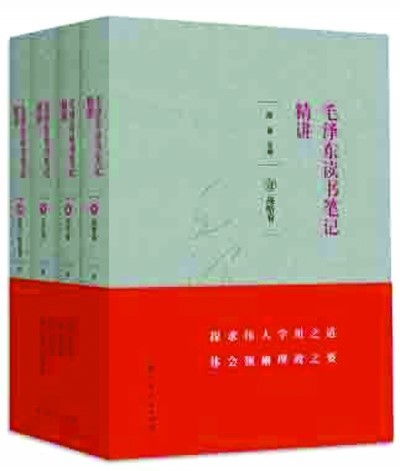
"Mao Zedong's Reading Notes", edited by Chen Jin, published by Guangxi People's Publishing House.
The reason why Mao Zedong stands taller and sees farther than many people of his contemporaries is that from the perspective of reading, it is because he has three conditions at the same time: one is to have profound knowledge, and the other is to pay attention to reading "society". The bigger and thicker "book without words", and the third is to be able to integrate these two aspects. To be thorough is to read the book "live".
Mao Zedong had a remarkable skill in reading.
The so-called "living" is to transform book knowledge into knowledge, knowledge into wisdom, wisdom into ability, ability into practice, and then create something in practice. From the mastery of knowledge to practice and creation, it embodies the logic from subjective to objective, from understanding the world to transforming the world. If you can't get through this logical chain, it's probably dogmatism. Because book knowledge can not help people one by one in the practice of complex judgments and difficult choices faced. In the same military book, Ma Su's usage is to memorize the "book", but Zhuge Liang's usage is not. Both Wang Ming and Mao Zedong read Marxist-Leninist works, and Wang Ming read even more, but he was dogmatic, Mao Zedong was not. It can be seen that the key to the effect of reading lies in the reading method and usage, and whether you have the ability to get in and out freely and wonderedly from books to practice, from subjective to objective.
Mao Zedong had this ability. This comes from his style of study of integrating theory with practice, and from his opposition to bookish reading and usage of copying. Especially when reading Western writings, including Marxism, Mao Zedong especially stressed the combination of China's reality to read. How can we connect with reality and "live" the "books"? Mao Zedong summed up his methods as two, that is, when reading, one is a "contact member" and the other is a "commentator". This was brought up when he talked with Tao Lu Jia and others in November 1958.
To be a "contact person", one must contact both books and reality.
The so-called "contact person" has two meanings. One is to think and understand the viewpoints, characters and events written in the book in connection with the aspects related to or opposite to these viewpoints, opinions, characters and events. For example, when Mao Zedong read the Records of the Historian and the High Patriarchs, he not only paid attention to the contents of Liu Bang, but also compared the description of Xiang Yu, the opposite of Liu Bang in the book, so as to deepen his understanding, thus drawing the conclusion that "Xiang Wang is not a politician, Han Wang is a wise politician. For another example, reading the "Dialogue on the New View of Elementary Particles", which can be further divided by the Japanese scholar Sakata Masaichi on elementary particles, Mao Zedong linked to the "Zhuangzi" said "one foot, half of the day, and the world is endless." To understand, I think that Sakata Masaichi said "is right".
The second meaning of "contact" is to be good at jumping out of books and connecting with reality to understand and play. Mao Zedong expressed the benefits of this reading in his comments on Stalin's "Socialist Economic Problems of the Soviet Union" in 1958. He said that it would be very interesting to read the book by changing the word "our country" (referring to the Soviet Union) to "China". In view of the existence of decentralism, departmentalism and prohibitions in practical work, he asked the leading cadres of the party to understand that Qin Shihuang was good at mobilizing all forces to concentrate on the main direction of attack in the war of unifying the six countries. After reading the Concise Philosophical Dictionary of the Soviet Union, Mao Zedong grasped the metaphysical view that its "identity" entry only emphasizes the opposition of contradictions and denies the transformation of contradictions. He understood it in connection with the situation that the Soviet Union was not good at handling contradictions among the people and did not transform contradictions between ourselves and the enemy during Stalin's period. He further believed that this entry reflected the ideological and methodological roots of Stalin's political mistakes in his later years.
To be a "commentator" is to have an opinion on the content of the book.
The so-called "commentator" means to have his own views on the contents of the book and to comment on it, not to follow the book, but to creatively play and use the book knowledge from his own knowledge background and practical needs. Mao Zedong's reading notes and talks often reflect the sharpness and insight of politicians. For example, he read "Xu Xiake's Travels" and Li Daoyuan's "Shui Jing Notes", focusing on the two authors through a large number of investigations and studies to write "scientific works" that have been discovered; reading Pu Songling's "Strange Tales from a Lonely Application" It is also said that Pu Songling "pays great attention to investigation and research", otherwise he would not have so many weird stories. Such comments have obviously left the theme of books and borrowed books to discuss matters, emphasizing that only investigation and research can write something of a level. For another example, "Tongjian Chronicle Ben Mo-Shi Le Kouhe Shuo" describes that Shi Le is not sure whether to attack Youzhou or not, and asks Zhang Bin, a strategist. Zhang Bin analyzed the situation of Wang Jun, Liu Kun and Wu Huan in detail to help him make up his mind to attack Youzhou. Mao Zedong read from it that "the analysis method is extremely important". In addition, Mao Zedong read the "Han Shu · Zhao Chong Guo Biography" and believed that Zhao Chong Guo suggested that Emperor Han Xuan carry out the memorial to the field. Due to proper analysis, he achieved "persuasive effect" to the public ministers. Reading Lao Tzu, he said that the sentence "misfortune depends on good fortune, and good fortune lies in bad fortune" is to warn people to analyze problems "not only to see the positive side of things, we should also see its opposite"; Reading "The Story of Not Afraid of Ghosts", I think that "Song Dingbo Catches Ghosts" describes "new ghosts are big, old ghosts are small", which shows that specific things "need specific analysis". From these comments, we can see how Mao Zedong paid attention to and was good at reading the methodology of understanding and transforming the objective world from books.
The reading method of being a "commentator" enabled Mao Zedong to often see in his books the subtlety that the average reader could not see, and to make comments that the average reader could not make. For example, he believes that Shang Zhou Wang, who was regarded as lustful in the past, is actually a very capable, literate and capable of martial arts; Song Yu's "Dengtuzi lecherous Fu" uses dialectics to praise a model husband; Mei Ching's Da Fu "Seven Fats" is critical of conservatism; Jia Yi's "Public Security Policy" is the best political theory; "Three dozen Zhujiazhuang" in "Water Margin", it reflects the importance of the united front; "A Dream of Red Mansions" is about social history and even class struggle. These comments are often the words of a family that have not been spoken before and today.
Mao Zedong's ability to read "live" books was admired by the party leadership.
Only when reading is a "contact member" can we compare and analyze, and then see what no one has seen; only when we are a "commentator" can we have identification and independent opinions, and then apply what we have learned. The two are in fact one with each other. Without the connection of "comment", there is no soul; without the comment of "contact", there is no foundation.
The method of studying as a "contact member" and a "commentator" demonstrates the style of study of integrating theory with practice and reflects the profound connection between Mao Zedong's reading activities and objective practice. This kind of connection activates books, makes some "idle books" useful and "dead books" become alive; it also activates Mao Zedong's thinking, so that he often has new ideological gains, and then has new applications and play in practice. For example, he read carefully the "Soil Science" by Williams of the Soviet Union, and he proposed the "Agricultural Eight-character Constitution" (soil, fertilizer, water, seed, density, protection, management, and work), which cannot be said to be unrelated. After reading Zhu Kezhen's paper "On Several Characteristics of China's Climate and Its Relationship with Food Crop Production" in 1964, Mao Zedong made new gains. When facing Zhu Kezhen, he said: Your article is well written, and the "Agriculture Eight-character Constitution" still has shortcomings. You should also add light and gas (sunlight and climate). The "Agriculture Eight-character Constitution" only cares about the land, and your article cares about the sky.
Mao Zedong's philosophy of reading and his ability to "live" books were highly praised by the party leadership. In his speech at the enlarged meeting of the political Bureau of the CPC Central Committee in October 1943, Zhu de said that Mao Zedong read no fewer books than others, and that he could read them well, which could integrate theory with practice. Zhou Enlai said in his article "Learning from Mao Zedong" in 1949: "Reading ancient books has made his knowledge more extensive and increased his greatness. "Liu Shaoqi preached in his speech at the Chengdu Central Working Conference in March 1958: It is possible to learn the chairman's thoughts, opinions, and methods by earnestly and earnestly; but some are inaccessible, such as reading so many books and memory. So strong, so rich in theory and experience, especially so rich in historical knowledge, which no one in our party can get. In the process of drafting the resolution on some historical issues of the party since the founding of the people's Republic of China, Deng Xiaoping specially said: now we need to improve our thinking and working methods, study Marxist philosophy and learn some history. In the resolution, Comrade Mao Zedong's contribution to Marxist philosophy should be written in a richer and more substantial manner, and the meaning of advocating learning should be added to the concluding remarks. This requirement is obviously inspired by Mao Zedong's reading ideas and methods.
(The author is deputy director of the Central Literature Research Office. This article is based on the preface to Mao Zedong's Reading Notes)
Source: Beijing Daily
Previous Page
Previous Page

Address: Buildings 4 and 5, Kechuang Huigu Park, Hongshun Road, Huaming High-tech Zone, Dongli District, Tianjin
Tianjin High-end Equipment Research Institute, Tsinghua University, Copyright
Website Construction: China Enterprise Power Tianjin
sweep
Pay attention to the official WeChat public number