




PARTY BUILDING
party building work
Decrypting the Soviet Area Anti-corruption "Red Storm"
Original title: Decryption of Soviet anti-corruption "Red Storm"
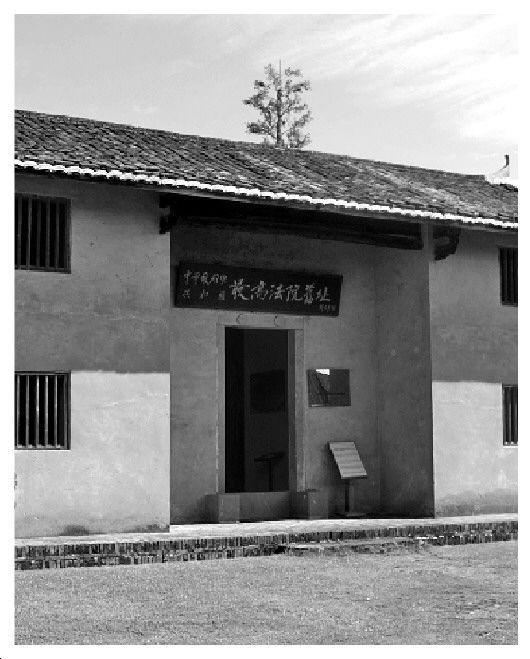
The former site of the Supreme Court of the Chinese Soviet Republic. Photo by Guo Hongpeng and Huang Hui
"Protecting the Soviets against corruption."
On the white walls of the former site of the Chinese Soviet Workers' and Peasants' Procuratorate (later renamed the Chinese Soviet Workers' and Peasants' Procuratorate), yellow anti-corruption propaganda slogans are still posted.
Recently, a reporter from the "Legal System Daily" came to Ruijin, where the Central Red Army set off on the Long March. By visiting the former sites of the Workers' and Peasants' Procuratorate, the Supreme Court and the Audit Committee of the Soviet Republic of China, they declassified the "Red Storm" of anti-corruption and corruption in the Soviet area more than 80 years ago ".
Campaign for Integrity in the Soviet Area
The first large-scale anti-corruption storm
The anti-corruption struggle of the Communist Party of China has a long history.
On November 7, 1931, after the establishment of the Provisional Central Government of the Chinese Soviet Republic, Mao Zedong was elected chairman. In the same month, the first Congress of the Soviet area of the Communist Party of China was held in Yeping, Ruijin, and passed the "Resolution on Party Building" and put forward the requirements of anti-corruption.
"With a political power, it will be accompanied by bureaucracy, privileges, and corruption. This seems to be a historical problem with regularity. Within the newly born red regime, various negative corruption phenomena, such as corruption and waste, Bureaucracy, abuse of power for personal gain, etc., are also more serious. "Yan Fan, a member of the Ruijin Revolutionary History Review Group, told reporters that for this reason, from the beginning of the establishment of the red regime, it was faced with the struggle between corrosion and anti-corrosion.
Mao Zedong pointed out: "The banner of the Communist Party is to bring down all corrupt officials! "All government workers should be made to understand that corruption and waste are great crimes. "When the Kuomintang corrupt officials were all over the country and the people dared to be angry but did not dare to speak, under the Soviet system, such a phenomenon was absolutely not allowed. If the Soviet staff found corrupt, passive and bureaucratic elements, the people could immediately expose the mistakes of these personnel, while the Soviet Union would immediately punish them and never tolerate them."
For this reason, since the beginning of 1932, the Soviet central government launched a massive anti-corruption campaign with the main content of eliminating corruption and waste, officially launching the first large-scale anti-corruption action in the history of the Communist Party of China.
In February 1932, the Central Soviet Area government meeting made a decision to strictly deal with corrupt elements among government staff, calling on the masses to report, expose and expel corrupt elements in the government. Subsequently, in the Central Soviet Area, governments at all levels, units, villages, streets and intersections, a special wooden box-accusation box was specially set up.
Mao Zedong made a statement on the spot: the first shot of punishing corruption in the Soviet area was fired.
After the accusation box was set up, it soon received the report materials about Xie Busheng.
Xie Busheng is a strange name today. However, more than 80 years ago, the name became famous.
Xie Busheng, who was from a poor family, worked part-time for the landlords at first. In 1929, he took part in the armed uprising of workers and peasants and served as the leader of the uprising team. He joined the party in 1930 and became the chairman of the Soviet government in Yeping Village, Yeping Township, Ruijin County. after xie bu sheng came to power, he soon degenerated.
before the "yisu conference," xie bu sheng was responsible for raising food for the conference. He used big fights to collect and small fights to sell to the preparatory office of the "One Soviet Conference", and also sold the remaining more than 3000 catties of rice to rice dealers, making a lot of money.
During his tenure as the leader of the riot team, Xie Busheng embezzled the gold and silver jewelry, salt, clothing, etc. obtained by the local tyrants and hid them at home. Before that, he also secretly killed a Red Army doctor and engulfed his gold ring, felt and other things.
Xie Busheng also secretly covered the big seal of the Soviet Provisional Central Government Management Section, forged passes and other documents, and privately trafficked buffaloes to the White Zone for sale, making a profit of 3 yuan per cow. At the same time, he lives a corrupt life, hooking up with the little wife of a big landlord.
'it was deng xiaoping, then secretary of the ruijin county cpc committee, who personally instructed the investigation. "Yan Fan told reporters that at the beginning, there was resistance in handling the case, because Xie Busheng's party introducer worked in the Central Bureau of the Soviet Area. He believed that Xie Busheng did not make a big mistake and that the investigators deliberately made trouble.
As a result, the leaders of the Central Bureau of the Soviet Area notified the Ruijin County Referee Department to release Xie Busheng without investigation.
Deng Xiaoping was very angry and patted the table and said, "If a corrupt element like Xie Busheng is not dealt with, how can I, the county party secretary, explain to the people?" He decided to go to the Central Bureau in person to reflect the facts of Xie Busheng's crime, and at the same time, asked the investigator to report the situation to Mao Zedong.
Mao Zedong stated on the spot: "Fighting corruption is the bounden duty of our Communists, and no one can stop it!"
On May 5, 1932, Ruijin County Soviet Judgment Department conducted a public trial of Xie Busheng and sentenced him to death. Xie Busheng refused to accept, to the Chinese Soviet Republic temporary Supreme Court appeal.
On May 9, 1932, the Provisional Supreme Court of the Soviet Republic of China opened a trial, rejected Xie Busheng's appeal, upheld the original judgment, and ruled that Xie Busheng should be executed within three hours, and all Xie Busheng's personal property should be confiscated. At 3 p.m. that day, Xie Busheng was executed.
A clear sound of gunfire, across the fields and hills west of Ruijin City, shocked the entire Soviet area. It was the party's first shot against corruption after the founding of the Chinese Soviet Republic. Xie Busheng also became the first corrupt official shot by our party in the history of anti-corruption.
The First Anti-Corruption Act
Corruption of more than 500 yuan to death penalty
On December 15, 1933, Mao Zedong signed the 26th instruction on punishing corruption and waste, which was also the first anti-corruption decree in the history of the Communist Party of China.
The instruction stipulates specific punishment standards for corruption, such as: those who embezzle public funds of more than 500 yuan shall be sentenced to death; those who embezzle public funds of more than 300 yuan and less than 500 yuan shall be sentenced to imprisonment for not less than two years and not more than five years.
"According to the prices at that time, 1 yuan could buy 2 truckloads of millet. Corruption of 500 yuan is equivalent to 1000 loads of millet. "Zeng Shiping, deputy chief procurator of the Ruijin City People's Procuratorate, told reporters that the promulgation of the instructions has greatly deterred corrupt elements and made the anti-corruption struggle in the Soviet area legal.
At the former site of the Workers' and Peasants' Procuratorial Department of the Soviet Republic of China, the reporter saw a number of cases in which party members and cadres were punished for violating instructions. For example, Yudu County Military Minister Liu Shixiang colluded with clerk Li qicai and other three people to jointly fake account receipts and falsely collect more than 400 yuan of mobilization fees from the General Supply Department of the Central Revolutionary Military Commission to share the stolen goods. Jin Huatang of Fujian Soviet government was dismissed because of 4.2 yuan; zheng Maode, an inspector of the Central Committee of the Communist Party of China, was expelled for selling a public mule and a horse for money.
According to reports, in the Central Soviet Area, with the deepening of the anti-corruption struggle, a number of major cases have been "exposed". According to the regulations of the Provisional Central Government, any organization or individual, once the facts of their crimes are ascertained, will be filed and dealt with in accordance with the law, and everyone is equal before the law.
"under the deterrence of policies and decrees, some people who had committed corruption have turned themselves in to seek leniency. "Yeping scenic spot commentator Lai Sha said that in Pingxiang, Shangrao and other Soviet areas, there were also cases of fathers accusing their sons and wives mobilizing their husbands to confess to the government.
It can be said that in the Central Soviet Area, all corrupt elements and corrupt and wasteful behaviors discovered are like "rats crossing the street", with no hiding place.
A popular local folk song vividly describes the scene at that time: "the instruction is like a thunderbolt, which makes the world sound. No matter how cunning the worms are, they won't go through the motions."
Reporter Guo Hongpeng Huang Hui
Source: Legal Daily

Address: Buildings 4 and 5, Kechuang Huigu Park, Hongshun Road, Huaming High-tech Zone, Dongli District, Tianjin
Tianjin High-end Equipment Research Institute, Tsinghua University, Copyright
Website Construction: China Enterprise Power Tianjin
sweep
Pay attention to the official WeChat public number