




PARTY BUILDING
party building work
An Important Revolutionary Base in Tianjin during the Anti-Japanese War
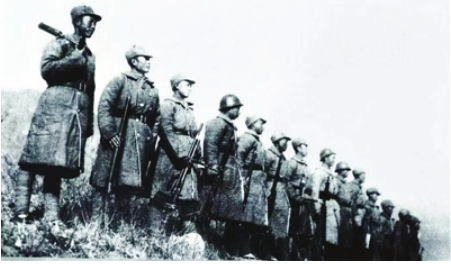
Some of the soldiers who participated in the anti-Japanese armed riots in eastern Hebei
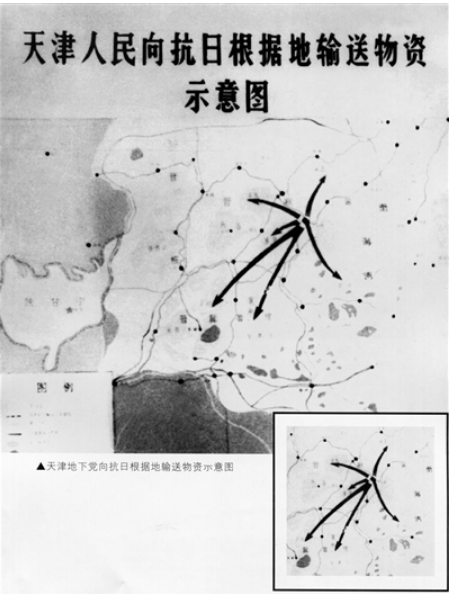
Schematic Diagram of Tianjin People Transporting Materials to Anti-Japanese Base Areas during the Anti-Japanese War
July 7, 1937 is a day that all Chinese people will never forget. On this day, Japanese militarism brazenly provoked the Lugouqiao Incident and launched an all-out war of aggression against China. Wherever the Japanese army went, there were mourning and suffering, the Chinese nation was towering, the mountains and rivers were stained with blood, countless people were killed, and hundreds of millions of compatriots were destroyed. However, the flames of war did not make the Chinese people afraid, but aroused resistance like a huge wave. The Chinese nation showed unprecedented cohesion and composed heroic songs against Japanese imperialist aggression.
Tianjin, the largest industrial and commercial city in the north, was used by the Japanese invaders as a bridgehead for swallowing North China. The suffering Tianjin people suffered humiliation, but never gave in. Under the leadership of the Communist Party of China, in the surrounding rural areas where the enemy's control is weak, people have taken up weapons to participate in the battle, held anti-Japanese armed riots, established anti-Japanese base areas, and carried out guerrilla warfare. The people from all walks of life in the city persisted in the struggle in a difficult environment, risking their lives to break through the blockade, supporting the war of resistance behind enemy lines, and showing the heroic spirit of unity against aggression against aggression.
The city of Tianjin under the haze
After the Lugouqiao Incident, the Japanese army mobilized a large number of personnel and weapons to arrive in Pingjin. A large number of soldiers, military vehicles, tanks and artillery were intensively deployed on the streets. The aircraft hovered in the air for reconnaissance all day long. The air was filled with the atmosphere of "the rain is coming and the wind is full of buildings". A big war is on the verge of breaking out.
The situation is extremely serious, Jincheng precarious. In the early morning of July 29, the 38th Division and security team of the 29th Army of the National Revolutionary Army stationed in Tianjin took the initiative to attack and dealt a heavy blow to the Japanese troops stationed in Tianjin, known as the "Tianjin War of Resistance". However, affected by unfavorable factors such as troops, weapons, and tactics, the progress of the operation was not smooth. In the end, the Chinese army had to withdraw from Tianjin......
On the evening of the 30th, Tianjin fell.
In the process of attacking and occupying Tianjin, the Japanese army dispatched a large number of planes and artillery to bomb the urban area indiscriminately, focusing on the municipal government, police station, security command, railway station, mint, paper mill, court, etc., as well as Nankai University, Nankai Middle School, Hebei Provincial Women's normal College and other colleges and universities, killing and injuring a large number of innocent civilians, what was once a bustling city turned into a hell on earth. According to statistics, the Japanese army bombed more than 2500 houses and 53 factories and enterprises in this battle. More than 2000 Chinese anti-Japanese officers and soldiers were killed in action, countless casualties among citizens, and more than 100000 homeless refugees.
"Blood and tears fly over the drums, and the mountains weep ghosts and gods". After the fall of Tianjin, the Japanese army began to carry out bloody massacres against the citizens of Tianjin. On the 31st, under the water tower of the East Railway Station, 46 railway workers were shot dead and innocent people were shot at random on the East Road. From August 3, a large-scale search and shooting of suspicious persons began in the urban area. on the 29th, at the beining railway hospital, more than 100 wounded and wounded soldiers were stabbed to death on the spot. According to the Xinhua Daily, the Japanese army interrogated pedestrians near the East Railway Station and found that suspicious persons were shot without review and buried in a large pit dug in advance. In just two months, more than 3000 people were killed. Cruelty shocked the world. The Japanese army also arbitrarily arrested labourers, set up concentration camps, and then sent them to the northeast and Japan to do hard work, set up "special teams", and plundered young women everywhere to transport them to barracks for wanton destruction. In addition, the Japanese army also created hundreds of horrific tragedies, such as the Donggu Port tragedy, the Fujunmiao Village tragedy, the Cuihuangkou tragedy, the platoon tragedy, and the ten-room tragedy, and carried out frenzied "sweeping" and "clearing the countryside" in the surrounding rural areas. the "three-light policy" has created a number of "no man's land" and "human circles", and countless people have been killed. The heinous crimes committed by the Japanese invaders against the people of Tianjin are countless.
After the Japanese invaders occupied Tianjin, they supported the puppet regime, the Tianjin Public Security Maintenance Association, and then established a puppet government to loot resources, seize enterprises, control finance, carry out economic exploitation, carry out cultural aggression, carry out enslavement education, and carry out brutal and barbaric fascist colonial rule over Tianjin for eight years in military, political, economic, ideological and cultural aspects.
In the face of the dark rule of the Japanese invaders, the Communist Party of China held high the banner of the anti-Japanese national united front, promoted the whole nation to persist in the war of resistance with outstanding political leadership and correct strategic strategies, and led the people of Tianjin to carry out a heroic struggle against the Japanese invaders.
Joining the Anti-Japanese Riots in East Hebei
The Chinese nation is a peace-loving nation, and has adhered to the peace concept of "kindness and benevolence" since ancient times. The Chinese nation is a nation with a great spirit, "with patriotism as the core, unity, peace-loving, hardworking and brave, and continuous self-improvement", so that the Chinese civilization has survived hardships and never failed.
After the fall of Tianjin, the Party Central Committee decided that the Northern Bureau of the CPC Central Committee would take Tianjin as the center to direct the guerrilla war in North China. The Hebei Provincial Committee of the Communist Party of China stayed in Tianjin to lead the work in the occupied areas in eastern Hebei and Pingjin. The focus of work shifted from the city to the countryside, and organized the anti-Japanese guerrilla war. The city work did its best to cooperate with guerrilla warfare. According to this deployment, the anti-Japanese battlefields behind enemy lines in the rural areas around Tianjin were quickly opened up and developed. Soon after, the party led and launched the Jidong riot that shocked China and foreign countries.
Tianjin is the seat of the Hebei Provincial Party Committee of the Communist Party of China, and it is an important support for launching anti-Japanese riots in eastern Hebei and carrying out armed struggles behind enemy lines. In order to ensure the victory of the riot, the Hebei Provincial Committee of the Communist Party of China and the Tianjin Municipal Committee of the Communist Party of China made intense and full preparations: set up a leading organization for the riot in the British concession; sent a large number of key party members to the rural areas of eastern Hebei, mobilized the masses, organized guerrillas and joined the Eighth Route Army, training in military knowledge, strategy and tactics for those responsible for carrying out riots; purchasing radio stations through underground party members of the telephone bureau to ensure smooth communication.
In May 1938, under the leadership of the Northern Bureau of the Central Committee of the Communist Party of China, the Hebei Provincial Party Committee, and the Jinchaji Military Region, the North China People's Anti-Japanese Self-Defense Committee held a meeting in Tianjin to make specific arrangements for the anti-Japanese riots in eastern Hebei. On July 14 of the same year, Bangjun Town of Jixian County fired the first shot of an armed riot in the western part of eastern Hebei Province, capturing the pseudo police station of the town. On the 15th, the Jixian County Party Committee of the Communist Party of China led members of the Salvation Association of all districts to launch an uprising at the same time to capture the pseudo-security team and pseudo-police station in Guandi Temple to the west of Xiacang Town. They fought fiercely with the Japanese puppet in Donghaomen, Jiagezhuang, Dawangzhuang, Longwang Temple, Panshan and other places in Jixian County. The masses in Baodi, Wuqing, Ninghe and other places also took part in the armed riots one after another, organizing teams to attack enemy strongholds, which became an important part of the anti-Japanese riots in eastern Hebei.
The raging fire of the Great riot in eastern Hebei quickly swept across the entire land of eastern Hebei. In more than a month, more than 200,000 workers, peasants, soldiers, businessmen, and patriots from all walks of life were mobilized in 22 counties, and 9 counties occupied by Japanese invaders were recovered. The functions of the puppet government of each county were paralyzed, and the Beining Railway was also cut off. The riot strategically cooperated with the battlefield behind enemy lines in North China, tactically contained and attacked the Japanese and puppet troops in the Tianjin area, and more importantly, at a moment of indignation and grief among the people of the whole country, it inspired people's fighting spirit to resist aggression and defend the country, and broke the myth that the Japanese army was invincible. The riot also ignited the anti-Japanese flames in the Panshan area, spawned the Panshan anti-Japanese armed forces, and laid a good foundation for the establishment of the Panshan anti-Japanese base area. As an important force in the Jidong riots, the people of Tianjin made important contributions to the large-scale armed struggle led by the party in the early days of the Anti-Japanese War.
Rock-solid mountain defense line
The Panshan area, with mountains and plains, can be attacked and defended, and is easy to defend and difficult to attack, which is very suitable for establishing base areas and carrying out guerrilla warfare. At the same time, it is the main throat for the Japanese army to enter North China from the northeast and swallow the whole of China, and it is also the only place to go between eastern Hebei, peaceful west and northern Hebei. After the July 7th Incident, a large number of Japanese troops and materials had to pass through here, and their strategic position was extremely important.
On New Year's Day in 1940, the Jidong District Party Sub-Committee ordered Bao Sen, Li Ziguang and Wang Shaoqi to lead a part of the team to open up the Panshan Anti-Japanese Base Area, and to rely on Panshan to open up Jixian, Pinggu and Miyun areas. Bao Sen and others gathered and rectified the guerrillas, eliminated bandits, established the Political Office of the Eighth Route Army in Panshan area, established the grassroots anti-Japanese democratic regime, and the Panshan Anti-Japanese Base was formally established. At the beginning of the establishment of the base area, the army's equipment was extremely backward. The guns were all kinds of earth guns collected by the people, the grenades were made of glass bottles and cans, and the artillery was made of elm with iron bars. It was with such simple equipment, under the leadership of the Jidong Military Division, the local soldiers and civilians adopted the method of internal and external coordination, and fought with the well-equipped Japanese and puppet troops more than a hundred times with flesh and blood, smashing the enemy's several "mopping up". Give the enemy a heavy blow. In the first World War of Baicaowa, a Japanese cavalry squadron was wiped out in more than 10 hours of fierce fighting, making the Japanese and puppet troops afraid to invade Panshan for more than half a year. In the anti-"public security enhancement campaign," Bao Sen led the 13th regiment of the Eighth Route Army to fight bravely. In the First World War along the Guohe River, with seven companies, they fought continuously for 16 hours, wiped out the fourth regiment of the "Public Security Army", killed and captured more than 1,000 officers and soldiers below the enemy and puppet lieutenant colonel, and seized a large amount of weapons and equipment, creating a miracle of winning more with less and defeating the weak. Bao Sen was so famous in eastern Hebei that the enemy was frightened. The Japanese and puppet troops even used "Go out to fight and meet Lao Bao" as the spell when swearing.
The development and growth of the Panshan base area is inseparable from the support of the people. There is a saying in the Panshan area: "Panshan fights with more than three: more stones, more holes, and more godmothers." The plain language vividly illustrates the flesh-and-blood ties between the Party and the masses of the people. More than a dozen members of the Panshan militia class, in order to cover the actions of the main forces of the Eighth Route Army, they stayed in the jungles and caves of the "no man's land" for two years, lived a savage life, and continued to fight with the Japanese army, and were awarded the "militia hero". Honorable title. Mother Yang, known as the "mother of the Eighth Route Army", once tactfully covered the Eighth Route Army many times, carefully took care of the wounded and sick, and risked her life to preserve anti-Japanese materials. In order to cover the officers and soldiers of the Eighth Route Army, some people would rather die than surrender in the face of the enemy's severe interrogation. In order to keep the secrets of the Eighth Route Army, the people in Huayu Village were killed by cruel means such as fire and stabbing, and 11 people were seriously injured, but none of them leaked the news. Protect the safety of the anti-Japanese team with their lives.
Under the correct leadership of the party, the Panshan Anti-Japanese Base developed around like a single spark and started a prairie fire. Soon, more than 280 villages in the south of Jixian County, east of Sanhe County and south of Pinggu County, as well as the second district in the east, the eighth district in the north, the south of Baodi, the southeast of Wuqing and the north of Ninghe all opened guerrilla areas one after another, connecting with the Panshan Base.
The Panshan Anti-Japanese Base Area built by the Eighth Route Army commanders and the people in the Panshan area with their lives and blood stood tall in the extremely arduous struggle. The patriotic spirit of bravery and fearlessness of sacrifice shown by them under the leadership of the party will be recorded in history forever.
Action for All Support Base Area
This is a battlefield without gunpowder smoke, but there will be bloodshed and sacrifice. This is a battle between blockade and anti-blockade, a struggle between oppression and anti-oppression, a contest of courage, wisdom and perseverance, and the outcome determines the tendency of the balance of war.
As an important industrial base and commercial center in the north, Tianjin has developed industry and commerce and abundant materials. After Japan occupied Tianjin, it carried out the policy of "supporting war with war" to build Tianjin into an important military station and material production and distribution base in North China. In order to prevent the anti-Japanese soldiers and civilians from "stealing" materials, the Japanese army imposed a strict economic blockade on the base areas, and imposed strict material control and traffic control on Tianjin. The Japanese puppet army police officers were all over the traffic roads. When suspicious persons were found, they were immediately arrested, tortured, and even executed on the spot.
In spite of this, in order to support the construction of the base areas behind enemy lines, the brave and intelligent Tianjin people skillfully used various methods to continuously transport a large number of strategic materials out of Tianjin, which not only caused great damage to Japan's industrial production and commercial order in Tianjin, but also greatly supported the anti-Japanese fronts throughout the country, including the Panshan base.
Although Tianjin is an occupied area, most of the people engaged in all walks of life are Chinese with conscience. They purchase controlled materials by virtue of their legal status and work convenience and risk transporting them to the base areas. With the help of the party organization, some purchased in and out of Tianjin as technicians of the pseudo county office and the purchase certificate of the county office, while others purchased on the basis of purchase orders on the grounds of production needs, cleverly avoiding the enemy's interrogation.
In order to transport materials out of Tianjin, the underground organization of the Communist Party of China secretly set up a party branch at the Great Red Bridge Wharf. Inspired by the party, even the leaders of the green gang who controlled the wharf participated in the joint delivery of materials for the base area. Everyone used their brains and invented various concealment methods, such as fixing materials on the bottom of the ship and dragging them along in the water, transforming the ship into a double bottom to carry materials, and burying materials under heavy goods. Many people also disguised illegal drugs as tonics and poured mercury into bicycle tires to transport drugs to base areas by returning to their hometowns. At railway stations, people hid supplies in coal trucks and pressed them under coal blocks to avoid enemy searches. When transporting by road, people divide the materials into small pieces, hide them in the bottom of the cart, load them with excrement, fix the small objects on the chassis of the cart, and transport them several times. Despite such meticulous care, many people and procurement personnel were tortured and even gave their lives.
During the Anti-Japanese War, Tianjin transported hundreds of materials such as communication equipment, machinery and equipment, medicines, medical appliances, steel, paper, printing equipment, oil, and chemical raw materials to the anti-Japanese fronts. Xingang alone has shipped more than 200 tons of steel and other strategic materials.
Nowadays, it is hard to imagine how people transported tons of machine tools, steel and large and small materials out of Tianjin under the harsh conditions at that time, and how many unsung heroes paid the price of their lives.
In addition to materials, transporting personnel is another important way for Tianjin people to support the construction of the base area. Since the early days of the Anti-Japanese War, the vast number of patriotic young students, progressive intellectuals, experts, technicians, and workers from all walks of life in Tianjin have consciously rushed to various anti-Japanese base areas to help develop production and cultivate technical forces, especially in breaking through military production. Played an important role in the problem. For example, the use of earth equipment to make shell casings, smokeless gunpowder, grenades and landmines, the use of enemy rails to make seamless steel pipes, rifles, etc., created a series of military legends and made great contributions to winning the victory of the War of Resistance Against Japan.
Modern Tianjin is the largest commercial port, the largest industrial and commercial city and economic center in North China, and its political, economic, industrial and cultural status is very important. After the Japanese invaders occupied Tianjin, they used Tianjin as a command center for attacking the anti-Japanese base areas behind enemy lines, a military station base for material supplies, and a maritime gateway to Japan. In order to consolidate Tianjin's position, the Japanese army imposed a tight blockade on the anti-Japanese base areas in North China, attempting to cut off all ties between the base areas and the outside world, and at the same time strengthened military offensives. The "three lights" policy of "killing, burning, and robbing" has established a "no man's land" of thousands of miles with "no farming, no living, and no pedestrians". Under such difficult conditions, the party led the people of Tianjin to share the same hatred of the enemy, defy hardships and dangers, overcome unimaginable difficulties, and made great sacrifices. They fought hard against the Japanese invaders for eight years with an indomitable spirit, and created a stable anti-Japanese base area. The suppression consumed a large number of Japanese and puppet troops and effectively weakened the colonial rule of the Japanese invaders in North China.
In August 1945, Japan announced its unconditional surrender. Under the leadership of the Communist Party of China, the people of Tianjin fought bravely and were not afraid of sacrifice, and finally ushered in the final victory of the War of Resistance against Japan. In order to win the Anti-Japanese War, the people of Tianjin made great sacrifices. According to statistics, the war caused 56615 deaths in the whole city (including suburban counties), 3.048 billion kilograms of grain losses, 1.025 million mu of land losses, 36879 houses damaged and property losses exceeding 5 billion French dollars (calculated at July 1937 prices). Ji Hongchang, Ruan Wude, Yang Shisan, Bao Sen, Yang Dazhang, Wang Chongshi, Tian Ye and a large number of anti-Japanese heroes built the Great Wall with clank and iron bones against strong enemies and flesh and blood, composing heroic songs of magnificent mountains and rivers, inspiring generations of Haihe sons and daughters to work hard and forge ahead for the great cause of building a powerful country and national rejuvenation.
Today, it has been 79 years since the victory of the War of Resistance Against Japan. The trials of war have made us more aware of the preciousness of peace, but the memory of blood and tears cannot be forgotten. The experience and lessons must be remembered forever. The great spirit of the War of Resistance should last forever. At a new historical starting point, we should unite more closely, carry forward the great spirit of the war of resistance, face up to difficulties, fight bravely, and make unremitting efforts to build a modern socialist country in an all-round way and promote the great rejuvenation of the Chinese nation in an all-round way.
Source: Tianjin Daily
Previous Page
Previous Page

Address: Buildings 4 and 5, Kechuang Huigu Park, Hongshun Road, Huaming High-tech Zone, Dongli District, Tianjin
Tianjin High-end Equipment Research Institute, Tsinghua University, Copyright
Website Construction: China Enterprise Power Tianjin
sweep
Pay attention to the official WeChat public number