




PARTY BUILDING
party building work
Zhu De and Investigation and Research-The Most Places to Go and the Most Investigation Reports to Write
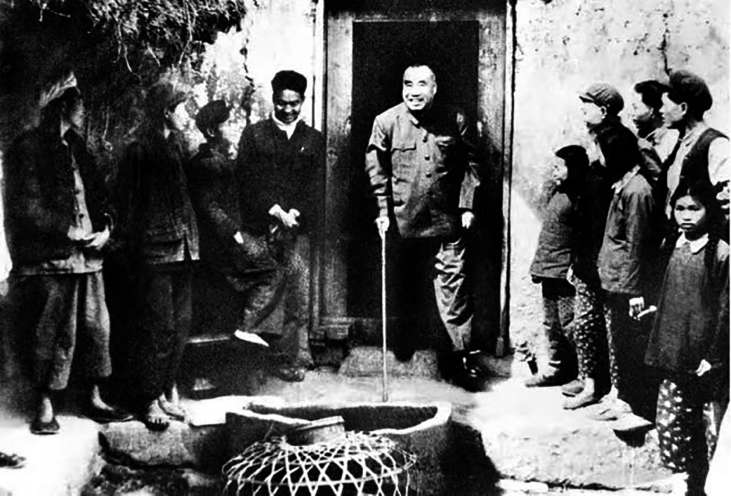
A pole, style forever; The "most" of the two is dedicated to the people. Zhu De's lifelong pursuit of seeking truth from facts, footprints throughout the border, poor areas. His high wisdom in governing the party, governing the country, and governing the army, and his truth-seeking and pragmatic style and feelings are worth remembering and learning forever.
Make a decision after finding out the situation
Zhu De's investigation and research generally includes flexible and diverse methods such as reading materials, listening to reports, holding seminars, visiting the scene in person, and sending staff around him to investigate. He believes: "All facts prove that only by proceeding from reality can the problem be solved correctly." In the war years, whenever the war came, Zhu De would appear on the front line, personally touch the situation, and provide opinions for the central decision-making. During the War of Liberation, in order to lay down Shijiazhuang, Zhu de went to the Shanxi-Cr-Hebei liberated area and "made a detailed investigation into the enemy's situation." he personally presided over a forum to discuss how to fight the war. He also talked to prisoners to learn about the enemy's deployment in Shijiazhuang. Because of a better understanding of the situation, the first urban battle was won.
From May to September 1963, torrential rains fell in some parts of Hebei, Henan, Jiangsu, Anhui and Shandong provinces, which caused floods. In the face of the disaster, the leading comrades of the Party Central Committee and the State Council were worried and quickly mobilized manpower and material resources to provide the greatest support to the disaster areas. On October 16, shortly after the Beijing-Guangzhou Railway was reopened to traffic, 77-year-old Zhu De rushed to the disaster-stricken area in Hebei on behalf of the Party Central Committee. He went to Baoding, Shijiazhuang, Xingtai, Handan and other places where the disaster was more severely affected, and then went to Cangzhou to check and understand the facts. In view of the climate characteristics of Cangzhou, Zhu De specifically pointed out that your area is sometimes short of water and sometimes flooded, so it is necessary to study and control it well. To the laws of nature, do not resist it, but master it, understand it, and transform it. After returning to Beijing, Zhu De wrote to Mao Zedong and other central leaders to reflect the situation of flood fighting and disaster relief in Hebei Province, and put forward specific suggestions for water conservancy construction and the development of agricultural production in the future.
The Lord "goes down"
According to statistics, from 1956 to 1966, Zhu De inspected and investigated 27 times, with an average of nearly 90 days per year. In the past 11 years, he wrote 24 letters and calls to the central government, wrote 13 investigation reports, and put forward many valuable suggestions on the economic construction and social management of New China.
At the end of March 1950, Zhu De set out from Beijing to Zhangjiakou for inspection and research. At midnight, the train slowly pulled into Zhangjiakou Railway Station. At this time, Zhu De in the carriage was wearing a gray old cotton-padded coat and was looking for the map from time to time with a magnifying glass in his hand. Sometimes he drew horizontal bars, vertical bars or circles with pencils, and sometimes he stared at the map and meditated. Outside the carriage, the winter in Zhangjiakou is not over, and the temperature at night is always floating around zero. Zhu De from time to time to put down the magnifying glass in his hands, ha ha hair cold hands. The escort was afraid that the chief would catch cold and suggested that he go to the hostel to have a rest. Zhu De said: "The city has just been liberated. The responsible comrades here have many things to deal with. We should not add trouble to the place." That night, Zhu De and his party stayed on the train. During this trip to Zhangjiakou, Zhu De asked for simplicity in arranging the reception. Apart from drinking some tea, they did not spend a penny of hospitality from the provincial and municipal party committees.
In June 1955, Zhu De came to Zhangjiakou again on his way home from Baotou. This time he still didn't open a room in the hotel. He told the person in charge who accompanied him that it was enough to find a very ordinary office in the municipal party committee and don't spend any more money. In the evening, regardless of the fatigue of the journey, Zhu De listened to the work reports of the local and municipal leaders at the symposium. At this time, it was raining heavily outside the house, and the meeting inside the house went on until late at night. Through this on-the-spot investigation of new and old enterprises in Zhangjiakou, Zhu de focused on in-depth thinking on the difficult problems faced in the construction of the first five-year Plan, and wrote a research report to the central government, and the suggestions put forward were later adopted.
In July 1958, Zhu De and his entourage went to Wuquan Mountain in Lanzhou, Gansu for an inspection. On the way, they saw a memorial arch. The memorial arch was written in the main book-"How is it better to be high and low", and the latter book-"It is harder to go down than to come up". Zhu De lamented: "The ancients wrote 'going down is more difficult than coming up' here, which is also a deep meaning! If we look at it in connection with our reality, it is indeed 'going down' more difficult. Therefore, Chairman Mao has repeatedly advocated that cadres at all levels should go deep into the actual situation, investigate and study; advocate that cadres be delegated to exercise, generals become soldiers under the company, and secretaries plant experimental fields." With regard to the bureaucratic practices of some cadres who have entered the city, Zhu de once sternly pointed out: this bureaucratic style of some party members and cadres, this indifference and irresponsible attitude towards revolutionary work and state property, it should be regarded as a criminal act against the party, the state, and the people.
SPEC for farmers
In 1958, under the wrong guidance of the "left", the "communist style" and "exaggeration" prevailed, and the public canteen became an indispensable part of the establishment of the people's commune. Zhu De gradually found many problems in the investigation and research, and expressed his opposition with a clear-cut stand. On the basis of many investigations and in-depth thinking, he put forward the correct view that "eating without money will not work.
In order to summarize the experience and lessons since the "Great Leap Forward" movement, the Party Central Committee held an enlarged meeting of the Politburo in Lushan in July 1959. In his speech at the Lushan meeting, Zhu De talked most about the issue of public canteens. He pointed out that the canteen should adhere to the principle of voluntary participation, but also to engage in economic accounting. We should make the peasants rich, not poor. Even if the canteen all collapsed, it is not necessarily a bad thing. After the Lushan Conference, the "left" mistakes that were once corrected were rampant again, and the public canteen was vigorously maintained as a "socialist position. Although Zhu De was wrongly criticized for advocating the dissolution of public canteens, he did not give up his attention to this issue.
In March 1961, after the central government's "Sixty Articles on Agriculture" was promulgated, Zhu De, regardless of his 75-year-old age, went to Sichuan, Shaanxi, Henan, and Hebei provinces to inspect. The issue of public canteens once again became the focus of his research. After returning to Beijing, he sent a letter to Mao Zedong, the drawbacks of public canteens. at the same time, the party central committee and party committees at all levels have successively organized a large number of investigation groups to go deep into the rural areas for investigation. In this way, the whole party has a deep understanding of the many disadvantages of public canteens, and has a real feeling of the strong desire of the broad masses of farmers to dissolve public canteens. From May to June 1961, the Central Working Conference passed the "Regulations on the Work of Rural People's Communes (Draft Amendment)". With the implementation of this document, public canteens that have been maintained for three years in rural areas across the country have been disbanded one after another.
The "two most"
Zhu De's life is admirable for the number of investigations, the wide range, the long time, and the number of research reports written. During the 27 years from the founding of New China to his death in 1976, Zhu De worked tirelessly and put it into practice. With his own eyes, he reflected the real situation in various places realistically. He drafted more than 100 research reports, the text is simple, covering a wide range of content, unique and profound insights. He went deep into reality and at the grass-roots level, and created two "most" in the investigation and research work of party leaders ".
The place to go the most. Zhu De spends two to three months or more every year to inspect all parts of the country. Except for Taiwan, Ningxia, and Tibet, other provinces and cities have come. According to Zhu De's inspection schedule, he has visited more than 170 places for investigation and research. Second, the largest number of investigation reports were written to the Central Committee. Every time Zhu De came back from inspection work, he always ignored the fatigue of the journey, carefully wrote the investigation report, reported the situation in a timely manner, made suggestions, and actively participated in major decisions on party and national construction. According to incomplete statistics, there are more than 100 research reports on Zhu De now. These research reports involve many provinces and regions across the country, including many industries such as industry, agriculture, forestry, mining, water conservancy, etc., and involve major policies such as the "Sixty Articles of Agriculture", the development of agricultural and sideline industries, the development of handicrafts, and the development of Hainan Island. The experience of governing the party and the country contained in the report is the precious spiritual wealth left to us by Comrade Zhu De. (Excerpted from Du Lirong/Text, Hebei Communist Party Member's Media Journal)
Source: China Organization and Personnel News

Address: Buildings 4 and 5, Kechuang Huigu Park, Hongshun Road, Huaming High-tech Zone, Dongli District, Tianjin
Tianjin High-end Equipment Research Institute, Tsinghua University, Copyright
Website Construction: China Enterprise Power Tianjin
sweep
Pay attention to the official WeChat public number