




PARTY BUILDING
party building work
Shook the foundation of the Kuomintang's reactionary rule in southern Zhejiang-The inscription on the monument of the 13th Army of the Chinese Workers' and Peasants' Red Army
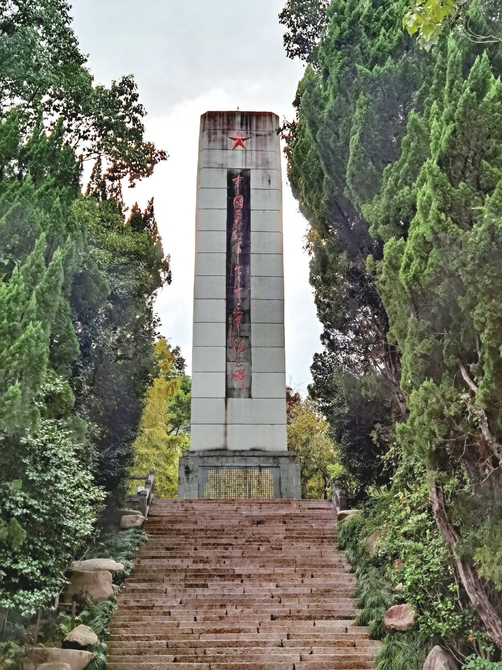
The 13th Army of the Chinese Workers and Peasants Red Army (hereinafter referred to as the 13th Red Army) Monument is located on a hill about 80 meters south of the former site of the Red Army Town in southern Zhejiang, Yongjia County, Zhejiang Province. It was built in 1986. The monument is 19.3 meters high, implying that the 13th Red Army was formally formed in 1930. Under the red five-pointed star in relief at the top of the front of the monument is engraved with the "Monument to the 13th Army of the Chinese Workers' and Peasants' Red Army" inscribed by Zhang Aiping ". At the bottom of the monument is a plinth, on which is inscribed an inscription as follows:
In 1927, after the Nanchang Uprising and the "August 7th" Conference, under the leadership of the Communist Party of China, armed peasant riots in southern Zhejiang have been repeated for years. In May 1930, under the direct deployment of the Central Military Commission, 32 southern Zhejiang Red Army guerrillas formed the 13th Army of the Chinese Workers' and Peasants' Red Army. commander hu gongmian, political commissar jin kuan-jin, and political department director chen wenjie. It has jurisdiction over the Red One Regiment, the Red Two Regiment and the Red Three Regiment (later changed to a division). It was one of the 14 Red Army teams in the country at the time. At its peak, the number was about 6,000. The military headquarters was located in Wuchi Village, one of the central areas of the peasant riots.
The activities of the 13th Red Army cover more than 20 counties in southern Zhejiang Province, including Yongjia, Wenling, Yongkang, Jinyun, Qingtian, and Xianju. They took Fenglin, fought Pingyang, fought Jinyun, attacked Ouqu, attacked Huzhen, fought Wuyan, and seized tea heads. They fought bloody battles for more than a hundred times, shaking the foundation of the Kuomintang's reactionary rule in southern Zhejiang. In the struggle, Jin Guanzhen, Chen Wenjie and other major leaders died bravely, and the commander of the army, Hu Gongmian, was unfortunately arrested. Due to the great disparity between the enemy and the enemy and the influence of the "left" errors in the party, the 13th Red Army suffered a setback and failed. However, his tragic battle course made due contributions to the development and growth of the Chinese revolution and later the revolutionary base areas in southern Zhejiang.
Cangshan is not old, but Nanshui flows long. The glorious achievements of the 13th Red Army will go down in history, and the dedication of the revolutionary martyrs will remain forever. In order to cherish the memory of the martyrs and inspire future generations, with the consent of the Zhejiang Provincial People's Government, the former military headquarters site was rebuilt and inscriptions were built.
Yongjia County People's Government
February 2, 1988
The inscription is concise in language and simple in writing. It truly and objectively describes the glorious deeds of the Red Thirteenth Army's hard struggle and the tragic course of bloody battles. It vividly reproduces the Red Thirteenth Army holding high the revolutionary red flag, not afraid of bloodshed and sacrifice, and going forward and succeeding. The historical picture scroll of struggle seeks truth from facts, and enthusiastically eulogizes the revolutionary martyrs' fighting spirit and sacrifice spirit of self, it is admirable and inspiring to read.
Creation of the 13th Red Army
The Central Committee of the Communist Party of China attaches great importance to the armed struggle of farmers in southern Zhejiang. In the second half of 1929, the Red Army guerrillas in southern Zhejiang, the Soviet regime in southern Zhejiang and the Yongjia Revolutionary Committee were established one after another. In January 1930, the Central Committee of the Communist Party of China sent Jin Guanzhen to inspect Wendai and other places. On February 28, Jin Guanzhen wrote a report to the Party Central Committee on the political situation, mass struggles, armed riots, and mass organizations of the party and workers and peasants. In early March, dispatched by Zhou Enlai, Hu Gongmian arrived in southern Zhejiang and established the guerrilla headquarters of the Red Army in southern Zhejiang, which was the predecessor of the 13th Red Army.
On May 3, 1930, Jin Guanzhen, Hu Gongmian, Lei Gaosheng and others discussed the establishment of the 13th Red Army headquarters in Yongjia Wuchi Village. At the same time, they decided to concentrate the Red Army guerrillas in various counties to Yongjia Fenglin for training. On May 9, Hu Gongmian assembled the Red Army guerrillas from all over the country and marched to Fenglin in three ways. After capturing Fenglin, in accordance with the designation and instruction spirit of the 13th Red Army stipulated in the military work outline of the Central military Commission of the Communist Party of China, the Red Army guerrillas of Wenzhou, Taizhou and Chazhou (Lishui) concentrated in Fenglin and officially announced the establishment of the 13th Red Army, commander hu gongmiao, political commissar jin guanzhen, and political department director chen wenjie. The 13th Red Army was established under the direct command of the Central Committee of the Communist Party of China and the Central Military Commission. It is one of the 14 Red Army of Workers and Peasants included in the official sequence of the Central Military Commission. The creation of the 13th Red Army was the most important result of the peasant riots in Zhejiang during the Agrarian Revolutionary War.
Heavy blow to reactionary forces
After the establishment of the 13th Red Army, based on guerrilla forces in Yongjia, Wenling, Yongkang and other places, three regiments (divisions) were established successively. In May 1930, the First Red Regiment and the 13th Red Army were established at the same time. They were originally formed by the integration of more than 30 Red Army guerrillas in Nanxi, Yongjia. On May 23, the Central Military Commission of the Communist Party of China issued instructions on the formation of the 13th Red Army and other issues: "The Central Committee has decided on the basis for your establishment of the 13th Army and will expand the existing three regiments into the future of the third division." In July, the Red Second Regiment was formed on the basis of Wugen guerrillas in Wenling, Taizhou, and the Red Third Regiment was formed on the basis of guerrillas such as Yongkang, Jinyun, and Xianju.
The 13th Red Army, with Yongjia in Zhejiang Province as its fighting area center, operates at the foot of Kuocang Mountain, the coast of the East China Sea and both sides of Ouhai Sea. They took Fenglin, Pingyang, Jinyun, Ouqu, Huzhen, Wuyan and Chaitou, spanning more than 20 counties in Wenzhou, Taizhou, Lishui and Jinhua. They fought for 11 years and experienced more than 100 battles, large and small. The 13th Red Army fought bravely and fought bloody battles, which dealt a heavy blow to the reactionary ruling forces in the core area of the Kuomintang. To a certain extent, it contained the Kuomintang's "encirclement and suppression" of the Central Soviet Area, and effectively supported the Central Soviet Area and the Red Army's Long March, leaving a glorious chapter in the history of revolutionary struggle in southern Zhejiang.
blood stained south zhejiang
The 13th Red Army is the only Red Army composed of Zhejiang soldiers under the leadership of the Communist Party of China. At its peak, the Red Army had more than 6300 people and played an important role in the history of the Communist Party of China and the army. Due to the great disparity between the enemy and the enemy, coupled with the influence of the "Left" errors in the party at that time, he suffered setbacks in the struggle. On May 20, 1930, political commissar Jin Kuan-jin was arrested by the enemy when he returned to Wenzhou City after his assignment from Pingyang and was killed that night. During the struggle, Chen Wenjie and other major leaders died bravely, and the commander of the army, Hu Gongmian, was unfortunately arrested. On May 23, 1932, the "Yitou Dongzong" incident occurred. The main force of the 13th Red Army was severely destroyed, and the rest continued to fight.
Under arduous conditions, the 13th Red Army was not afraid of sacrifice and fought bravely. More than 1700 Communist Party members and Red Army soldiers in southern Zhejiang gave their precious lives for the revolution. Most of the commanders and fighters above the battalion level and the main leading members of the Southern Zhejiang Special Committee of the Communist Party of China were martyred and lay in the land of southern Zhejiang. They fought bloody battles on the battlefield, fought hard and unyielding in prison, regarded death as home and upright on the execution ground, and wrote a great revolutionary spirit with their lives and blood.
Source: Learning Times
Previous Page
Previous Page

Address: Buildings 4 and 5, Kechuang Huigu Park, Hongshun Road, Huaming High-tech Zone, Dongli District, Tianjin
Tianjin High-end Equipment Research Institute, Tsinghua University, Copyright
Website Construction: China Enterprise Power Tianjin
sweep
Pay attention to the official WeChat public number