




NEWS
News Center
National Key Laboratory of High-end Equipment Interface Science and Technology has made important progress in the field of micro-nano manufacturing based on colloidal self-assembly
Recently, the National Key Laboratory of High-end Equipment Interface Science and Technology of Tsinghua University has made important progress in the field of micro-nano manufacturing based on colloidal self-assembly. Relevant achievements were published in the journal Advanced Functional Materials (Advanced Functional Ultrafast) under the title of "Ultrafast Manufacturing of Large-area Colloidal Crystal Micropatterns Based on Colloidal Self-assembly and Transfer Printing" (Materials Fabrication of Large-Area Colloidal Crystal Micropatterns via Self-Assembly and Transfer Printing), and were selected as the cover article (Cover).
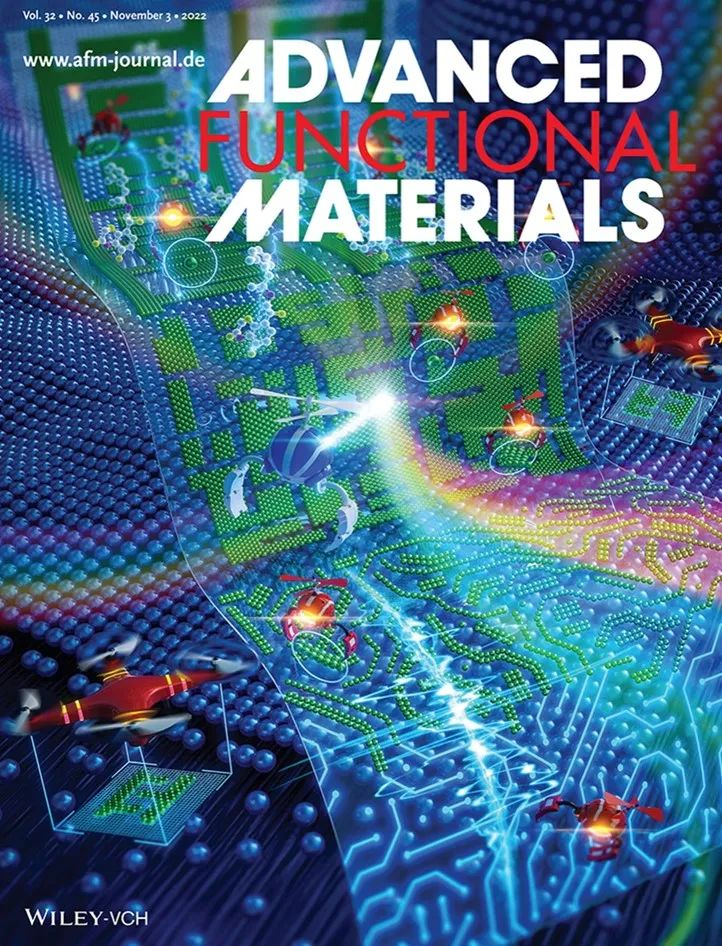
Since its emergence, micro-nano manufacturing technology has brought great breakthroughs in many important fields, and it is of great significance to promote the development of national industry and economy. However, the traditional micro-nano manufacturing method is highly dependent on expensive and complex precision equipment, which has the problems of slow processing speed, small preparation area and high cost. In recent years, various colloidal materials have been developed. If these colloidal micro-nano particles can be accurately induced to form specific structures spontaneously through colloidal self-assembly, it will help to greatly improve efficiency, reduce costs, and promote the development of micro-nano manufacturing.
Colloidal particles can be assembled into "colloidal crystals" in a certain order and cycle. Due to the specific arrangement, micro-nano size and material properties of colloidal particles, many unique and interesting properties have emerged, which bring various opportunities for a large number of applications. For example, the size and period of micro-nano particles are located in the size of light waves, which can affect the propagation of electromagnetic waves to produce photonic band gap, so it is expected to bring breakthroughs in photonic crystals, structural color, structural color sensors and other fields; the intrinsic unit scale of micro-nano particles makes it easier to manufacture various high-precision/high-resolution micro-patterns, bringing promising opportunities for microelectronics/sensing, anti-counterfeiting encryption and other fields. However, most of the colloidal self-assembly in the current academic research is slow and small in size, which can not be applied to the real industrialization process.
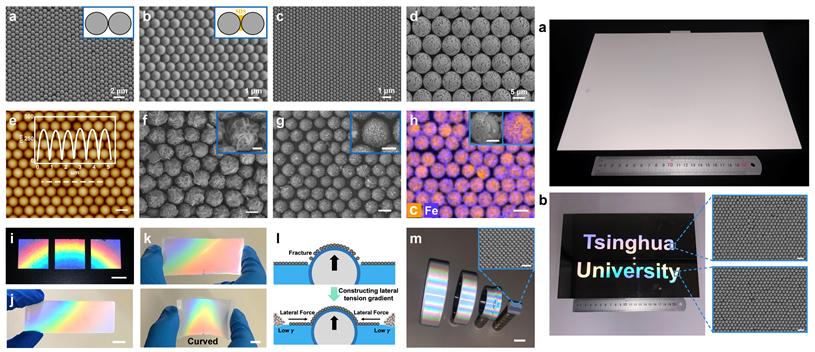
Fig.1 Results of ordered large-area self-assembly of micro-nano particles
In this study, the tension gradient is innovatively introduced into the liquid-gas interface self-assembly, and a unique tension gradient-induced nanoparticle liquid-gas interface rapid large-area self-assembly method is proposed. In this work, the method and design criteria for the loose suspension structure of nanoparticles at the liquid-gas interface based on surface tension and hydrophobic modification of the surface of nanoparticles are first established. The surfactant-loaded gel is further used to construct a liquid-gas interfacial tension gradient, induce interfacial convection, break the electrostatic repulsion energy barrier between nanoparticles, and quickly form a dense and orderly large-area colloidal crystal self-assembly structure. The experiment shows that the lateral capillary force of the liquid-gas interface can induce self-assembly but at the same time will damage the self-assembly orderliness of the "double-edged sword" effect, and the effectiveness of inhibiting the interface capillary agglomeration and improving the quality of the liquid-gas interface self-assembly based on the tension gradient is proposed and proved, the controllable preparation of self-assembled films with different sizes (from 400 nm to 8 μm) and different shapes (spherical, flower cluster, core-shell structure, etc.) of micro/nano particles on various substrate surfaces is realized. The advantages of flexible and sustainable construction based on tension gradient self-assembly are studied, which solves the problem of high-quality self-assembly manufacturing of nanoparticles on curved surfaces to a certain extent. The research realizes the ultra-fast preparation of super -1000 cm2 self-assembly structure in a few seconds, and the manufacturing area is increased by more than two orders of magnitude compared with the traditional method, which effectively solves the industrialization problem of large-size self-assembly structure to a certain extent.
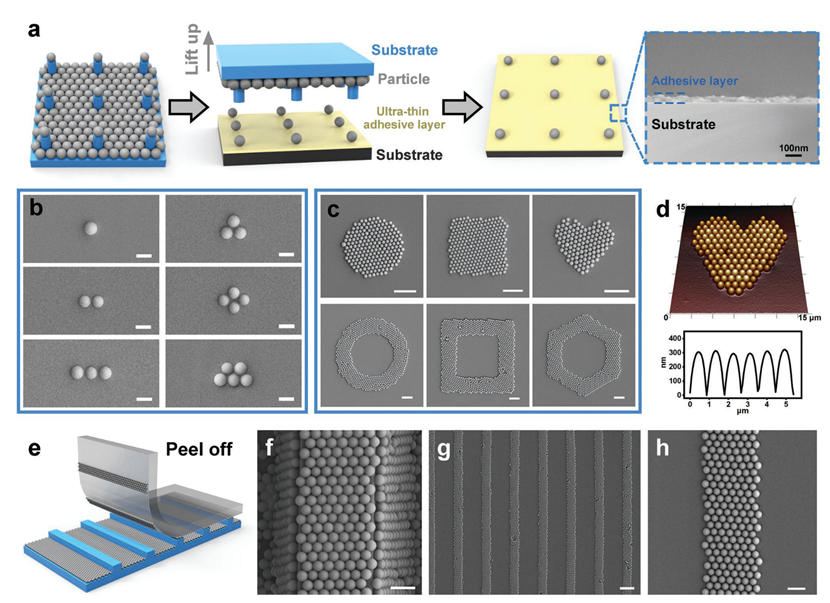
Fig.2 Micropattern fabrication strategy based on nanoparticle self-assembly-transfer printing
Inspired by traditional ink printing, a colloidal crystal micropattern preparation method based on nanoparticle self-assembly transfer printing is further proposed, and the experiment reveals the mechanism of nanoparticle adhesion and desorption transfer, realizes the micropattern preparation of single nanoparticle precision, and inherits and retains the advantages of ink printing batch rapid manufacturing. Further combined with the conductive colloid material, it proves its application potential in the field of large-scale manufacturing of flexible microelectronics. This efficient large-area self-assembly of nanoparticles-micropatterning manufacturing strategy provides new ideas for photonic crystals, micro-structure/pattern manufacturing, flexible microelectronics and many other fields, and provides broad opportunities for academic and practical industrial applications.
Li Xuan, a 2018-level doctoral student in the Department of Mechanical Engineering of Tsinghua University, is the first author of the paper, Professor Wang Jiaodao is the corresponding author of the paper, assistant researchers in the Department of Mechanical Engineering, Chen Lei, Ma Yuan and Weng Ding, and doctoral students in the Department of Mechanical Engineering, Li Zhaoxin, Song Lele, Zhang Xuanhe and Yu Guoxu, have contributed to the work, which is supported by funding from the National Natural Science Foundation of general projects and other projects.
Reprinted │ National Key Laboratory of High-end Equipment Interface Technology
Previous Page
Previous Page

Address: Buildings 4 and 5, Kechuang Huigu Park, Hongshun Road, Huaming High-tech Zone, Dongli District, Tianjin
Tianjin High-end Equipment Research Institute, Tsinghua University, Copyright
Website Construction: China Enterprise Power Tianjin
sweep
Pay attention to the official WeChat public number