




NEWS
News Center
【Scientific and Technological Achievements Promotion】 Oil-soluble graphene
As the most common element in nature, carbon is widely around us, and it is indispensable for all living systems known. It can be said that without carbon, life would not exist.
Carbon as the most common element has various allotropes, for example: diamond, graphite, soccer ball, graphene, etc.
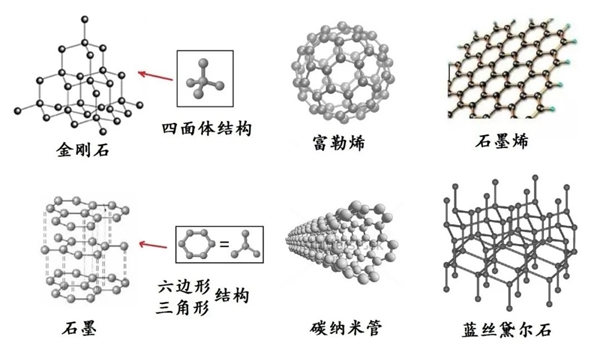
carbon allotropes
The scientific and technological achievements to be shared with you in today's issue of "Promotion of Scientific and Technological Achievements" are related to one of the carbon allotropes, that is, our hospitalLubrication Technology Research Institute(hereinafter referred to as "Lubrication Institute") developed and preparedCarbon-based lubricating material-oil-soluble graphene.
science and technology research and development
Let's first understand graphene and see what characteristics TA has ~
Graphene is a two-dimensional material with hexagonal lattice formed by carbon atoms in sp2 hybrid orbitals. The thickness of single-layer graphene is only 0.34nm (the thickness of one carbon atom). The two-dimensional graphene structure can be regarded as the basic constituent unit forming all sp2 hybrid carbonaceous materials. For example, graphite can be regarded as multi-layer graphene, and carbon nanotubes are graphene rolled into cylinders.
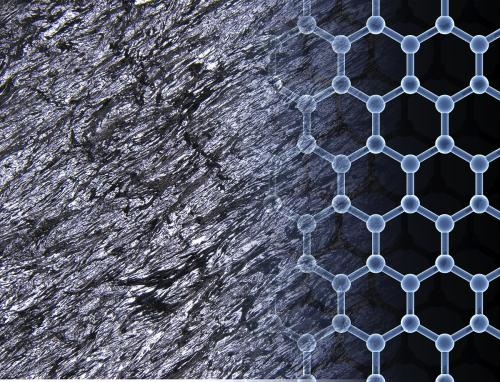
Graphene has excellent mechanical, thermal, electrical, optical, and tribological properties, and is widely used in materials science, biomedicine, batteries, composite materials, and antifriction lubrication. Graphene material itself has high mechanical strength, extremely low interlayer sliding friction and good chemical stability, which determines that it can be used as a potential lubricating material. It can be used as a solid lubricating material to reduce the amount of wear of the material can also be used as a liquid lubricant additives to enhance the anti-friction and anti-wear properties of the lubricant.
After the graphene forms a lubricating film on the friction surface in the solid lubricating material, the atomically smooth surface and the lower interlayer shear strength make the graphene lubricating film can effectively reduce the friction between the surfaces.
However, the strong π-π bonds between graphene sheets make them easy to reunite and delaminate, so the dispersion of graphene in liquid lubricants limits the further development of graphene.
In order to solve this problem,We used chemical methods to modify graphene to make it oil-soluble, and prepared oil-soluble graphene products.
Preparation of Oil-soluble Graphene
Step One
Graphene oxide was first prepared. The schematic diagram of the obtained product is as follows:
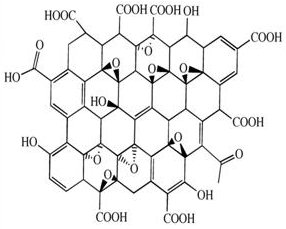
Schematic diagram of graphene oxide structure
Step 2
The graphene oxide was modified by chemical reaction to change it from water-soluble to oil-soluble. After the reaction, the black solid-oil-soluble graphene (MG) was obtained after post-treatment.
The analysis shows that the prepared graphene oxide (GO) and oil-soluble graphene (MG) are 2-5 μm in two-dimensional size and 2.6 and 3.1 nm in thickness, respectively. In the FTIR spectrum of MG, C- H typical peaks can be observed at the cm-1 of 2914 and 2846, the peaks at the cm-1 of 1457 and 1368 represent CH3, and the typical peak of (CH2)n at the cm-1 of 710. These results confirm the existence of typical oil-soluble groups on graphene.
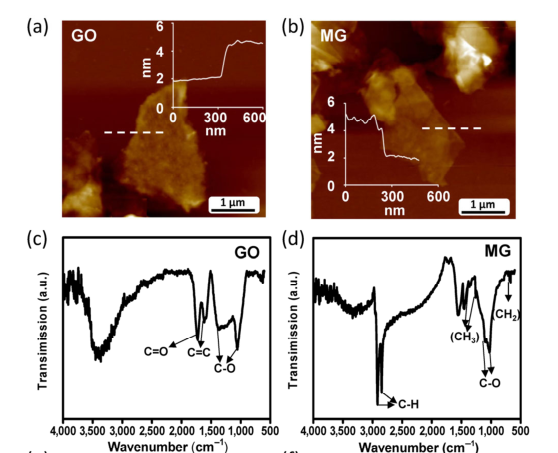
AFM and FTIR spectra of graphene oxide and oil soluble graphene
science and technology innovation
After obtaining oil-soluble graphene, the small partners of the lubrication institute did not stop the pace of exploration, but carried out a series of experiments, and finally came to a better use of oil-soluble graphene.-Oil-soluble graphene/dispersant.
Oil-soluble graphene/dispersant means that we use oil-soluble graphene while compounding dispersant to achieve better use effect.Please follow our experimental results for details ~
Oil-soluble graphene and oil-soluble graphene/dispersant were added to the base oil (PAO6) to make them stably dispersed by mechanical stirring and ultrasonic treatment. The results showed that the stable dispersion time of oil-soluble graphene and oil-soluble graphene/dispersant in the base oil (PAO6) was 30 days and 120 days respectively.
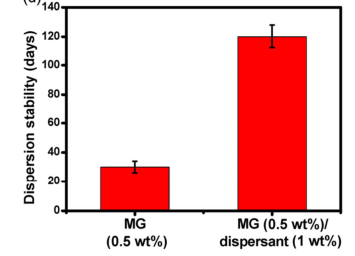
Stability of oil-soluble graphene and oil-soluble graphene/dispersant
When the oil-soluble graphene was added at 0.5 wt% in the base oil (PAO6), the lowest coefficient of friction was about 0.12, resulting in a reduction of about 33.3% compared to the pure base oil (PAO6)(about 0.18). The coefficient of friction of PAO6 with the addition of oil-soluble graphene/dispersant is about 0.10, which is 16.7% lower than the coefficient of friction of base oil (PAO6) with the addition of oil-soluble graphene (-0.12). These results show that the oil-soluble graphene dispersed in the base oil (PAO6) has excellent friction reducing properties.
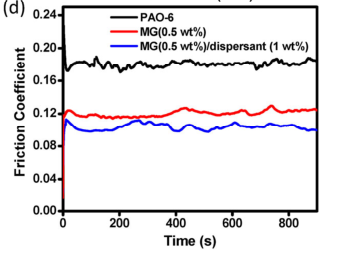
Friction Coefficient of Lubricating Oil and Additive
The wear depths of oil-soluble graphene-containing base oil (PAO6) and oil-soluble graphene/dispersant-containing base oil (PAO6) were 47 nm and 21 nm, respectively, which were 79% and 90% lower than that of pure base oil (PAO6)(221 nm). The use of oil-soluble graphene and oil-soluble graphene/dispersant in the base oil (PAO6) can prevent severe wear of the friction surface during sliding.
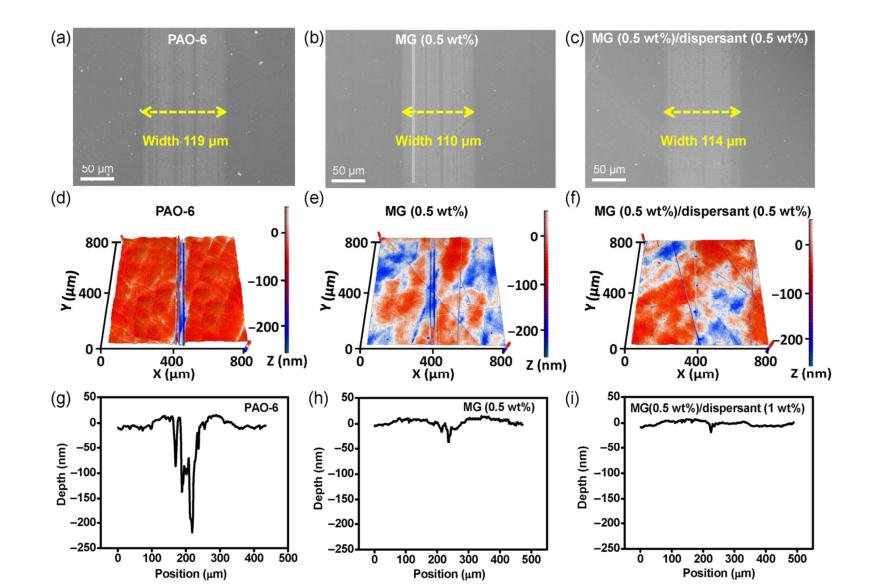
Friction Surface Topography
Oil-soluble graphene with the addition of dispersants can also improve the tribological properties of commercial oils. The friction coefficient of 10W-40 oil after adding oil-soluble graphene/dispersant is about 0.10, which is 9.1% lower than that of pure 10W-40 oil. The wear trace depth of 10W-40 oil containing modified oil-soluble graphene/dispersant is about 39 nm, which is 32.8% lower than that of pure 10W-40 oil
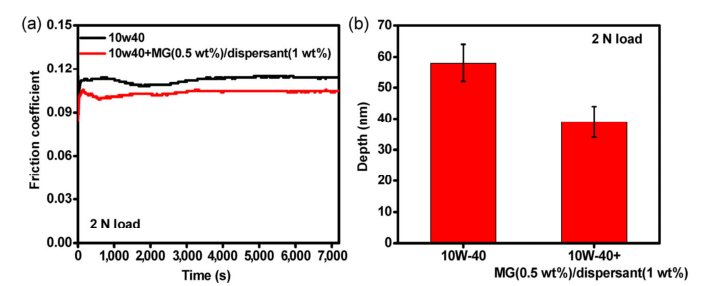
10W-40 tribological data before and after adding additives
Advantages of oil-soluble graphene
01 Better dispersion stability
In the preparation process, by using chemical synthesis methods to modify graphene oxide, the finalOil-soluble graphene has good dispersion stability.At the same time, the selection of polymer ashless dispersant and its compounding,The stable dispersion time of oil-soluble graphene is further prolonged.Similar products use polymer stabilizers (such as PVP, PSS, PDDA) to disperse graphene, but there are problems such as large amount of dispersant, the effect is not obvious, and the stable dispersion time of graphene is difficult to exceed 30 days.
02 Better anti-friction and anti-wear effect
Another advantage of modification by chemical synthesis is that:The oil-soluble graphene can be imparted with a better antifriction and antiwear effect.Compared with similar products, the oil-soluble graphene prepared by lubrication is added to the base oil (PAO6) at the same dose, and the wear depth is only 80% of that of similar products.
03 Shorter preparation time
The preparation process is simpler and the preparation time can be greatly shortened.Compared with other processes, the reaction temperature is effectively reduced and the reaction time is shortened, which is conducive to the industrial production of the product.
application value
Oil-soluble graphene is used in magnetorheological fluid, which has good anti-friction and anti-wear effect and can effectively improve the performance of magnetorheological fluid. In view of the fact that magnetorheological fluids are widely used in machinery, transportation, ships, aerospace, vehicles, robots, bridges, construction and other fields of magnetorheological dampers (damping effect), the improvement of its performance will actively promote the development of related industries.
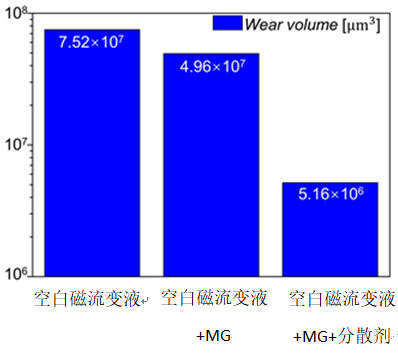
Comparison test of magnetorheological fluid
In addition, the oil-soluble graphene developed by Lubrication can be applied to grease and related lubrication products, which can further improve its performance in terms of friction reduction and anti-wear.
Lubrication Technology Research Institute
Lubrication is a high-end metal processing fluid, lubricants and core functional additives research and development and industrialization as one of the main objectives of the research and development institutions. With Academician Luo Jianbin as the leader, the research team is composed of the State Key Laboratory of Tribology of Tsinghua University and Tianjin High-end Equipment Research Institute. It has long been engaged in nano-lubrication theory, water-based lubrication research and application technology development of ultra-precision metal surface processing lubricating fluid, and is at the leading level in the research and development fields of nano-lubrication film formation and nano-scale ultra-precision surface processing.
Under the good platform foundation and R & D strength, the team adheres to the principle of "innovation leading, excellent quality, customer first, and honest service", constantly develops new technologies and new processes, improves the scientific and technological content of products, and gradually compares with the world's advanced level; at the same time, deeply excavate the product application space, expand the application field, and provide customers with better products and services.
Technical docking and business negotiation
Contact: Zhang Jiping
Telephone: 15802225427
Email: zhangjp@tsinghua-tj.org
Source | Institute of Lubrication Technology
Editor | Zhang Shu
The final interpretation of the above related technologies belongs to the Institute of Lubrication Technology.

Address: Buildings 4 and 5, Kechuang Huigu Park, Hongshun Road, Huaming High-tech Zone, Dongli District, Tianjin
Tianjin High-end Equipment Research Institute, Tsinghua University, Copyright
Website Construction: China Enterprise Power Tianjin
sweep
Pay attention to the official WeChat public number