




NEWS
News Center
The research group of He Yongyong, the Department of Mechanical Engineering of Tsinghua University and the Executive Vice President of our institute, has made new progress in the study of interfacial friction mechanism in the field of liquid lubrication.
The research group of He Yongyong, the State Key Laboratory of Tribology, Department of Mechanics, Tsinghua University, published a paper "Coupling effect of boundary lubrication film and dynamic pressure lubrication film" (boundary tribofilm and hydrodynamic film) in Cell Reports Physical Science, which is a subsidiary of Cell. From the angle of the coupling behavior of boundary lubrication film and dynamic pressure lubrication film, for the first time, the inverse correlation phenomenon of friction and wear performance of liquid lubrication interface is systematically explained, the internal coupling mechanism of boundary lubricant film and dynamic pressure lubricant film is clarified, and the coupling model of the two is proposed. This study is of great academic and technical value for the study of friction theory, especially for the correct understanding of the essential relationship between friction and wear and the controllable design of interface lubrication systems.
It is found that under the same experimental conditions, the friction coefficient of graphene and hexagonal boron nitride in the grease lubrication state is significantly lower than that of molybdenum disulfide and tungsten disulfide (better anti-friction performance), but the corresponding wear depth of graphene and hexagonal boron nitride is significantly greater than that of molybdenum disulfide and tungsten disulfide (worse anti-wear performance). This very interesting inverse correlation between friction and wear has led researchers to think about two basic problems. First, from the perspective of wear, why molybdenum disulfide and tungsten disulfide corresponding to the friction coefficient is larger, but the wear is smaller? Second, from the perspective of friction, wear is an important origin of friction, graphene and hexagonal boron nitride wear is more serious, why the friction coefficient is smaller?
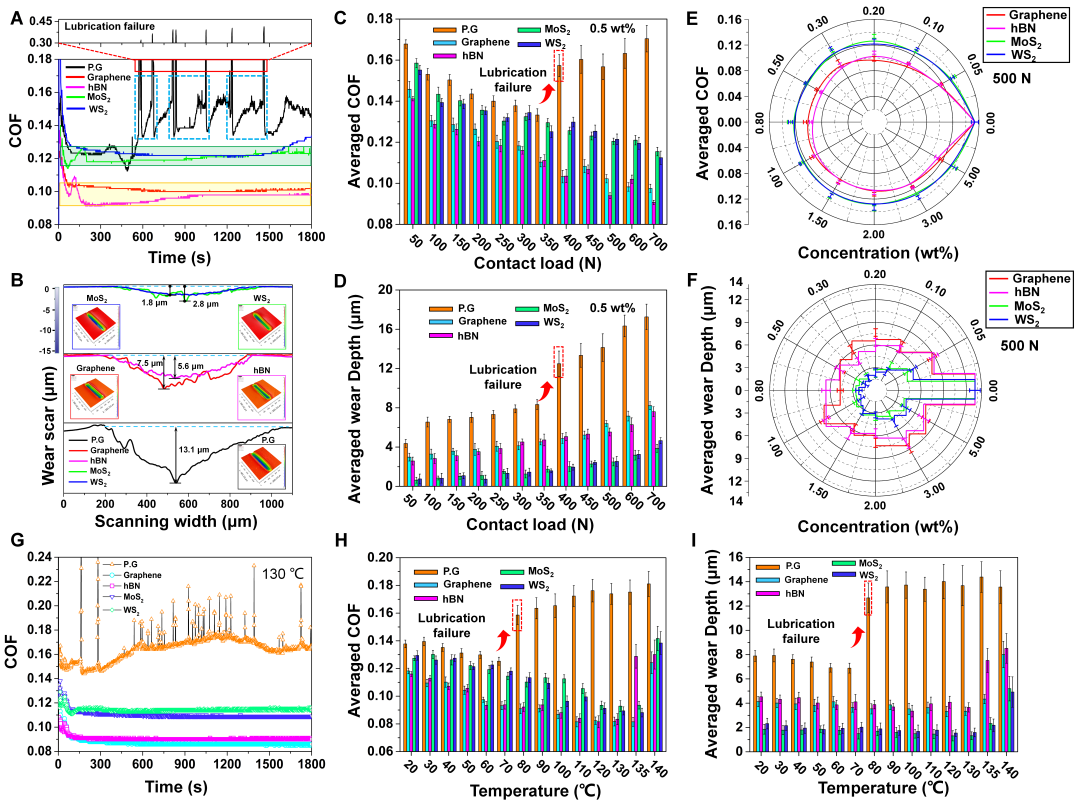
Fig. 1 Tribological properties of graphene, hexagonal boron nitride, molybdenum disulfide and tungsten disulfide. The friction coefficient of graphene and hexagonal boron nitride is significantly lower than that of molybdenum disulfide and tungsten disulfide, but the depth of wear scar is significantly larger than that of molybdenum disulfide and tungsten disulfide.
The friction domain of the liquid lubrication interface is mainly composed of boundary lubricant film and dynamic pressure lubricant film, and the coupling effect of the two films dominates the anti-friction and anti-wear performance of the interface. It is found that the boundary lubricant film thickness of molybdenum disulfide and tungsten disulfide is about 200-250 nm, while the boundary lubricant film thickness of graphene and hexagonal boron nitride is about 30-60 nm. Although the friction coefficient of molybdenum disulfide and tungsten disulfide is high, the ultra-high robustness of the boundary lubricant film ensures its superior anti-wear performance. Under the induction of mechanical stress and frictional heat, the tribochemical reaction of molybdenum disulfide and tungsten disulfide nanosheets occurs at the lubricating interface. A covalent bond is formed between the sulfur atom and the iron atom at the friction interface, resulting in iron sulfide and iron sulfate, which greatly enhances the adhesion characteristics of the molybdenum disulfide and tungsten disulfide nanosheets at the interface, thereby enhancing the robustness of the friction interface boundary lubrication film.
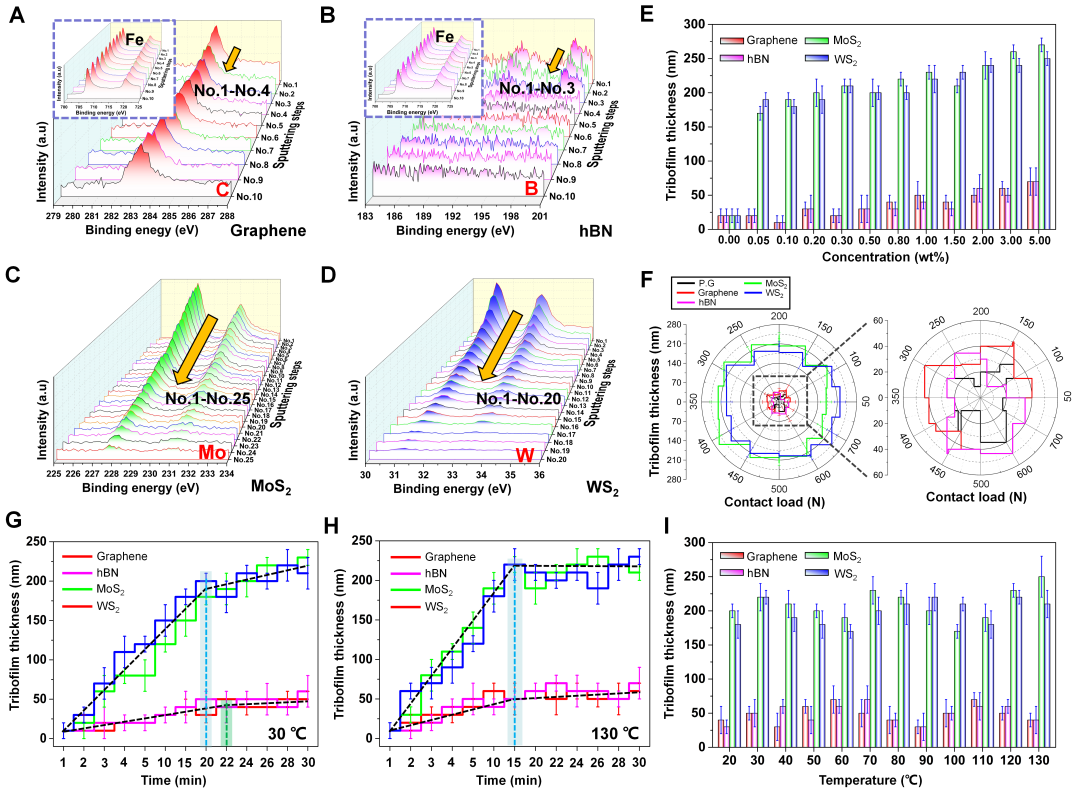
2 Quantitative measurement of boundary lubricant film thickness by AIS and XPS
The researchers further explored the hydrodynamic lubricant film behavior in the interfacial friction domain through experiments and computational fluid dynamics (CFD) simulations. In the liquid lubrication state, the interface friction mainly comes from two aspects, one is the contact (wear) of the interface roughness peak, and the other is the internal shear force (viscous resistance) of the lubricating medium. It is found that the dynamic pressure film thickness of graphene and hexagonal boron nitride is significantly smaller than that of molybdenum disulfide and tungsten disulfide. The flow rate of the dynamic pressure lubrication film increases with the decrease of the film thickness, so graphene and six-party boron nitride significantly enhance the shear thinning phenomenon of the grease, the corresponding dynamic pressure lubrication film has a lower viscosity, and the friction force generated by the viscous resistance is smaller.
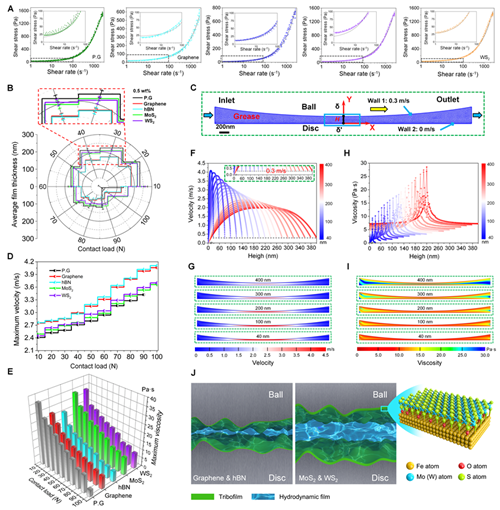
Fig.3 Effect of two-dimensional materials on film thickness, flow rate and viscosity of hydrodynamic lubrication
The first author of the paper is Jin Bao, a 2021-level doctoral student in the Department of Mechanical Engineering, and the corresponding authors are He Yongyong, a researcher at the State Key Laboratory of Tribology, Department of Mechanical Engineering, Tsinghua University, and Zhao Jun, an associate professor at Beijing University of Chemical Technology. The work was supported by the National Natural Science Foundation of China (51905027), the National Key R & D Program (973)(2014CB046404) and the Tribology Science Foundation of the State Key Laboratory of Tribology (SKLTKF18A02).
Paper Information
Bao Jin, Guangyan Chen, Jun Zhao, Yongyong He, Yulong Li, Jianbin Luo, Coupling effect of boundary tribofilm and hydrodynamic film, Cell Reports Physical Science, 2022, 100778.
Original link:
https://doi.org/10.1016/j.xcrp.2022.100778
Introduction to Periodicals
Cell Reported Physical Science (Cell Reports Physical Science) is the Cell Press Publishing Group's high-impact comprehensive magazine in the field of material science, which aims to publish major cutting-edge research advances in physics, chemistry, energy science, materials science, and interdisciplinary fields.
Contributor: Jinbao
Editor: Yang Fan
Reviewed by: Hu Chuxiong
Reprinted | Department of Mechanical Engineering, Tsinghua University

Address: Buildings 4 and 5, Kechuang Huigu Park, Hongshun Road, Huaming High-tech Zone, Dongli District, Tianjin
Tianjin High-end Equipment Research Institute, Tsinghua University, Copyright
Website Construction: China Enterprise Power Tianjin
sweep
Pay attention to the official WeChat public number