




PARTY BUILDING
party building work
Five points to watch! Please keep this "viewing guide" for China's first autonomous Mars exploration mission
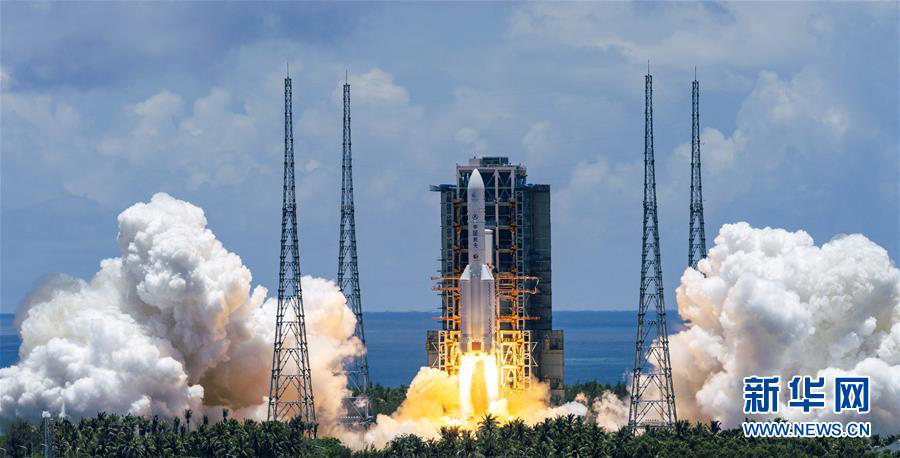
On July 23, the Long March 5 Yao-4 carrier rocket was ignited and lifted off at China's Wenchang Space Launch Site to implement my country's first Mars exploration mission (Tianwen 1 mission).
The world's first step to achieve Mars exploration "around, on, patrol", the maximum distance of 0.4 billion kilometers how to achieve ultra-long distance deep space communication? Mars probe after the launch will experience what kind of process to reach Mars? 23, China's first Mars exploration mission "Tianwen 1" probe successfully launched in China's Wenchang space launch site, the reporter for you to sort out a "viewing guide" for the Mars exploration ".
For the first time in the world: one step to achieve "around, with, patrol"
Mars is the planet with the closest and most similar environment to the earth, and has always been the preferred target for human beings to carry out deep space exploration out of the earth moon system. At present, human beings have carried out 44 exploration missions to Mars, of which 24 have been successful. Mars is one of the planets with the deepest understanding of human beings.
Through previous exploration of Mars, people have found evidence of the existence of water on Mars. The question of whether there are conditions for life on Mars and whether Mars is the past or the future of the Earth has been haunting scientists and has become a major scientific question for Mars research.
With the super lineup of Mars orbiter and landing rover, China's first Mars exploration mission can achieve the three goals of "orbiting, landing and patrolling" of Mars in one step, which has never been achieved by other countries in the first Mars exploration mission.
Compared with the lunar exploration, Mars exploration mission is more difficult. Because Mars is relatively far away from the earth, it puts forward high requirements for the technical fields of launch, orbit, control, communication and power supply.
Wang Xianzhong, deputy chief engineer of the "Tianwen No. 1" probe system and chief designer of the surround device of the Eighth Academy of China Aerospace Science and Technology Corporation, introduced that the development team has not only overcome key technical difficulties such as Mars brake capture and long-term autonomous management, but also realized the ultra-long-distance measurement and control communication between ground fires.
A kick to the door: brake capture "step on the brake"
Mars capture is one of the most technically risky and important links in Mars exploration missions. In the process of Mars probe flying from Earth to Mars, there is only one chance to be captured by Mars' gravity. Using the rocket boost, the probe gained the energy to get rid of the earth's gravity, and using a well-designed transfer orbit, the probe was able to finally reach the vicinity of Mars smoothly.
However, limited by the limited propellant carried, the orbiter must seize the only opportunity to brake and capture Mars after reaching Mars. When the Mars exploration mission was captured, the probe was only 400 kilometers away from Mars. At this time, the speed of the probe relative to Mars was as high as 4 to 5 kilometers per second. If you are not careful, it will hit Mars or fly away. The success of the capture becomes The key to the success of the Mars exploration mission.
In this braking capture process, the Mars orbiter faces many challenges. Since the detector is 0.193 billion kilometers away from the earth at the time of capture and the one-way communication delay reaches 10.7 minutes, the ground cannot monitor this braking process in real time, and can only rely on the detector to independently execute the capture strategy. In addition, during the braking process, the orbiter needs to complete the corresponding processing autonomously in case of its own sudden situation, so as to ensure the success of Mars capture to the maximum extent.
Liu Tongjie, spokesman for the first Mars exploration mission and deputy director of the Lunar Exploration and Space Engineering Center of the National Space Administration, said that during the capture process, the Mars orbiter needs to accurately ignite and brake. If the brake ignition time is too long and the probe speed drops too much, the probe will hit Mars head-on. If the brake ignition time is too short and the probe speed is too fast, it will fly away from Mars and cannot enter orbit, this puts high demands on the autonomous navigation and control of the surround device.
0.4 billion km: ultra-long-range deep space communications
During the ring fire flight phase, due to the operation of the earth and Mars, the probe is as far as 0.4 billion kilometers away from the earth. In order to solve the problem of ultra-long-distance communication, the Mars orbiter is equipped with an integrated measurement and control data transmission system, which achieves the goals of light weight, high communication efficiency and reliable communication link.
In order to compensate for space attenuation, the Mars orbiter is equipped with a high-power traveling wave tube amplifier and a large-diameter drivable directional antenna, which greatly improves the probe's communication capability to the earth.
Autonomous management: exploring Mars requires a thinking "brain"
Normally, satellites orbiting the earth are controlled by a ground control center based on the real-time status of the satellite and mission requirements. However, due to the long distance from the probe to the earth and the large communication delay, the Mars orbiter cannot completely rely on ground commands to deal with emergencies on the star in real time.
In addition, the communication between the surround device and the ground station has its space particularity, resulting in communication interruption ("day-to-day") of up to 30 days, during which it is necessary to rely on itself to complete long-term task management, and adjust the antenna direction in time after the "day-to-day" to quickly re-establish contact with the ground.
It is reported that in the key nodes of the Mars exploration mission, autonomous management also needs to play a huge role. When the Mars rover is separated from the landing rover, the orbiter needs to complete three attitude adjustments and two orbit changes in a short time, which requires very high accuracy in attitude and position measurement and control. It is relying on the autonomous on-orbit management system that the Mars orbiter can accurately and timely complete the separation from the landing rover.
Various Loads: Take a "Chinese Makeup Photo" of Mars"
The Mars orbiter carries a total of seven payloads, which can carry out scientific exploration of ground fire transfer space, Mars orbital space, the surface of Mars and its subsurface, obtain interplanetary radio spectrum data, Mars surface images, Martian geological structure and topography, Martian surface structure and groundwater ice distribution, Martian mineral composition and distribution, Martian space magnetic field environment, near-Martian space environment and ground fire transfer orbit energy particle characteristics and their changes.
Among them, the medium-resolution camera can carry out a general survey of the topography of Mars around the world, and the high-resolution camera can carry out a detailed survey of local high-resolution topography in key areas of Mars, which will take "fixed photos" from China for Mars ".
Source: Xinhua

Address: Buildings 4 and 5, Kechuang Huigu Park, Hongshun Road, Huaming High-tech Zone, Dongli District, Tianjin
Tianjin High-end Equipment Research Institute, Tsinghua University, Copyright
Website Construction: China Enterprise Power Tianjin
sweep
Pay attention to the official WeChat public number