




PARTY BUILDING
party building work
No urgent work, no urgent money, no need-How did the Shaanxi-Gansu-Ningxia Border Region Government live a tight life during the Yan'an period
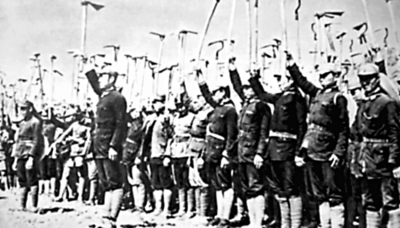
In 1943, Yan'an, Shaanxi Province to carry out the mass production movement of the oath of the General Assembly
After the outbreak of the Southern Anhui Incident in 1941, the Kuomintang government implemented a financial blockade policy of cutting off confessions and postal services in the Shaanxi-Gansu-Ningxia Border Region. The Border Region government led by the Communist Party of China encountered unprecedented financial difficulties. The Communist Party of China has led the broad masses of people to grasp self-reliance on the one hand, to strengthen troops, simplify administration, and to implement savings on the other. The government has taken the lead in living a tight life and striving to be a model for leading everyone to tide over difficulties.
Issuing national salvation bonds to defend the economy of the border region in order to smash the economic blockade of the Japanese aggressors and the Kuomintang.
On August 22, 1940, Chairman Mao pointed out in a letter to Xie Juezai, Secretary-General of the Border Region Government: "The Border Region has major political, military, economic, financial, anti-rape, and cultural tasks. In terms of sudden changes, economic construction is the center of other items. With clothing, food and housing, everything is active and easy to handle." Later, in his speech on "Economic and Financial Issues", he emphasized that "We must pay attention to economic work. Leaving economic work and talking about education or study is just superfluous empty talk. Leaving economic work and talking about'revolution' is just a revolution. The life of the Department of Finance and the life of the enemy will not be hurt by you at all." In order to defend the economy of the border region and smash the economic blockade of the Japanese aggressors and the Kuomintang, the Shaanxi-Gansu-Ningxia border region government issued the "Shaanxi-Gansu-Ningxia border region government construction national salvation bond" in 1941. the original plan was to issue 5 million yuan. due to the enthusiastic support of the people in the border region for the government, the actual amount completed was 6.18 million yuan. the bond was issued in 5 million yuan for economic construction investment and the remaining 1.18 million yuan for expenditure. The issuance and use of public bonds adhere to the principle of voluntary subscription and construction. In agriculture, it is mainly used to repair water conservancy, set up model farms, purchase cotton seeds, open forest farms, lend low-interest loans to immigrants and poor farmers, improve agricultural tools and seeds, improve livestock breeds, and train veterinarians. In industry, it is mainly used to set up various factories manufacturing daily necessities, loans to private mining and industrial enterprises, and production cooperation, as a result, all kinds of supplies will gradually not have to be bought outside the border region. In terms of commerce, it is mainly used to develop consumer cooperatives and help public and private shops. This public debt was repaid twice in 1942 and 1943, with a total of more than 130 million yuan in two years, and was fully repaid in 1944 together with the interest payable in this year of 5 million yuan.
With indirect taxes as the main source of tax, small traders are exempt from tax and reduce taxes, "great power to pay attention to the construction of the people's economy"
In response to the contradiction between "saving the country with more public food" and "saving the people with less private food", Chairman Mao pointed out in his speech at the meeting of senior officials in the Shaanxi-Gansu-Ningxia Border Region: "If our party and government do not pay attention to mobilizing the people and help the people develop Agriculture, industry and commerce, the people's lives can neither be improved, nor can they be supplied for the needs of the war. If the hearts and minds of the army and the people cannot be consolidated, there will be no way to talk about it. Therefore, it is a very important task for the party and the government to pay great attention to the construction of the people's economy."
At that time, the Shaanxi-Gansu-Ningxia Border Region government had four types of taxes:(1) excise tax (import and exit tax);(2) business tax (commercial tax);(3) livestock commission tax (livestock food handling fee);(4) salt tax. The first three are levied in the tax bureau, and the latter is the production tax on salt. Salt is levied only once in circulation in the whole border area and is levied by the Salt Bureau. There are several typical characteristics of the tax revenue of the Shaanxi-Gansu-Ningxia Border Region Government: first, the goods tax (I. e. tariff) occupies the most important position. In 1941, excise tax accounted for 74% of the total tax revenue for the whole year, in 1942, 84%, commercial tax accounted for only 19% of the total tax revenue for the whole year in 1941 and 13% in 1942, which fully shows that the main source of tax revenue in the border region is indirect tax rather than directly levying income tax from businessmen. Second, there is no tax for industry, whether private, public or public or public-private. Third, such as cotton, textiles, paper and industrial raw materials are completely tax-free. In order to make the business tax more fair and reasonable, from the simple apportionment to the net income as the progressive collection standard. For example, the merchants in Yan'an City are divided into 10 grades and 30 grades. In the process of collection, the interests of small traders are often taken into account, either tax-free or light taxes. These facts fully demonstrate the principle that the tax policy of the border region takes into account the affordability of the people and the interests of all sectors.
Strict diligence and thrift, government spending cut by half
As early as August 1937, the Northwest Office of the Central Provisional Government, the predecessor of the Shaanxi-Gansu-Ningxia Border Region Government, made a decision: the government implements the principle of the most frugality. The office expenses of the county government are stipulated to be 30 yuan per month, and even if the office expenses of the administrative commissioner are increased at a discretionary amount, the maximum amount shall not exceed 50 yuan per month. As for the public expenses of the district-level government, it is stipulated that the monthly expenses are from 3 yuan to 4 yuan, and the township government's expenses are subsidized by the border government to 6 yuan every month, including office expenses, and the township head does not pay for food, shoes and socks. The chairman of the border district government receives a monthly allowance of 5 yuan and the head of the township receives a monthly allowance of 1.5 yuan. The monthly office expenses of the township government are only 1 yuan. In the whole township government, only the head of the township is separated from production and has no salary. Apart from the allowance of one yuan and fifty cents, the daily public grain is one catty and four ounces, and the vegetable money is four cents. Except for the head of the township, other committee members, administrative village directors and village heads do not have any salaries and allowances.
In 1943, the "Outline for the Implementation of Simplified Administration in the Shaanxi-Gansu-Ningxia Border Region" stipulated: (1) Do not do urgent tasks, do not use money that is not urgent, and must strive for a reasonable economy in urgent and urgent needs; (II), in addition to ensuring supplies, other funds, All must be saved. Advocate thrift and plain living, avoid extravagance and waste; Evacuate organs, adjust cave dwellings and stop construction; Reduce tolerance and promote hands and feet. The implementation of food stamps to avoid the waste of double grain; Pay attention to the saving of a piece of paper, a piece of cloth, a little lamp oil and a match. Cherish every public property and make it more useful. No additional budget, and establish a strict audit system; (III) focus on urgent economic undertakings, implement the economic accounting system; strengthen its management and supervision, and carry out the struggle against corruption and waste; (IV) cherish the people's power, control mobilization, and do not waste a person's power or animal; (V) adhere to the style of honesty and economy, and strictly oppose corruption.
The Department of Finance of the Border Region has actively implemented the contents of the outline from the perspective of budget saving: first, all the cloth of more than 60000 people is woven by themselves without buying a piece of cloth, and all wear homespun, which can save 10 million yuan; The second is to determine the printing and publishing, ordnance equipment, communication materials and other plans and the budget for government and military affairs in order to save money. Third, the middle school students of the children in the border region should bring their own clothes and food, and the government. Fourth, personal savings and public savings. In terms of personal savings, everyone should work out personal savings methods according to their own specific conditions. In terms of public savings, special attention should be paid to the savings in food, bedding, construction, and utensils.
In 1944, the government of the Shaanxi-Gansu-Ningxia Border Region proposed that only half of the government's office funds should be paid for a trial period of three months. As a result, most agencies could save money and reduce waste. Only a few agencies ate "hens" (old capital). According to statistics, in 1945, the whole border region saved 2 billion yuan, enough for the public to live on for one year. In the words of Lin Boqu, chairman of the government of the Shaanxi-Gansu-Ningxia Border Region, it is "the finance of the border region is 'taken in the right way and used appropriately. 'In terms of quantity, there is no such poor and incorruptible government in the world, and in terms of content, there is no such rational and measured finance in the world."
Three times to streamline administration and build a conservation-oriented government
In 1942, Chairman Mao stressed at the meeting of senior cadres in the Shaanxi-Gansu-Ningxia Border Region: "All the comrades in the anti-Japanese base areas must realize that the material difficulties in the future are bound to be even greater than the present, and we must overcome this difficulty. One of our important methods is to streamline our military and government ...... If we reduce our own institutions and make our military and government simpler, our war institutions will still have strength although they are small; by overcoming the contradiction of big fish and small water and making our war institutions suitable for the situation of war, we will appear more and more powerful, and we will not be defeated by the enemy, but will finally defeat the enemy." Commander-in-chief Zhu De pointed out at the whole financial meeting: "Now that there are too many people, it is not easy to be a family because there is no money. Egalitarianism makes many things impossible for us. Now we have to change this thinking, so we must clarify the system and distinguish people's positions. Everyone does not do things, as long as they are officials, they must study, and they must have food and clothing."
the shaanxi-gansu-ningsia border region government system has carried out three times in succession the campaign of streamlining troops and administration. The first campaign to streamline the administration began in December 1941 and ended in April 1942. The main achievement was the reduction of some parallel branches and thousands of staff. Among them, "the first level of the border region was reduced to 82%, and the special department, county and township levels were reduced to 70%." The shortcomings are "lack of experience, insufficient understanding of the necessity of streamlining work, little improvement in thinking, and little improvement in work." The second streamlining activity started in June 1942 and ended in August 1942. The focus of this streamlining was to establish some work systems of "co-operation, division of government affairs and affairs, strengthening of subordinates, and improving the functions and powers of the county government." the result of streamlining is that "the system has been established and improved, and the higher-level organs have also streamlined some personnel, but they have enriched the grass-roots organizations, and the actual streamlining is not much." The third streamlining activity started in January 1943 and ended in January 1944. This streamlining activity followed the policy of "strict, thorough and universal, rather than perfunctory, painless and partial" put forward by Comrade Mao Zedong, and conscientiously implemented the links of "summing up experience, unifying understanding, preparing documents, listening to instructions and implementing them, unlike the previous two activities of streamlining troops and streamlining administration, which were only carried out in the government system, the third one was carried out in an all-round way in the government system, the Party Central Committee system, the Northwest Bureau system and the military system. After one year's efforts, the five goals of simplification, unification, efficiency, economy and opposition to bureaucracy have been basically achieved.
In short, in the face of the enemy's military friction and financial blockade, the Shaanxi-Gansu-Ningxia Border Region Government under the leadership of the Communist Party of China has conscientiously implemented streamlining troops, streamlining administration, strict economy and all other measures to save and make sufficient people's power. At the same time, from the daily issues of dressing and eating, we have told the people with realistic actions and concrete facts that the party and the government are connected with them and share weal and woe, the party and the government are not only loyal protectors of the people's interests in the face of the enemy, but also a model of gritting their teeth and enduring hardships in the face of difficulties, planning and methods to lead everyone through the difficulties. The Communist Party of China tells everyone with its practical actions: "The difficulties encountered at present are the difficulties before victory. The long night is about to dawn. As soon as the current darkness is over, the sky will be clear."
Source: Beijing Daily
Previous Page
Next Page
Previous Page
Next Page

Address: Buildings 4 and 5, Kechuang Huigu Park, Hongshun Road, Huaming High-tech Zone, Dongli District, Tianjin
Tianjin High-end Equipment Research Institute, Tsinghua University, Copyright
Website Construction: China Enterprise Power Tianjin
sweep
Pay attention to the official WeChat public number