




PARTY BUILDING
party building work
Red Army note painted by the door god
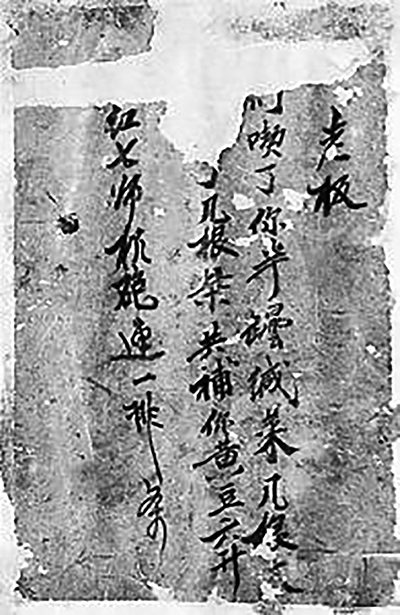
A note left by the Red Army to fellow villagers.
"Boss:
We ate half a jar of pickles, several sticks of pickles, and several sticks of firewood to supplement six litres of soybeans.
Red 7th division machine gun company row by row"
This is a note left to fellow villager Huang Tangzhen when the Red Army passed through Huangjiaba in Pengshui County, Sichuan Province. Although the note has been yellowed and damaged, there are only 30 words on it. But these short few crosses are full of strong military and civilian fish and water conditions, demonstrating the fine style of the Red Army commanders and fighters in strictly enforcing mass discipline.
In the summer and autumn of 1933, Chiang Kai-shek launched the fifth "encirclement and suppression" campaign against the Central Soviet Area, and at the same time mobilized a large number of troops to attack the base areas on the border of Hunan and Hubei. The Third Army of the Chinese Workers' and Peasants' Red Army (referred to as the Red 3rd Army), led by commander he long and political commissar Guan Xiangying, carried out arduous guerrilla warfare on the border of Hunan, Hubei, Sichuan and Guizhou. At that time, due to the lack of a solid revolutionary base area, the Red Army's personnel supply, ammunition and weapons, and the placement of the wounded were very difficult.
On May 8, 1934, He Long and Guan Xiangying led the Red 3rd Army to attack Pengshui County in the rain, annihilating a battalion of the 13th Brigade of the 21st Army of the Kuomintang, capturing more than 400 enemies, surrendering more than 300 guns, and successfully occupying the county seat. Subsequently, the Red 3 Army crossed the Wujiang River to the west and marched in the direction of eastern Guizhou. On the march, he entered the Huangjiaba area where the poor Miao and Han nationalities live together. Due to the inconvenience of local transportation, the blockage of information, and the rumor propaganda of the reactionary government, the local people did not understand what kind of army the Red Army was, and they went out with their families to "flee". For a while, the whole village was deserted.
The Red Army officers and soldiers of the 1st platoon of the 7th Division of the Red Army 3rd Army saw that the walls of the houses were covered with reactionary slogans, and they knew that the local villagers had mistakenly believed the rumors, regarded the Red Army as an old warlord, and fled their homes one after another. After days of marching and fighting, the Red Army had already eaten up the dry food it carried. The common people did not go home for a long time. The village did not even have a place to buy things. The soldiers were hungry. At this time, the soldiers saw the door of a house open, like someone, they knocked on the door, but did not get any response. In desperation, they had to push the door into the house. They found half an altar of pickles under the stove and a few green onions in the yard. So they got some firewood and made a meal of pickles and green onions. Before leaving, the soldiers not only carried water to fill the water tank in the house, and cleaned the house, but also left 6 liters of soybeans as compensation for the fellow villagers whose names they did not know. At the same time, they posted this on the door panel. Note to explain the situation to the people.
After the Red Army left, the owner of the house, Huang Tangzhen, "took refuge" and returned home. He saw a red note posted on his door and excitedly pushed open the door. What he saw was a neat courtyard and full of water tanks. He held in his hand the red army left soybean, a warm current into the heart. Only then did he truly realize that the Red Army is the people's army, a force with iron discipline. Feeling the difference between "these soldiers", Huang Tangzhen decided to save the note as a permanent memorial. But because the paper is thin and sticky, the note will tear when it is removed. If it is not removed, the local area is under the rule of the Kuomintang regime, and his life and note will be difficult to keep. So Huang Tangzhen bought a door god painting and pasted it on the door panel, just covering the note.
From then on, Huang Tangzhen would carefully remove the old door god painting and replace it with a new one every New Year. At the end of 1949, in the festive atmosphere of celebrating the founding of New China throughout the country, amid the noise of gongs and drums and the sound of firecrackers, Huang Tangzhen excitedly removed the door god painting, revealing the note left by the Red Army.
In 1958, the Party Central Committee and the Central Military Commission called on the people of the whole country to donate revolutionary cultural relics. After learning the news, the old man Huang Tangzhen took the initiative to saw off the door panel with the Red Army note from his own door, handed it over to the Fuling Military Sub-district, and then handed it over to the Military Museum for collection through the former Chengdu Military Region Exhibition Office.
Source: March 27 China Military Network
Previous Page
Next Page
Previous Page
Next Page

Address: Buildings 4 and 5, Kechuang Huigu Park, Hongshun Road, Huaming High-tech Zone, Dongli District, Tianjin
Tianjin High-end Equipment Research Institute, Tsinghua University, Copyright
Website Construction: China Enterprise Power Tianjin
sweep
Pay attention to the official WeChat public number