




PARTY BUILDING
party building work
Why did Mao Zedong say "I can be the Minister of Health"
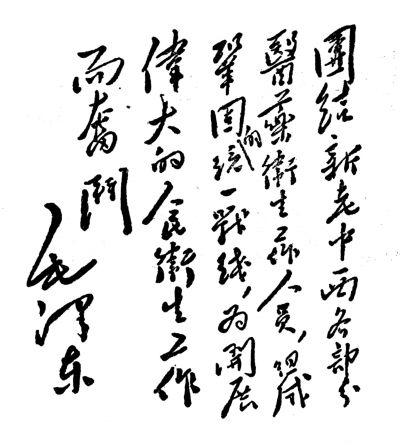
In 1950, Mao Zedong wrote an inscription for the first national health work conference.
In the 1950 s, Mao Zedong once said, "I can be the Minister of Health". There are dozens of national ministries and commissions. Apart from the Ministry of Health, Mao Zedong never proposed to be the minister of any other ministry. Why did he just say "I can be health minister?
The specific situation is as follows: on April 15, 1955, Mao Zedong said to traditional Chinese medicine: "acupuncture is the essence of traditional Chinese medicine. It should be well promoted and studied, and its future is very broad. Some comrades persist in their efforts and have achieved results, which also proves that the policy of traditional Chinese medicine is correct. The experience of Chinese medicine is very rich. It has a history of thousands of years. It is necessary to have comrades to sort it out. This work is difficult to do. First of all, the administrative leadership of the Ministry of Health does not support it. It may be better after July last year, but there is no concrete action. I support it. I can be the Minister of Health and I can do this job. Don't think that I can't do it if I don't understand medicine. This is not a question of understanding medicine, but a question of thinking."
Pay attention to Chinese medicine, pay attention to Chinese medicine
As early as the struggle in the Jiangxi revolutionary base area, Mao Zedong regarded "building a better Red Army hospital" as one of the three methods to consolidate the base area. This Red Army hospital includes traditional Chinese medicine, "treated with both Chinese and Western methods". This is quite different from the Northern Warlords and the Kuomintang government's emphasis on Western medicine, contempt for Chinese medicine, and even want to abolish Chinese medicine.
During the Yan'an period, Mao Zedong not only attached importance to the military and economic work in the border area, but also attached great importance to cultural and health work and paid great attention to traditional Chinese medicine. He proposed that "each township should have a small clinic" in the border region ". In response to the epidemic at that time, he pointed out: "if the Communist Party is in charge here, we should see it and find ways to solve it." How to solve? To play the role of Western medicine, but also to play the role of Chinese medicine. Mao Zedong said, "Comrade Li Dingming, the vice chairman of our border region government, is a Chinese medicine, and some people are studying Western medicine. These two kinds of doctors have never talked about the united front. Let's all study it, do we want a united front? I don't understand Chinese medicine, and I don't understand Western medicine, whether it is Chinese medicine or Western medicine, the role is to cure the disease." "If we can raise the baby and cure the sick, we will reward Chinese medicine and western medicine. We put forward such a slogan: these two kinds of doctors should cooperate." At that time, the Border Region established the Chinese and Western Medicine Research Association. In order to help research and transform Chinese medicine, several proposals for the development of Chinese medicine were also passed. At that time, the lively and prosperous situation in Yan'an was closely related to the emphasis on preventing and treating people's diseases, and the emphasis on the role of Chinese medicine and Western medicine.
After the founding of New China, with the development of Western medicine, many people think that Chinese medicine is unscientific, and the phenomenon of despising or even crowding out Chinese medicine has risen. Mao Zedong clearly put forward the importance of traditional Chinese medicine, the development of traditional Chinese medicine. In December 1953, he told the leaders of the Ministry of Health: We must strengthen the unity of Chinese and Western medicine and have a correct understanding of Chinese and Western medicine. In June 1954, he told Zhou Zezhao, director of the Beijing Hospital, that he attached importance to foreign things and despised things from his own country. Look down on their own things, look down on Chinese medicine, this kind of ideological style is very bad, very bad. He proposed to establish a Chinese medicine research institution, and said: "No one from the Ministry of Health will do this work, I will do it." In July, he clearly pointed out: "The problem of unity between Chinese and Western medicine has not been done well. The reason is that there are big problems in western medicine, mainly because western medicine has a sectarian style. After western medicine was introduced to China, a large number of people ignored traditional Chinese medicine. Traditional Chinese medicine must be taken seriously." After that, the whole country has strengthened the attention and research of traditional Chinese medicine. In December 1955, the Institute of traditional Chinese medicine was established, and then many colleges of traditional Chinese medicine were established in Beijing, Shanghai, Guangzhou, Chengdu and other places.
Traditional Chinese Medicine is an Important Carrier of Chinese Traditional Culture
Why was Mao Zedong so deeply concerned about and valued TCM? The first reason is that he deeply realized that TCM was handed down from the ancestors of the Chinese nation from generation to generation, that it dissolves in the blood and genes of the Chinese nation, and that it is an important carrier of traditional Chinese culture.
Mao Zedong has a famous saying: "Our nation has a history of thousands of years, has its characteristics, and has many precious products." In his eyes, traditional Chinese medicine is a prominent precious product in the thousands of years of history of our Chinese nation, and a large amount of important heritage that can be enjoyed by the whole world. In December 1953, he said: "If we in China have something to contribute to the world, I think Chinese medicine is one." In June 1954, he pointed out: "The issue of Chinese medicine is not just a matter of giving a few people a good view of the disease, but a matter of cultural heritage." In July, he also pointed out: to develop Chinese medical science, "this is not only for China's problems, but also for the world." The issue of traditional Chinese medicine "is a part of the work related to the dignity and independence of our Chinese nation and the improvement of national self-confidence". According to Xu Tao, a doctor close to Mao Zedong, Mao Zedong said: "I think there are two things in China that contribute to the world. One is traditional Chinese medicine, the other is Chinese cuisine, and diet is also culture". Mao Zedong believed that Chinese diet culture also contains the content of diet treatment of traditional Chinese medicine. "Our ancestors also found drugs in the process of searching for food. Medicine and food are of the same origin. Many foods can be used as medicine in traditional Chinese medicine, such as lily, yam, hawthorn, jujube, and even scallion, ginger and garlic can cure diseases". What kind of traditional culture does Chinese medicine convey? From Mao Zedong's talk and narration, we can see the three aspects of "middle", "basic" and "pre.
The first is the "in" word. This "Zhong" is not the "Zhong" of China on the surface, but the "Zhong" of the mean, the "Zhong" of the middle way, and the "Zhong" of the balance of yin and yang ". Mao Zedong pointed out: "It is said in ancient Chinese books that 'medicine is the country, Chinese medicine is the person, and medicine is the disease. 'This means to emphasize the integrity of people, which is consistent with Pavlov's doctrine. Chinese medicine used new technologies thousands of years ago, such as 'sports', 'massage' and so on. Although there are some idealistic things in it, we can extract the good ones from it." That is to say, traditional Chinese medicine is a doctor who does not go to extremes, attaches importance to the balance of yin and yang, and serves people as a whole.
The second is the "word. This is the original, origin, fundamental "this". The country is based on the people, the people are based on food, life is based on qi, and death is cut off. Huangdi Neijing is divided into two parts: Su Wen and Ling Shu. Su Wen is the main question. Mao Zedong attached great importance to this word all his life. He attached great importance to medical treatment and made clear the original situation. He said: "Doctors first diagnose when they see a doctor. Traditional Chinese medicine calls looking, smelling, asking and cutting. It means to find out the condition first and then prescribe it." Everyone has his own particularity, "the difference between things and feelings". In order to treat diseases, doctors should follow the way of harmony but difference, and do a good job in every special "look, smell, ask and cut".
The third word is "pre. This "pre" is prevention, and all doctors and doctors are "pre-established, not pre-determined, waste". In his report on the coalition government at the Seventh National Congress of the Communist Party of China, Mao Zedong proposed that "we should actively prevent and treat people's diseases and promote people's medical and health undertakings." On April 21, 1954, when reviewing and revising the instructions (draft) of the CPC Central Committee on strengthening the work of traditional Chinese medicine, he added "prevention of disease" before "treatment of disease". Mao Zedong knew very well that in the culture of traditional Chinese medicine, the prevention of diseases is the first, and the treatment of diseases is the second; if prevention is not done well, it will be too late to treat the disease.
Traditional Chinese medicine plays an important role in the prevention and treatment of diseases
The oldest and greatest doctors in the world are in China, that is, traditional Chinese medicine in Chinese history, such as Shennong, Zhang Zhongjing, Hua Tuo, Sun Simiao and Li Shizhen. More than 5000 years ago, Yandi and Huangdi were called the ancestors of the Chinese nation, and Yandi and Huangdi were the earliest traditional Chinese medicine in the legend. The Yellow Emperor's Internal Canon, which was called the Yellow Emperor's Medical Canon, was not written by the Yellow Emperor, but it was somewhat related to the legend of the Yellow Emperor. Emperor Yan was known as Shennong because of his contribution to agriculture. Legend has it that he was good at using herbs to cure people's diseases, and finally lost his life by tasting heartbroken grass. He can be said to be the earliest inventor and practitioner of traditional Chinese medicine. Mao Zedong praised him for this. Mao Zedong's famous poem "Send the Plague God", the name of the imperial doctor Hua Tuo entered it: "Green waters and green mountains are in vain, Hua Tuo has no choice but to be a worm!" Mao Zedong was concerned about schistosomiasis, which was harmful to people's health, and concerned about the history of traditional Chinese medicine, which paid attention to solving the problem of plague. Mao Zedong praised traditional Chinese medicine in history, not only because they left a rich cultural heritage for the Chinese nation and mankind, but more importantly, because of their lofty spirit of serving the people in preventing and treating diseases for the people. Being able to play the role of preventing and treating diseases for the people is the second reason why Mao Zedong pays attention to traditional Chinese medicine and attaches importance to traditional Chinese medicine.
Mao Zedong is a leader with the heart of serving the people, and the word "people" carries more weight than the sky and the earth in his heart. In Yan'an, Mao Zedong's attention to traditional Chinese medicine, the importance of traditional Chinese medicine has had a significant impact. The reason is that Mao Zedong believed that traditional Chinese medicine can play a great role in people's health and treating diseases for the people. Zhou Enlai said, "In northern Shaanxi, there were only a hundred people in Western medicine, many of whom were small doctors, but the masses needed doctors. Chairman Mao called for the unity of Chinese and Western medicine to treat the people." The Ministry of Health was established after the founding of New China. Mao Zedong believed that the Ministry of Health was in charge of the birth, old age, sickness and death of the people of the whole country and had a great task. "Our western medicine less, the people urgently need, at present is to rely on traditional Chinese medicine." "The problem of traditional Chinese medicine is related to the prevention and treatment of diseases by hundreds of millions of working people". In Mao Zedong's eyes, the reproduction of the Chinese population and the continuity of history have a lot to do with traditional Chinese medicine. He said: "Chinese medicine has a part of the credit for China's population reaching 0.6 billion."
Serving the people is not serving a few people, but serving the broad masses of the people. On June 26, 1965, Mao Zedong talked with the medical staff around him and criticized the concentration of medical and health resources in cities and the lack of access to medical care for farmers. He believed that doctors should be put into the countryside to improve their medical skills in practice like Hua Tuo and Li Shizhen. He said: "China's 85% population is in the countryside. If it does not serve the countryside, what else is it called serving the people. In the work, a lot of manpower and material resources are put on the so-called cutting-edge, high, difficult, and deep disease research, and how to prevent and improve some frequently-occurring, common, and common diseases. No matter, no one pays attention, or The power to release is very small. The cutting-edge problem is not that we don't want it, but we should put a small amount of manpower and material resources, and a large amount of manpower and material resources should be placed in the countryside, with the focus on the countryside." He called for "putting the focus of health care in the countryside". Under Mao Zedong's concern, the number of medical teams from cities to rural areas has grown up, and "barefoot doctors" who pay special attention to the use of acupuncture and Chinese herbal medicine to prevent and treat diseases for farmers have grown up in large numbers in rural areas.
Integrating Chinese and Western Medicine to Create Chinese New Medicine
Mao Zedong proposed that "I can be the Minister of Health", which is closely related to his attention to Chinese medicine, the importance of Chinese medicine, the protection and inheritance of traditional Chinese medicine culture, and the importance of medical and health services for the people. It is also closely related to his emphasis on the integration of Chinese and Western medicine to create new Chinese medicine.
The combination of Chinese and Western medicine is always advocated by Mao Zedong. During the Jinggangshan period, he put forward "treatment with Chinese and Western methods". During the Yan'an period, he called for the unity of Chinese and Western medicine. After the founding of New China, he wrote an inscription for the First National Health Conference: "Unite the new and old Chinese and Western medical and health workers to form a consolidated united front and strive for the great people's health work." It was at this meeting that Mao Zedong agreed to determine the three major health work guidelines for workers, peasants and soldiers, prevention first, and integration of Chinese and Western medicine.
Why the integration of Chinese and Western medicine? Mao Zedong believed that Chinese medicine and Western medicine have their own strengths and weaknesses, and that combining them to create a new Chinese medicine is not only for China, but also for the world. Traditional Chinese medicine "emphasizes the integrity of human beings" and "has the longest history and rich contents". Traditional Chinese medicine is produced on the basis of agriculture and handicraft industry. "The gold, wood, water, fire and soil of traditional Chinese medicine are unreasonable. Western medicine says that the brain, cerebellum, cells and bacteria are scientific." "Western medicine also has unreasonable parts, which should be criticized." He believes that traditional Chinese medicine and western medicine can promote each other. For example, the study of acupuncture and moxibustion will play a great role in the reform of medical theory. Acupuncture and moxibustion will be used by all countries in the world in the future. With the foundation of traditional Chinese medicine and the combination of traditional Chinese and western medicine, "we have the conditions to create our own new medicine".
How to realize the combination of Chinese and Western medicine? Mao Zedong thought that it was not good for Chinese and Western medicine to look down on each other, and sectarianism must be broken. If Western medicine does not have a sectarian style, the efficacy of Chinese medicine in curing diseases can be sorted out with scientific methods. He said: "To master traditional Chinese medicine, it is necessary to have western medicine and absorb experienced traditional Chinese medicine. It is not enough to rely on one side. Western medicine alone cannot do without traditional Chinese medicine, nor can traditional Chinese medicine without western medicine." He advocated that traditional Chinese medicine should enter big hospitals, medical universities and go abroad. He not only affirmed that it is good for traditional Chinese medicine to learn a little western medicine, but also proposed that western medicine should learn from traditional Chinese medicine and possess two sets of skills so as to combine traditional Chinese and western medicine and have a unified new Chinese medicine and new pharmacy.
These important thoughts of Mao Zedong "can be the Minister of Health" have had and will continue to have a significant impact on the creation of new Chinese medicine. Tu Youyou's team studied traditional Chinese medicine and discovered artemisinin, which saved the lives of many patients in China and the world, and won the Nobel Prize, which is a proof. The achievements of the combination of Chinese and Western medicine in the fight against the new coronary pneumonia epidemic are even more powerful proof. The success of this nationwide epidemic prevention and control campaign is inseparable from General Secretary Xi Jinping's guidance and command of putting people's lives and health first, doing everything possible to prevent the spread of the epidemic, and adhering to the integration of Chinese and Western medicine.
Source: Beijing Daily

Address: Buildings 4 and 5, Kechuang Huigu Park, Hongshun Road, Huaming High-tech Zone, Dongli District, Tianjin
Tianjin High-end Equipment Research Institute, Tsinghua University, Copyright
Website Construction: China Enterprise Power Tianjin
sweep
Pay attention to the official WeChat public number