




PARTY BUILDING
party building work
Why can the Forbidden City become a "net red"?
From 1949 to 2019, the People's Republic of China has gone through 70 years of wind and rain. The Communist Party of China has led the Chinese people to rely on themselves and work hard, creating a Chinese miracle that has attracted worldwide attention. Realizing the great rejuvenation of the Chinese nation is the social ideal that all Chinese people with lofty ideals have dreamed of since modern times. In the 70 years since the founding of New China, we are closer to the goal of the great rejuvenation of the Chinese nation than at any time in history, and we are more confident and capable of achieving this goal than at any time in history. How did all this happen? Why can the Communist Party of China do it? Why does China do it? Where does the confidence in the path of socialism with Chinese characteristics, the confidence in theory, the confidence in system and the confidence in culture come from? The world is full of curiosity and the times keep asking questions. People's Daily Online launched a large-scale all-media series of "70 Years and 70 Questions" to find the "Chinese genes" contained in historic achievements and crack the "Chinese code" behind historic changes ".
The sun is blazing in Beijing in July, but even the high temperature close to 40 ℃ can't stop the enthusiasm of tourists.
"In the past, when I went to the museum during the summer vacation, my classmates would say that I was old-fashioned. Now the tickets to the Forbidden City are" top goods ". It's very foreign to visit the Forbidden City!" Xiao Yan, a college student from Hunan, wiped his sweat and told reporters that since watching "National Treasure", he has always wanted to come to the Forbidden City and finally got his wish this year.
In recent years, more and more young people like Xiao Yan are willing to enter the Forbidden City. Especially in the summer, 80000 tickets sold out every day has become the "daily" of the Forbidden City ". Among the tourists from all over the world, some feel that it is not enough to watch the Forbidden City with their mobile phones, and they want to see it for themselves. Some want to see the prototype of the creative products they bought. Some have seen "I Repair Cultural Relics in the Forbidden City" and hope to "encounter" Master Wang Jin in the Imperial Garden. There are also people who simply want to come to the Forbidden City to "kick the cat......
On December 30, 2013, when General Secretary Xi Jinping presided over the twelfth collective study of the Political Bureau of the CPC Central Committee, he emphasized that it is necessary to systematically sort out traditional cultural resources, so that the cultural relics collected in the forbidden palace, the heritage displayed on the vast land, and the writing The words in the ancient books are all alive. In recent years, the Forbidden City has been determined to forge ahead and bring forth the new, and has continued to bring the surprise of "this kind of operation" to the public. A warm and friendly Forbidden City "out of the circle" overnight ". This "super antique" with a history of nearly 600 years has become a new "Internet celebrity" and won the enthusiastic acceptance of this era.
Human heritage, civilization window, "the people's Forbidden City" popular
Since its completion, the Forbidden City has been famous for its magnificent palace architecture and exquisite art treasures. Not only that, as a beautiful business card of Chinese excellent traditional culture, the Forbidden City has unique significance in promoting friendly exchanges between China and other countries in the world and enhancing mutual learning among civilizations. It can be said that these are the "hard currency" that the Forbidden City can become a "net red".
The Imperial Palace, is China's ancient royal architecture "into".
According to statistics, the area within the walls of the Forbidden City is 720000 square meters, and the existing construction area is 167000 square meters. It is the world's largest and most well-preserved wooden palace complex; there are more than 9000 temples and palaces, which are called "Dianyu". Sea ". Such majestic, solemn and harmonious buildings as the Forbidden City are rare in the world.
The Forbidden City is the museum with the richest collection of cultural relics in China.
Since its establishment in 1925, the Palace Museum has 1862690 precious collections. From slash and burn cultivation in the Neolithic Age to the legacy of the Republic of China in modern times, tourists can always feel the freshness and weight of Chinese civilization in the unique collection of more than 180 million pieces (sets). When the magnificent ancient buildings are integrated with the cultural relics in the collection, the Forbidden City has also become an important carrier of excellent traditional culture and a cultural symbol of Chinese civilization. In 1987, the Forbidden City was included in the World Cultural Heritage List. The Forbidden City is not only the pride of the Chinese nation, but also the precious cultural heritage of all mankind.
The Forbidden City is an important window to show Chinese culture and Chinese style to the world.
On May 15, 2017, Peng Liyuan, wife of President Xi Jinping, invited the spouses of foreign leaders attending the "Belt and Road" International Cooperation Summit Forum to visit the Forbidden City. Over the years, the Forbidden City has witnessed a number of major moments in China's home diplomacy. "The Forbidden City plays an irreplaceable role in spreading Chinese culture, displaying national image, and enhancing the soft power of Chinese culture." The former president of the Palace Museum, the Imperial Palace College Dean Shan Jixiang said.
But it is such a beautiful Forbidden City. At the beginning of this century, the area that most people can set foot on and watch is less than 1/3 of the entire area of the Palace. It was only in 2012 that the situation improved significantly.
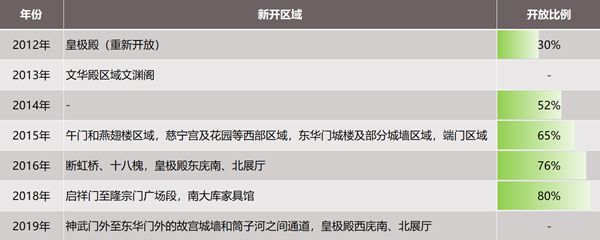
Since 2012, the new opening area and the total opening proportion of the Forbidden City.
Source: official website of the Palace Museum, People's Daily, Beijing Daily, Beijing News, etc. Drawing: Wei Yanxing
Since 2012, the Forbidden City has opened new areas almost every year. On April 25, 2012, the Huangji Hall was reopened to the public; on April 29, 2013, the Wenyuan Pavilion in the Wenhua Hall area was opened to the public in its original form; on September 29, 2016, the Palace Museum officially opened the western duanhongqiao to Cining Palace area, and opened the north-south passage of the two; on the eve of the Lantern Festival in 2019, the Palace Museum announced the opening of night show during the festival, which was the first time in 94 years......
From 2012 to 2018, the opening ratio of the Forbidden City increased from 30% to 80%. Every time the Forbidden City opens a new field, it will trigger a new round of public opinion and visits. In 2018, the Forbidden City received more than 17.5 million tourists annually, ranking first among all museums and world cultural heritages in the world today. With the continuous expansion of the open area, the popularity of the Forbidden City has become more and more prosperous. Almost from this time on, the "People's Forbidden City" has opened its own "Internet celebrity" road.
The "younger" Forbidden City is "out of the circle"
How to attract more young people to pay attention to the Forbidden City and enter the Forbidden City is an important issue facing the Forbidden City. "If you want to open up the dusty history and interpret the classic culture to the ordinary audience, especially young people, you need to express it in a vivid and popular form." Shan Jixiang hit the nail on the head and pointed out the problem-breaking pass.
On the road of "rejuvenation", the Forbidden City has taken the lead.
In 2013, the "Forbidden City Taobao" was revised to strengthen the page design and the use of cultural elements of the Forbidden City. The overall design and language are more in line with the aesthetic needs of young people. In 2014, the official account of Taobao WeChat of the Forbidden City published the article "Yongzheng: Feeling Cute". The humorous language and lively and lovely facial expressions changed the stereotype of young people on the Forbidden City. The change of "painting style" brings immediate effect.
The "Asahi Pearl Headset" won the first place in the "Top Ten Most Popular Cultural and Creative Products in China" in 2014, and the "Forbidden City Calendar" has become a must-have product for more and more people. At the beginning of this year, the Forbidden City lipstick triggered a rush to buy... While maintaining practicality, the Forbidden City's unique cultural and creative products perfectly integrate cultural heritage with fashion trends. So far, the Forbidden City has launched more than 10,000 cultural and creative products, which have become synonymous with "style" in the minds of young people.
The "younger" Forbidden City even entered the "film and television circle".
"Shangxin • The Forbidden City" has both new ideas and new knowledge, and its cultural heritage and aesthetic accumulation make people shine. In the first episode, young actors Deng Lun and Zhou Yiwei formed the resident "Forbidden City Brothers", plus the "Empress" Cai Shaofen, to explore the "Emperor's Secret Garden" together ". The audience in the "lively" at the same time, do not delay the increase of knowledge. In the professional field, Zhu Yong, director of the Film and Television Research Institute of the Palace Museum, and Zhang Jieming, a staff member, were invited to explain the knowledge of cultural relics and the protection of popular science cultural relics. The program talks about the ancient but not the ancient, making the audience hooked. Cheng Jun, deputy director of the program center of Beijing TV station satellite TV, said: "the new Forbidden City is to tell you that the Forbidden City in 600 years has a young heart."
From a series of cultural and creative products of "the Forbidden City" to film and television programs such as "the new Forbidden City", the Forbidden City has changed its image of sitting tight in the past, closely following the laughter, tears and interests of young people, and has won a wide range of "likes" from young people ". Recently, the Palace Museum has launched a new comic book "Echo of the Palace Museum". Through cooperation with the Internet platform to launch an animation innovation competition, the Palace Museum directly solicits ideas from young netizens and incorporates the wisdom with the most characteristics of young people into its creation.
Looking back on the "rejuvenation" road of the Forbidden City, the Forbidden City is indeed "investing in the favor of young people", but this kind of "investing in its favor" is not aimed at immediate economic benefits, but at attracting more participation of the younger generation. A series of "operations" make "the Forbidden City alive" and "cultural relics alive", and the "reverse growth" Forbidden City can naturally attract more young people. According to the official data of the Palace Museum, in 2018, the post-80s and post-90s have become the main tourists of the Palace Museum, with 40% of tourists under the age of 30. Only when more young people pay attention to and participate in it, can cultural and cultural and creative undertakings have a new source of fresh water. Such a Forbidden City is hard to think of without being red.
Cultural relics have been "reborn" and they can "speak" themselves. Science and technology have made the Forbidden City more popular.
Whether it is expanding the open area, increasing the number of cultural relics on display, or launching surrounding cultural and creative products and film and television works, these are ultimately "external forces". Activating the vitality of the cultural relics in the Forbidden City collection, letting the cultural relics "move" by themselves, and letting the cultural relics "speak" by themselves, all of which are inseparable from the empowerment of new technology.
At the end of 2016, the Imperial Palace Heritage Hospital was officially listed. In the cultural relics hospital, modern scientific and technological means and advanced instruments and equipment make the restoration of cultural relics even more powerful. With the help of advanced equipment such as small molecular structure equipment, thermal performance equipment and application of cultural relic CT machines, the cultural relic restorers made a "full body examination" for the already bleak Thangka in the Buddha Hall of Yangxin Hall ". With the support of advanced equipment, after the 100-fold magnification of the Thangka, every gold and silver thread can be seen clearly, ensuring that every detail is repaired as much as possible.
February 19, 2019 is a memorable day for the Forbidden City. This day is the Lantern Festival on the 15th of the first month of the lunar calendar. The Palace Museum held the "Lantern Festival" for the first time in 94 years ". "Will this large-scale lighting event cause damage to buildings and cultural relics?" Excited, many people have expressed such concerns. According to the relevant person in charge, this "light show" in the plan formulation stage, it is considered to avoid damage to ancient buildings due to lighting. Therefore, by setting different light intensities to produce light and shadow contrast, it naturally produces a three-dimensional effect at night, so as to achieve the lighting effect of "seeing the light but not the light", which can not only make the audience fully feel the night style of the Forbidden City, but also will not damage the cultural relics.
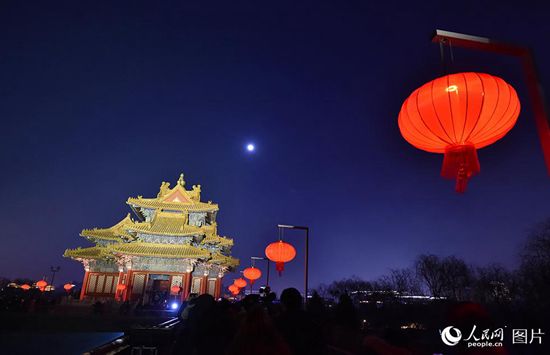
For the first time in 94 years since the establishment of the Palace Museum, the "Lantern Festival" was held ". People's Daily Online reporter Weng Qiyu photo
The advancement of science and technology has not only brought convenience to the protection and restoration of cultural relics, but also continuously innovated and enriched the "expression methods" of the Forbidden City ". In recent years, the Forbidden City has used advanced scientific and technological means to build a "digital Forbidden City" that is as brilliant as the real Forbidden City in virtual time and space ". When the cultural relics of the Forbidden City are displayed in front of people in digital form and touched by the public, the ancient civilization is also given new vitality by science and technology.
In July 2019, the "Unbounded Future-Digital Forbidden City Conference" was held, and the Forbidden City launched several digital products. Among them, the "Digital Cultural Relics Library" released the basic information of more than 1.86 million pieces (sets) of collections, and the first batch of high-definition images of 50000 cultural relics were selected for public disclosure; the "Famous Paintings of the Forbidden City" used billions of pixels of ultra-high-definition images And smooth zoom viewing experience, so that the audience can more conveniently view the famous paintings of the Forbidden City; "Digital Duobao Pavilion" uses high-precision three-dimensional data to display the details and, the audience can "touch" and interact with the cultural relics from zero distance.
In the program "if the National Treasure can talk", through the use of three-dimensional scanning holographic digital collection technology, holographic storage and expansion technology, the jade version of the jade turtle in Lingjiatan, a cultural relic in the Palace Museum, has also been "moved". The use of new technologies and new means has eliminated the gap between the cultural relics and the audience, making the audience closer to the cultural relics.
The power of science and technology can not only make the disrepair and "disheveled" cultural relics glow, but also provide more care for the Forbidden City in large-scale activities; the innovation of science and technology brings more diversified presentation methods and expression methods, so People listen to the stories of cultural relics up close. The 600-year-old Forbidden City has never been so close to science and technology. When the national treasure is inserted with the wings of science and technology, the dusty past becomes clear, and the distant future becomes within reach. The Forbidden City, which hitchhikes on technology, will be "red" longer.
To Play the "Net Red" Effect, the Forbidden City Undertakes the Important Mission of Mutual Learning among Civilizations
Nowadays, the "red" of the Forbidden City has become a social and cultural phenomenon, and the public services of the Forbidden City are becoming more and more humane. The people who have the most say in this, of course, are tourists. "I have been to the Forbidden City before, and I think the service of the Forbidden City is more perfect and humane now." During the interview, a tourist introduced that the content of the signs in the Forbidden City was more and more detailed, and even if there was no dedicated person to explain, he could understand the Forbidden City more deeply than before.
To realize the transformation from emphasizing management to emphasizing service, in Shan Jixiang's view, the most important thing is that all work should be centered on the convenience of the audience. "I used the eight words of sincerity, pure heart, peace of mind, ingenuity, contenteousness, happiness, comfort, and enthusiasm to summarize the question of how the Palace Museum should serve the audience. Its essence is to require the Palace Museum to adopt a humanized and people-oriented service. The concept is to let the cultural resources of the Palace Museum enter people's real life." Shan Jixiang said.
A single flower is not spring, a hundred flowers bloom in spring garden.
The "prosperity" of the Forbidden City is a microcosm of the development of cultural and cultural undertakings in the 70 years since the founding of New China, and it also provides reference and reference for the development of cultural and cultural undertakings in the new era. In recent years, the Forbidden City has taken the lead in taking the lead and actively exerting the "net celebrity effect", which has led a large number of domestic cultural and cultural institutions to actively innovate and bring forth the new.
The Dunhuang Mogao Grottoes in the desert and Gobi are a model for the exchange and mutual learning of the Silk Road civilizations. The Dunhuang Academy uses digital means to establish a scientific and technological system and digital archives for the protection of murals, compare murals in a timely manner, monitor damage, and establish a "digital Dunhuang resource library platform" at the same time. The high-definition images of 30 caves have been shared globally, providing unlimited possibilities for academic research and diversified utilization.
In 2018, the National Museum of China cooperated with the outside world to launch the "National Treasure Brilliant China" series of activities, and activated and reproduced the scenes of Aoshan Lantern Festival and fireworks in the collection "Ming Xianzong Lantern Festival Music Picture" through the interactive operation of mobile phones. This year, Guobo has also introduced cultural and creative foods such as "Fu Lu Shou Xi Cai" lollipop and "Ji Jin's dinner" relief chocolate, and has carried out authorized cooperation with business fashion brands to interpret the national style from a contemporary perspective, so that "Guobo Wen Chuang" will continue to heat up. The cultural creation of the museum, represented by the Forbidden City, is in full swing from line to surface.
Internally, the Forbidden City is the "forerunner" and "leader"; externally, the Forbidden City undertakes the important mission of friendly exchanges with different countries and mutual learning of civilizations. As President Xi Jinping emphasized in the keynote speech at the opening ceremony of the Asian Civilization Dialogue Conference on May 15, 2019, civilizations communicate because of diversity, learn from each other because of exchanges, and develop because of mutual learning.
Since the "the People's Republic of China Unearthed Cultural Relics Exhibition" in 1973, the Palace Museum has organized and implemented more than 200 major cultural relics foreign exhibition and exchange projects. The exhibits have covered more than 30 countries and regions on five continents, with more than 0.1 billion visitors. In addition, the Forbidden City is also a witness of cultural exchanges between China and foreign countries. In October 2015, the Palace Museum hosted the "Forbidden City Forum". Famous museum curators and guests at home and abroad gathered in the Forbidden City; in October 2016, the Palace Museum invited government officials and cultural scholars from China, Egypt, Greece and other ancient civilizations. Jointly organized the "World Ancient Civilization Protection Forum" and passed the "Taihe Declaration" aimed at inheriting the ancient civilization of mankind and protecting the world cultural heritage.
The Forbidden City is not only a palace and pavilion in the high walls of vermilion, but also a "vanguard" in spreading Chinese excellent traditional culture and promoting mutual learning among world civilizations ". Today, the Forbidden City, which once did not know how deep the courtyard was, has become a "net red" punch-in place where ordinary people and tourists at home and abroad can freely enter and leave. Those cultural relics "hidden in the deep palace and unknown" have also turned around magnificently through innovation and become topics that men, women, old and young can talk about after dinner.
Today, when we stand at the historical node of the 70th anniversary of the founding of New China and look back at the 600-year-old Forbidden City's "net celebrity" road, we can clearly see that this is not only a "live" to "fire up" The road of "net celebrity" is also a road of cultural self-confidence of self-innovation, technological innovation, and innovation. The excellent Chinese traditional culture, represented by the Forbidden City, is constantly adjusting itself in the course of development, coordinating with the most basic cultural genes of the Chinese nation and modern society, and approaching the common people in a way loved by the public. let the cultural spirit that spans time and space, is full of eternal charm and has contemporary value "come to life", let the contemporary Chinese cultural innovation achievements that inherit the excellent traditional culture and carry forward the spirit of the new era, both based on the country and facing the world, "go out".
Zheng Xinmiao, the old president of the Palace Museum, once said: "The Palace Museum is alive, because culture is a living life." What we hope to leave to future generations is a cultural existence with fresh vitality, not just majestic houses and cold cultural relics. This requires more museums to actively approach the masses, constantly expand the channels for the public to perceive culture, and attract more people, especially young people, to enter the museum, approach cultural relics, and approach the broad and profound Chinese culture. We hope that after the Forbidden City, there will be more "net celebrity" museums, which will become a spiritual home to meet the cultural needs of the public and absorb cultural nutrition.
Source: People's Daily Online

Address: Buildings 4 and 5, Kechuang Huigu Park, Hongshun Road, Huaming High-tech Zone, Dongli District, Tianjin
Tianjin High-end Equipment Research Institute, Tsinghua University, Copyright
Website Construction: China Enterprise Power Tianjin
Business License
sweep
Pay attention to the official WeChat public number