




PARTY BUILDING
party building work
Qiushi: What a strong system of party leadership means for China
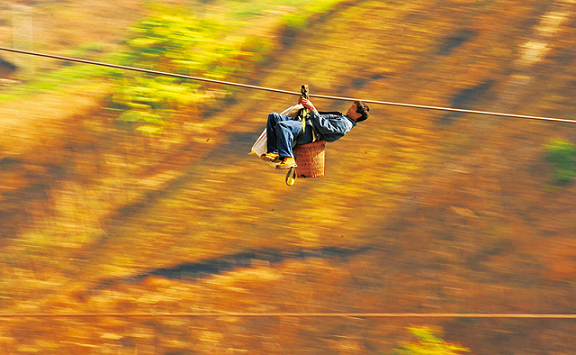
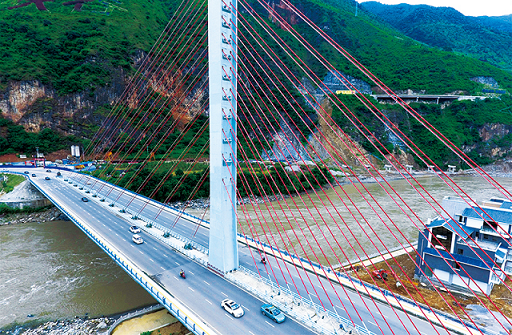
Since the 18th National Congress of the Communist Party of China, my country has placed poverty alleviation and development in a prominent position, made decisive progress in poverty alleviation, and steadily moved towards a historic solution to absolute poverty and building a well-off society in an all-round way. More than 98% of the land of Nujiang Lisu Autonomous Prefecture in Yunnan Province is high mountains and valleys, with steep mountains. In the past, people had to rely on rope to cross the Nujiang River, which made it extremely difficult to travel. Today, the traffic situation in Nujiang Lisu Autonomous Prefecture has been greatly improved, and many ziplines have been replaced by bridges. The picture above shows a villager from Shuangmidi Village, Liuku Town, Lushui City, taken on February 2, 2013, returning from the market to purchase New Year's goods and crossing the Nujiang River (Xinhua News Agency reporter Wang Changshan/photo). The picture below shows the Tongda Bridge, a two-way six-lane large-scale highway crossing the river, taken on September 9, 2016 (Xinhua News Agency reporter Hu Chao/photo).
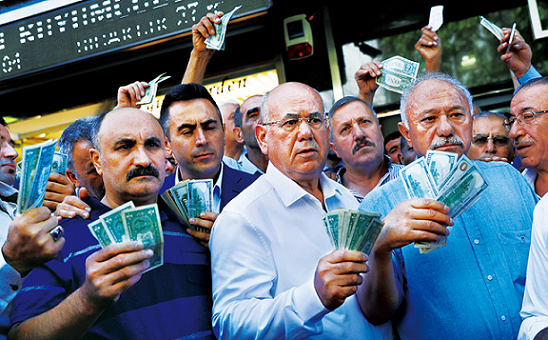
In 2018, due to the Fed's interest rate hike leading to a large-scale return of international hot money, US sanctions against Turkey and Iran, and the impact of trade protectionism, the currencies of many economies such as Russia, Argentina, Turkey, and South Africa suffered significant devaluations. The picture shows that on August 14, 2018, in Ankara, the capital of Turkey, people respond to the government's call to stand in front of the currency exchange office with US dollars in hand and sell their US dollars to support their national currency lira. Xinhua News Agency/Reuters
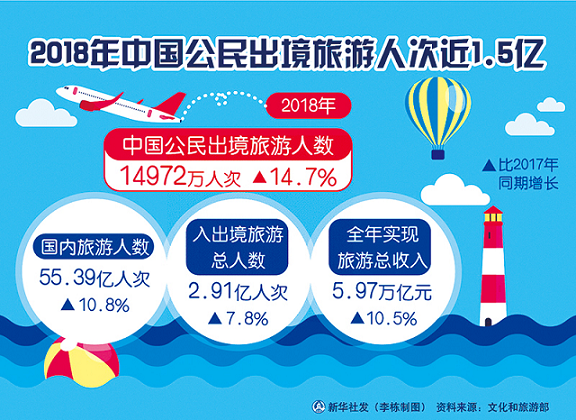
In recent years, with China's economic and social development, people's living standards have been significantly improved, national tourism and leisure life is more exciting, outbound tourism has become a new fashion. The picture shows the data related to Chinese citizens' outbound tourism in 2018. Xinhua News Agency issued Li Dong/cartography
China under the leadership of the Communist Party of China has achieved rapid development in today's world, and China's political system has become the biggest focus of outsiders talking about China, and outside discussions, especially Western views, have in turn affected many Chinese people. Here I would like to make a few personal superficial views on the Chinese system, especially the leadership of the Party. I talk more about my feelings as a media person looking back at China when interviewing around the world.
What role did the 1. CPC leadership system play in China?
In the 70 years since the founding of the People's Republic of China, the achievements made are far greater than the mistakes made. It should be said that there is not much controversy about this, but there is an unreasonable statement that China is far less developed than the United States and Europe. In fact, the starting point of New China is completely different from that of the United States and Europe in the middle of the last century, so that there are problems in how to compare the two sides. In terms of the stock of modernization, the U.S. and Europe are clearly ahead so far, and China is no match. Judging from the speed of development, China is obviously much faster. In 1949, China and the West were far apart, but now the two sides have drawn a lot closer. China has even made the West feel "threatened" in some aspects. We are undoubtedly the winners of the speed of development. However, China is a late-developing country and should develop faster.
People who advocate that the Chinese mainland system has delayed the development of the country often cite the example of Taiwan, arguing that they are all Chinese, but Taiwan has obviously taken a step faster.
It is true that Taiwan's development is a step earlier than that of the mainland, but the part of its economic and social development level higher than that of the mainland is shrinking, and the gap in the living standards of the people on both sides of the strait is getting smaller and smaller. Taiwan still has its advantages, but many of our industrialization achievements have also made the other side of the community "look at the land and sigh". It is predicted that it will not be long before Taiwan falls behind the top ten provinces in China's economic ranking. Of course, this comparison is not interesting, the frame of reference is cross, fuzzy, persuasive is not strong. We should look at the value of the Taiwan example from a larger perspective.
Taiwan is the development of the "Four Little Dragons of Asia", and the development of the "Four Little Dragons of Asia" is generally an accessory to the strategic layout of the United States and other Western countries during the Cold War. The U.S. economy was in full swing at the time, and it was able to help its useful partners, and the "Four Little Dragons" were able to rise. It must be said that they had good luck, and such luck has never been replicated since the Cold War. Most importantly, the total population of the "Four Little Dragons" today is only over 8000 million, which is equivalent to the population of Jiangsu Province in mainland China. Their examples can be used to raise the bar, but they are not representative.
What is more valuable in comparison with China are several former or current political geographic units, namely the Soviet Union and the Eastern European Group, the ASEAN Group, and the South Asian subcontinent. The Soviet Union and the Eastern European bloc not only have hundreds of millions of people and vast land, but also once had similar political systems with China. The ASEAN Group is close to China and is inextricably linked with China economically and culturally. The population of the South Asian subcontinent is as large as that of China, and it is on the same level of economic development as ours.
Compared with these three major blocks, China's comprehensive development level today greatly exceeds that of Southeast Asia, and even leaves the South Asian subcontinent far behind. The Soviet Union and the Eastern European bloc fell apart after the Cold War. Some joined the European Union and NATO. They have a population of about 0.1 billion. Their living standards have stabilized or improved, but their development gap with Western Europe still exists. The standard of living of more than 0.2 billion people has regressed or stagnated. Looking at the Soviet Union and Eastern Europe, the comprehensive power is regressive.
Compared with the surrounding population of about 2 billion, the development of New China is remarkable and beautiful. In fact, the history of New China should be viewed from an earlier period. The collapse of the Qing dynasty as a large empire inevitably led to a period of considerable chaos, including the invasion of foreign enemies. The CCP ended that period of turmoil and took over an extremely backward and poor country. At the beginning of the founding of New China, it experienced a period of exploration, which lasted less than 30 years, with twists and turns, as well as achievements in industrial layout and national defense construction, and achieved a high degree of national independence. After that, China embarked on a period of rapid development that shocked the world and leapt to the position of the world's second largest economy in one fell swoop. The people's livelihood of this country was fundamentally reshaped.
I think it is comprehensive to look at what the system of CPC leadership has brought to China.
2. from the perspective of the world pattern, what does the strong leadership of the CCP mean for China today and in the future?
It is not very difficult for a country to develop at a high speed for a period of time. What is really difficult is to maintain long-term stable development. In the past 30 years, many countries in the world have experienced a period of prosperity. I went to many countries to interview and found that their foundation is actually quite thick. Brazil reached a considerable level of development before and after the First World War. The Pakistanis said that the Koreans sent one after another to study, and China also introduced some advanced management experience from Pakistan. I have not carefully examined the trajectory of the modernization of those countries, but the ups and downs of the development of most countries should be a true picture of the whole world.
Southeast Asia's "Nanyang countries" such as Indonesia and the Philippines used to be better than China's economic situation. In 1997, the waves of a financial crisis hit and made them all wither. The Soviet Union was the most interesting. It was once so powerful that it could fully compete with the United States. Its first artificial satellite and first astronaut clearly proved its institutional strength, let alone defeated fascist Germany. The Soviet Union has problems, but they can be changed. Its industrial structure is a bit deformed, focusing too much on heavy industry and military industry, and the problem of weak agriculture and light industry is prominent. This was originally a problem that could be solved through adjustment. However, the whole country did not understand that the final choice was to give up, to give up the party, to give up the system and to give up the road. The strategic squeeze on Russia today from the United States and NATO is a legacy of the collapse of the Soviet Union. In order to resist this squeeze, Moscow has attracted joint sanctions from the United States and Europe. The devaluation of the Russian ruble has seriously affected people's lives.
As long as the general environment in which countries live remains unchanged, there will be inertia in their development. What they fear most is the superposition of internal and external problems, which will lead to the reversal of the development momentum. China's luck and misfortune lie in our huge scale. Just halfway through our development, we have become a behemoth second only to the size of the US economy. The number of mobile phone sales in China is the largest in the world, and the number of car sales is the largest in the world. The economies of scale have begun to incubate large companies with global competitiveness such as Huawei, Ali, and Tencent. China's development has been given super geopolitical significance by the outside world, and we are finally being targeted. Bringing down China has become a realistic impulse for some elites in individual countries.
Is it easy to bring down a country? It turns out not to be difficult. If a country has an overwhelming global military advantage, controls the global financial system, the Internet system, or is the world's largest consumer market, it can be said that it can do whatever it wants, and there is no need to worry about fatal retaliation. It can destroy Japan's economic vigor and squeeze Russia's strategic space. In addition to imposing severe economic sanctions on small and medium-sized countries, it can also take military subversive actions, causing countries it does not like to "die or hurt", and the injuries are very serious.
One of the hallmarks of a country being "broken" is the collapse of its currency. When the Soviet Union collapsed, the ruble was devalued hundreds and thousands of times. In the last year, the Turkish lira and the Iranian rial have both experienced short-term precipitous declines in exchange rates. In August 2018, due to the deterioration of US-Turkish relations, the Turkish lira fell by 30% in a few days. Before May last year, the Iranian rial 40000 exchanged for more than one US dollar. On May 8, the United States announced the resumption of sanctions against Iran, causing the real exchange rate of the rial to plunge, which had soared to more than 100,000 rials before it could be exchanged for one US dollar.
In 2018, the United States and China had the largest trade friction in history, such a situation, the average country is estimated to have fainted. Even on the surface of calm, the exchange rate will let the anxiety show. With the intensity of the United States' overall pressure on China last year, the renminbi plummeted to more than 10 yuan to 1 U.S. dollar, or even more than 15 yuan to 1 U.S. dollar, which should be a high probability event; even if more than 20 yuan is exchanged for 1 U.S. dollar, history will not be surprised. It is precisely that the renminbi has stabilized, but it is worth history's "jaw-dropping".
This is indeed a miracle. In fact, many Chinese people panicked last year, and the RMB exchange rate also fell faster than normal, but it quickly stabilized. In today's exchange rate of the renminbi, it can be said that trade frictions have failed to "leave a mark". What is the reason? Economists can give all kinds of answers, but in my opinion, the most fundamental reason is that China has the strong leadership of the Communist Party, the Party Central Committee has a strong core, and the Party's political determination at critical moments has inspired the people of the whole country and strengthened the confidence of the whole society that all difficulties can be overcome. In other words, the shock wave of the geopolitical "nuclear level" came, and China adapted to it with only a slight wobble and stood firm on its own position. Then let other countries toss, we respond to changes with the same, and the energy accumulated by the whole society over the past 40 years of reform and opening up has been released, which has greatly disappointed those who hope to make a "quick decision" in the trade war against China.
In my opinion, there is no doubt that the other side greatly underestimated China's will and ability to bear pressure. I did not expect that China has been so beaten, and the CCP's mobilization of society and control of risks are so strong. I believe that after this trade friction, some people are bound to form a new understanding of the strength and soundness of China's system.
China is a super-large society, and the fundamental driving force of social development is the people's pursuit of a better life. The Chinese people are not satisfied with the status quo, and bear hardships and stand hard work, which determines the trend of China's continuous development. It is the people who are pushing the Chinese economy forward. Because ordinary people want color TV sets, refrigerators and washing machines, China's GDP ranks high in the world; because ordinary people want to improve their housing and drive cars, China has become the second largest economy; and ordinary people also need better education, medical care, better ecology and vacation. These wishes are "forcing" China to move forward, and the country has no choice.
Historically, "second child" is a risky position, and there are few good endings. In my opinion, the probability that China will eventually survive the dangerous period and become the world's largest economy is only 50% under normal circumstances. In other words, half of it may be that international politics does not accept China as the largest economy. We have fallen on the halfway of national rejuvenation for various reasons and in ways that we cannot expect. So, is there a key factor that can increase China's probability of success to more than 51%?
I think there is, this key factor is the leadership of the Chinese Communist Party.
The Communist Party of the Soviet Union was shaken at an important juncture, and many countries were panicked when they were frightened. China may encounter much more complicated challenges in the future. However, China is already a nuclear power, has the world's most complete industrial system, and is becoming the world's largest market in many fields. We have the basic conditions to firmly follow the path of socialism with Chinese characteristics. The next most important thing is whether this country can be sober and rational for a long time, not panic when encountering shocks, and maintain a steady and enterprising posture under any circumstances. The CCP is the most capable force to manage various uncertainties and challenges. It is precisely because of this that some radical political elites in the West have developed a serious sense of failure and even despair. In the past, many other systems have been broken; in the future, it is time to test the Chinese system under the leadership of the Communist Party of China. The fate of all Chinese people is actually tied to the CCP's big test. We must support the CCP to create history and get a high score.
3. from the perspective of China, what does the system of CPC leadership mean?
China is a country with a large population and a large territory at the same time. Chinese civilization has never been interrupted. It has profound cultural and physical and geographical reasons. For example, Chinese characters, Confucian culture, and rivers with frequent floods have all played a role in uniting this nation in history. The pursuit of unification has undoubtedly been the main theme of Chinese civilization for thousands of years.
The CCP provides a strong driving force for national development and promotes social equity. It also has a special effect on this country, that is, it contributes to the political cohesion of our large country with huge regional differences, multi-ethnic groups and vast territory. The CCP is a political organization that transcends ethnicity, religion, and regionality. Its ideology is very strong, and it has constructed a common vision that truly belongs to the entire Chinese nation, or it has drawn the largest concentric circle. There are a large number of members of the Communist Party of China. They are not only the Party Central Committee with extraordinary leadership, but also deeply integrated into the grassroots society. Its organization can penetrate various traditions and historical deposits, thus forming a political reconstruction of China's entire territory and society.
In 1993, I went to Yugoslavia as a journalist and met a senior American journalist. He was once based in Beijing, Moscow, is a "socialist". Once talking about the CCP, he said that China is a very complicated country from any level, and the CCP is China's cohesive force. He said that the disintegration of the Soviet Union and Yugoslavia originated from the division of the Soviet Union and the Southern Communist Party, and the leadership of the Communist Party of China is decisive for China's future. He believes that China must not weaken the leadership of the Communist Party of China. Once this happens, China will have another round of disintegration. This senior American journalist will not have our beliefs and positions. His above-mentioned understanding is just a third-party observation and conclusion worthy of our listening.
When I went to Ukraine in 2014, a new round of color revolution took place in Ukraine and the country was in chaos. I asked Mr. Zakhanovich, Director of International Relations at the Institute of Strategic Studies under the then President of Ukraine, what lessons should the outside world, such as China, take from the situation in Ukraine? He thought for a moment and said to me: when a country transitions from a Soviet-style traditional socialist model to a modern social governance model, it is important to maintain the state's ability to control the process. Yes, the CCP is precisely a great force capable of initiating this kind of reform and of harnessing it.
In addition to contributing cohesion, the CCP has also provided social mobilization power for the development of Chinese society that far exceeds that of the general ruling party, as well as the ability to design and execute construction plans. The Communist Party of China also has a great advantage: seeking truth from facts, not extreme, and having the ability to correct itself. At present, China should be the country that attaches the most importance to people's livelihood in the world and has the most achievements in this respect. As far as precision poverty alleviation is concerned, China regards it as one of the three major battles at the national level. No country has done so much to help the poor as China ".
Because of its purpose of serving the people, the Communist Party of China has made great efforts in the people's livelihood, and the Party Central Committee is sure of the people's support. Therefore, not only the major infrastructure projects are well done, but also the major reform projects dare to make decisions. Since the 18th National Congress of the Communist Party of China, corruption has been eradicated and a large number of corrupt officials have been arrested; major economic transformation, production capacity reduction and structural adjustment have been carried out; military reform has been promoted and anti-corruption has been deepened into the army. If these major events are placed in other countries, one of them is enough to make a big mess, but China has actually done them at the same time. The fundamental reason is that the Party Central Committee has a strong and mature leadership core like Xi Jinping, and its decision-making power and control have reached new heights. While continuing the economic miracle, China has actually created a comprehensive reform that is both drastic and at the same time rare and stable. Political miracle.
Reform and opening up and rapid development have put China in a very rapid change. Various new situations and new contradictions are constantly coming. The system led by the Communist Party of China has supported the country and society's response to them. We have not been blocked or suffocated by them. The country seems to have a lot of problems, but the country's ability and resources to solve them are growing faster. The CCP has been established for almost 100 years. It has done a great responsibility worthy of history during the most critical and most vigorous times in this country, and has made great contributions to the people, the nation, and the country.
4. what does a strong country and a strong system mean to the common people?
It is often said on the Internet that whether the country is strong or not has something to do with me as an ordinary citizen. In fact, it has a lot to do with it.
There is an old saying in China: Heroes emerge in troubled times. In fact, it is only for a very few, very few people. For the vast majority of people, a safe day is the most important. The CCP has brought the country to the position of the second largest competitive economy, and can stabilize in this position, providing a basic platform for every Chinese to seek personal development and happiness.
The country is the most external barrier to everyone's interests. In times of peace, this barrier will not be so obvious, and globalization makes it even more hidden. But this barrier is real, and its influence on the living conditions of most people is everywhere.
A hard-working middle school teacher, he made the same efforts in the 1980 s and today, but his position in the global competition and wealth network has undergone major changes. He did the same thing. Thirty or forty years ago he was a poor man in the world, but today he can use his vacation to travel abroad. When he arrived in the general cities of Europe, he would also find that his house was about the same value as the local house. In the past, the children of ordinary Chinese families did not dare to study abroad, but now sending their children to study abroad is something that Chinese middle-income families can afford. All these changes are the phenomenon of China's development reflected in the lives of ordinary people.
In other words, China is "valuable" and more and more elements of Chinese society are rising with the tide. Ordinary people benefit, especially the elites. Without the support of the "China" element, Ma Yun would not have become a world-class first-class entrepreneur. More and more top-notch figures in all walks of life in China have gradually gained international influence. Even some anti-system "dissidents" have "benefited" from China's development, and anti-China and unfriendly forces in the world have given them unprecedented flattering and awards.
Imagine that if the CCP collapses, all Chinese people will be the collective losers. As I wrote earlier, the yuan was first devalued into a few tens of dollars for a dollar, and we're sure to go through a big devaluation that helps us re-understand what inflation is. I have personally experienced the financial turmoil in which the currency depreciates every day. When I was a reporter in Yugoslavia in the 1990 s, I caught up with hyperinflation. At that time, international long-distance calls were very expensive, but I could call Beijing and talk as long as I wanted. At the end of the month, there will be a figure for the phone bill for the current month. Don't worry. There is a 15-day payment period. During these 15 days, the local currency will depreciate 2% 30. After 15 days, no matter how many phone calls I made last month, the final payment is one dollar. I want to tell the people that that is inflation!
Chinese people dare to deposit RMB in banks, but in many countries, people don't dare to do that. They only dare to deposit US dollars or euros. Because if you save your local currency, you might suddenly fall by half one day. Dare to use RMB to buy bonds and do financial management, instead of rushing to convert it into foreign exchange as soon as they are paid. This is not a right that Chinese people necessarily enjoy as citizens of developing countries.
Some people say that I am not afraid of the division of the country. If my country is as small as Switzerland or Singapore, it doesn't matter as long as the life is good.
But there can be a few Switzerland and Singapore in the world! In the 1990 s, I heard a newly independent Central Asian citizen say that they want to be the Switzerland of Central Asia. But after all these years, they are still a country in Central Asia.
China is first of all a big platform and a big market for ordinary people. Chinese migrant workers have almost the largest radius of life activities for grassroots workers in the world. Such a radius of activity means more opportunities to improve life and destiny. The huge size of China has broadened the horizons of every Chinese, which makes it easier for Chinese people to explore their position in the wave of globalization and keep up with the trend of the times. We have always said that Chinese people are bound to the land and are unwilling to move, but today Chinese society is the most mobile society in the world. Look at the annual Spring Festival travel to see how far ordinary Chinese people run and how many other opportunities they have experienced or scanned before taking up their current jobs. They're not drifting, they're choosing, they're competing.
In recent decades, the population structure of major cities in China has undergone tremendous changes. Many emerging cities were built entirely by immigrants. The long-distance "migratory bird" migration of Chinese people is really amazing. The size of China has shaped the unique life style of modern Chinese society. China is not only big, but also more and more powerful. The direction of strength is to resist foreign enemies at first, and gradually develop to support everyone to carve a safe and happy life. The Chinese Communist Party's governance is historically achieving such a progressive.
The socialist system pursues fairness and justice. With the increase of China's national strength, this institutional commitment has gradually become the real practice of the country. Fairness must be supported by a large amount of material resources, otherwise it is poor fairness in the form of a big pot of rice. We have experienced that situation, and it is not lovely. Today, however, China's fair construction under the conditions of a market economy should be said to have made very remarkable achievements in developing countries.
China is far from among the countries with the widest gap between the rich and the poor in the world, but the attack on the gap between the rich and the poor in Chinese public opinion can be called the most intense in the world. This shows that the socialist ideology and traditional fairness concept among the people are very strong, and the pursuit of fairness is the collective belief of this country. China is indeed a socialist country, and it is not "capital" that has the final say, but "society" that has the final say. China's development is also very tortuous, but the party has led the country and has never forgotten the fundamental purpose of the socialist system.
The strong leadership of the Communist Party of China has brought this country a very competitive character in the world, but we have become accustomed to China's many outstanding performances in the world, and we can no longer feel their special features. Some people's frame of reference often goes wrong, not to compare the speed of progress of the country, but to compare the current situation of China with the development stock of developed countries, thus creating a serious illusion that China is inferior to people everywhere.
The strength of China's system must include the ability to correct such illusions and build a mainstream and realistic collective self-awareness in the public opinion field, especially in the Internet. At a time when diversification has become a social reality in China and China's expanding opening up makes it easier for the West to penetrate our values, such a correction is undoubtedly a huge challenge. But I believe that success is the most powerful evidence, and there is no iron curtain in this world that can cover up the facts for a long time.
The Communist Party of China is leading the Chinese people to do an earth-shattering and sobbing event for more than one billion people to realize modernization. These billions of people are hundreds of millions more than the total population of western developed countries combined. China is very busy. This country has too many achievements to create. Its interest is to solve problems, not to compete for high and low. We believe that every society has its own beliefs and pride, and that mutual respect and learning from each other is the most worthy of advocacy. But if there are people and forces who insist on stirring up arguments and distorting common-sense logic, then we are welcome. Let's all post their transcripts and see who is really embarrassed to put their transcripts next to China!
Source: Seeking Truth Magazine
Author: Hu Xijin, Editor-in-Chief of Global Times

Address: Buildings 4 and 5, Kechuang Huigu Park, Hongshun Road, Huaming High-tech Zone, Dongli District, Tianjin
Tianjin High-end Equipment Research Institute, Tsinghua University, Copyright
Website Construction: China Enterprise Power Tianjin
sweep
Pay attention to the official WeChat public number