




PARTY BUILDING
party building work
During his talks with Japanese Prime Minister Shinzo Abe, Li Keqiang stressed: strive to achieve long-term, healthy and stable development of Sino-Japanese relations
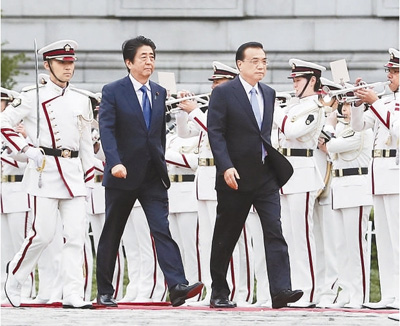
On the afternoon of May 9, local time, Premier Li Keqiang held talks with Japanese Prime Minister Shinzo Abe at the Tokyo Guest House.
Li Keqiang said that China and Japan are important close neighbors and major economies in the world. The healthy and stable development of bilateral relations is related to the well-being of the people of both sides, as well as the peace, stability and prosperity of the world, especially Asia. Sino-Japanese relations have gone through a lot of ups and downs in the past few years and have gone through a detour. Recently, Japan has released important positive messages on its relations with China, and relations between the two countries have shown a momentum of improvement. The purpose of my current visit is to work with Japan to push Sino-Japanese relations back to normal track, and hope that the two sides will meet each other halfway and strive to maintain the long-term, healthy and stable development of Sino-Japanese relations.
Li Keqiang stressed that this year marks the 40th anniversary of the conclusion of the Sino-Japanese Treaty of Peace and Friendship. The treaty confirms the principles of the Sino-Japanese Joint Declaration in legal form and clearly proposes the development of lasting peaceful and friendly relations between the two countries. No matter how the situation develops and changes, both sides should abide by the principles of the four political documents between China and Japan, maintain the political foundation, properly manage contradictions and differences, and jointly create the future of bilateral relations in the spirit of taking history as a mirror and facing the future. The Japanese government and leaders have repeatedly expressed their willingness to face up to and reflect on the past history, and hope that the Japanese side will reflect it with practical actions. On the Taiwan issue, it is hoped that the Japanese side will honor its commitments and adhere to the one-China principle. The two sides should jointly maintain the stability and improvement of the situation in the East China Sea and make the East China Sea a sea of peace, cooperation and friendship. Proceeding from the fundamental interests of the two peoples, adhere to the path of peaceful development, truly regard each other's development as an opportunity, and reflect the political consensus that they are partners and do not pose a threat to each other in their actions, so that peaceful coexistence and friendship from generation to generation will always become the main theme and direction of Sino-Japanese relations.
Li Keqiang pointed out that pragmatic cooperation is an important engine and support for the development of China-Japan relations. The economies of China and Japan are highly complementary. We should further tap the potential, strengthen cooperation in key areas such as energy conservation and environmental protection, technological innovation, high-end manufacturing, finance and finance, sharing economy, medical care and elderly care, and explore the "Belt and Road" cooperation to jointly explore third-party markets. The two sides have reached a consensus in principle on the signing of the local currency swap agreement. The Chinese side agreed to grant the Japanese side a RMB Qualified Foreign Institutional Investor (RQFII) quota. The two sides should carry forward the tradition of people-to-people friendship, strengthen exchanges in culture, localities, education, sports, media, and youth, and further do a good job in drawing people's hearts.
Shinzo Abe said that since last year, Japan-China relations have been effectively improved, and the two sides have restarted high-level economic dialogue between Japan and China and realized the exchange of foreign ministers' visits. Looking back on the road we have taken and looking forward to the future, Japan will adhere to the path of peaceful development and is willing to take Premier Li Keqiang's visit as an opportunity to inherit the spirit of its predecessors, continuously improve and promote Japan-China relations, and promote the implementation of strategic and mutually beneficial relations. to build a more mature Japan-China relationship. Japan is willing to strengthen political mutual trust with China, maintain high-level exchanges, and strengthen communication and coordination on international and regional issues. The Japanese side will maintain only non-governmental contacts with Taiwan in accordance with the provisions of the Japan-China Joint Declaration. Japan supports China's reform and opening up, and is willing to continue to promote cooperation in key areas, jointly safeguard the free trade system, safeguard a fair and open multilateral system based on rules, and further expand exchanges and cooperation in investment, tourism, culture, food, disaster reduction, marine development and other fields. Joint third-party market cooperation. Addressing global challenges together.
The two sides also had an in-depth exchange of views on the situation on the Korean Peninsula and other international and regional issues of common concern.
After the talks, Li Keqiang and Shinzo Abe jointly witnessed the signing of a number of bilateral cooperation documents such as humanities, medical and health care, service trade, third-party market cooperation, and the establishment of a sea-air liaison mechanism.
Before the talks, Shinzo Abe held a grand welcoming ceremony for Li Keqiang in the guesthouse square. When Li Keqiang arrived, Shinzo Abe went to greet him, and the leaders of the two countries boarded the welcome desk. The military band played the national anthems of the two countries, and the national flags of China and Japan fluttered in the wind. Accompanied by Shinzo Abe, Li Keqiang reviewed the guard of honor.
Wang Yi and He Lifeng attended the talks.
Source: Xinhua

Address: Buildings 4 and 5, Kechuang Huigu Park, Hongshun Road, Huaming High-tech Zone, Dongli District, Tianjin
Tianjin High-end Equipment Research Institute, Tsinghua University, Copyright
Website Construction: China Enterprise Power Tianjin
sweep
Pay attention to the official WeChat public number