




PARTY BUILDING
party building work
Luo Nanhui: The Young General of the Long March with Blood
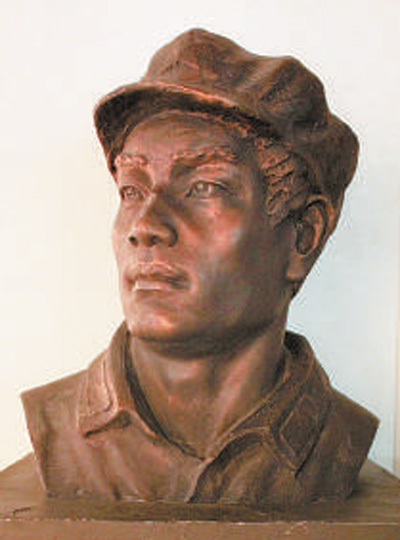
On an ordinary hill in Dadunliang, Zhongchuan Township, Huining County, Gansu Province, there are more than 800 Red Army officers and men sleeping forever. Luo Nanhui, the 28-year-old deputy commander, was the highest general of the Red Army who died in that battle. Today, the Red Army Martyrs Monument, hidden by pines and cypresses, silently tells the solemn and stirring hymn 82 years ago.
Luo Nanhui was born in 1908 in a peasant family in the western suburbs of Chengdu, Sichuan Province. He worked in a hookah shop in his early years. In 1926, he joined the 7th mixed brigade of the Jiangfang Army of the Sichuan Army as a soldier. In 1927, he secretly joined the Communist Party of China and engaged in military transportation in his army. He united and educated the lower-class soldiers, organized and established a "soldiers' federation" to fight against reactionary officers. In June 1929, he participated in the Shehongzui uprising in Suining County led by Kuang Jixun, brigade commander of the 7th mixed brigade, and served as the battalion commander of the uprising. After that, he was sent by the party organization to the 2nd mixed brigade of the Sichuan army and the river defense army to continue his military transportation work. In October 1930, he participated in leading the brigade to hold an armed uprising in Hanzhou (now Guanghan) and served as the chief of the guard.
At the end of 1930, Luo Nanhui went to Wanxian County, Sichuan Province to serve as the secretary of the CPC Sichuan East Special Committee Military Commission, and was soon arrested for being a traitor. He stood firm in prison, tactfully and skillfully fought against the enemy, never revealing his identity. After being released from prison, he served as the leader of the anti-rape team of the Sichuan Provincial Committee of the Communist Party of China, leading the team to execute a group of traitors and spies and protect the safety of the party organization.
In 1932, Luo Nanhui served as secretary of the Central Committee of the Communist Party of China Nanchong County Military Commission. In November of the same year, he participated in launching and leading the Nanbu County Sheng (Zhong Temple) Bao (City) peasant uprising. After that, he was sent to the 29th army of Sichuan army to do military transportation work. in the spring of 1933, he led a company uprising of the army to participate in the fourth red army. In October of the same year, he served as deputy commander of the newly established Red 33rd Army and led his troops to participate in the anti-"six-way siege" of the Sichuan-Shaanxi Soviet area ". He served as the front-line commander, led his troops to beat back more than 20 successive enemy attacks, wiped out four enemy regiments, captured nearly 2000 enemy soldiers, and won the first victory after the establishment of the Red 33rd Army. After the command post cleared the reactionary armed "magic force" on the Sichuan-Shaanxi border, it won five battles and five victories and annihilated more than 5000 enemies, effectively defending the safety of the rear.
In 1935, Luo Nanhui took part in the Long March and led his ministry to take on the task of raising grain. In sparsely populated Tibetan areas, he strictly implemented the party's ethnic policy, actively carried out mass work, went from village to house, collected and purchased food, and ensured the needs of the army to the greatest extent. In November of the same year, the Red 33rd Army and the Red 5th Army were co-organized into the Red 5th Army, and he served as deputy commander. Later, he was wounded in command operations in Tongwei, Gansu Province. In October 1936, in order to cover the rendezvous between the Red Fourth Front Army and the Red First Front Army, Luo Nanhui was ordered to lead the Red Fifth Army as a guard. He lay on a stretcher to command operations and block the enemy in the Huajialing area of Huining, Gansu. On October 23, he was bombed by enemy planes in Dadunliang, Zhongchuan Township, Huining County. Luo Nanhui died heroically at the age of 28. Xu Xiangqian, commander-in-chief of the Fourth Red Front Army, was deeply saddened when he heard the news. He said in tears: "Comrade Nan Hui is an excellent commander in the Red Army, and his sacrifice is a great loss to our army."
In order to remember the heroic achievements of the martyrs, in October 1986, the People's Government of Huining County built the Dadunliang Red Army Martyrs Monument in the Dadunliang Martyrs Cemetery. In October 1996, the People's Government of Huining County carried out a comprehensive repair and expansion of the Dadunliang Martyrs Cemetery, and erected a new tombstone in front of Luo Nanhui's tomb to express its deep memory for this outstanding Red Army commander.
Source: Communist Party Network
Previous Page
Previous Page

Address: Buildings 4 and 5, Kechuang Huigu Park, Hongshun Road, Huaming High-tech Zone, Dongli District, Tianjin
Tianjin High-end Equipment Research Institute, Tsinghua University, Copyright
Website Construction: China Enterprise Power Tianjin
sweep
Pay attention to the official WeChat public number