




PARTY BUILDING
party building work
How the Communist Manifesto entered China
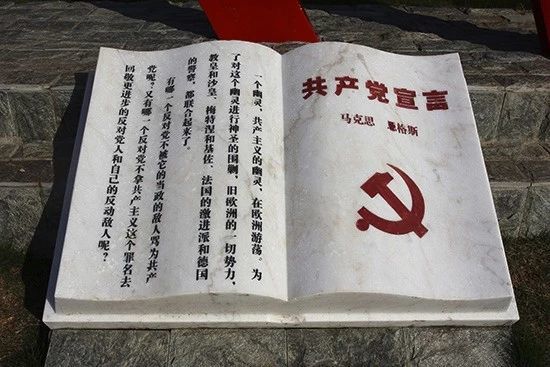
"The power of those who do things over the five continents is suddenly beyond the scope of the monarch."
This is a word from the Communist Manifesto.
Is it a mistake? The Communist Manifesto is so difficult?
There is no mistake. In 1899, the Shanghai "World Communique" serialized an article called "Big Classmate" translated by a British missionary Timothy, which translated and quoted this passage from the "Communist Manifesto. Of course, in classical Chinese.
Perhaps, in another way of translation, everyone will not be unfamiliar: "The bourgeoisie, because it has opened up the world market, has made the production and consumption of all countries worldwide."
Interesting, isn't it? This is the earliest Chinese translation of the Communist Manifesto seen so far. And the "Communist Manifesto", the "ghost" that first wandered around Europe, was so eloquently at the beginning of China.
However, this is not the first contact between the Communist Manifesto and China. The fate of the two can be traced back to earlier.
Sun Yat-sen read the Communist Manifesto for the first time
In 1896, there was a 30-year-old young Chinese in London, England. He had nowhere to live in the country and was forced to go into exile here. Because he was hard to let go of his worries about the disastrous motherland and the uncertain future of his personal destiny under the rule of the Qing Dynasty, he often walked to the British Museum and buried himself in a variety of rich writings to gain a wide understanding of the political and economic conditions of European and American countries and European socialism. movement. It was in the course of this research that the young Chinese learned the names and activities of Marx and Engels for the first time, and read Marxist works such as the Communist Manifesto for the first time.
This young Chinese is Sun Yat-sen.
History, sometimes it is so unexpected, but deep in reason.
It was Sun Yat-sen, the great forerunner of the Chinese revolution, who took the lead in pressing the button that the "Communist Manifesto" is closely related to the destiny of China in the past century.
Under the influence of Sun Yat-sen, China's bourgeois revolutionaries have attached importance to and studied the idea of the Communist Manifesto. Later, more parties and people also wrote articles about the Communist Manifesto. Of course, their move is by no means in favor of Marxism or consciously spreading Marxism in China. It is only out of a strong desire to change China. They believe that the "Communist Manifesto" is an important work among many progressive theories in the West and should be studied. So the contents of the Communist Manifesto continue to appear in their articles.
Cheng She I was the first to extract and translate the Communist Manifesto.
The "Communist Manifesto" really attracted great attention from the Chinese people and carried out comprehensive and extensive research and dissemination, of course, after the October Revolution. During this period, the first person to translate and introduce the "Communist Manifesto" was Cheng Shewo, who later became a famous reporter. On April 6, 1919, he published the last few paragraphs of the second chapter of the Communist Manifesto in vernacular in the 16th "masterpiece" column of the weekly review founded by Li Dazhao and Chen Duxiu, including the full text of the ten major programs, the title is the Communist Manifesto, and the translator's signature is "she". In May and November 1919, Li Dazhao published "My View on Marxism" on the 5th and 6th of "New Youth". The fifth and sixth parts of the article introduce and extract the important ideas of the Communist Manifesto. The article played a significant role in the enlightenment of the spread of Marxism at that time. Driven by Li Dazhao, Chen Duxiu and others, more and more advanced elements have joined the ranks of studying and publicizing the Communist Manifesto.
Chen Wangdao is the first translator of the complete Chinese version of the Communist Manifesto.
Chen Wangdao belonged to the first group of intellectuals in China to accept Marxism. As early as when he was studying at Waseda University in Japan, he met the early Japanese socialists Kawakami and Yamagawa, and read their translated Marxist works, which were deeply influenced by them. After returning to China, he first worked as a Chinese teacher in Zhejiang First Division, then resigned and returned to his hometown of Fenshuitang Village.
Chen Wangdao, who lived in the countryside, chose the secluded firewood house as his studio and began to concentrate on translating the Communist Manifesto. Later, the translation was printed by the "Youxin Printing Institute" prepared by Chen Duxiu in Shanghai, and was officially published and distributed by the Shanghai Socialist Research Institute in August 1920. This is the first complete Chinese translation of the Communist Manifesto in China.
As soon as it came out, it caused great repercussions in the ideological circle, and the first 1000 copies were soon sold out. Due to the shortage, it was reprinted a month later and another 1000 copies were printed, which were still sold out. At the repeated request of readers, by May 1926, Chen's translation had been reprinted in as many as 17 editions. During this period, the title of the book was changed three times, the title was changed four times, and the unit was changed six times, breaking through the blockade and creating a legend in the history of publishing. After Chen's translation, new translators have successively published full translations, and the sales volume is very huge. According to the statistics of some scholars, by 2008, there were 12 full translations of this book in China with different translations.
Direct birth of the founding of the Communist Party of China
In modern times, no book can influence the development process of Chinese history so profoundly as the Communist Manifesto.
In the same month that Chen Duxiu and others published the full translation of the Communist Manifesto, they established the earliest Communist Party organization on the land of China, the early organization of the Shanghai Communist Party, in Shanghai. Its name is "the Communist Party of China". It essentially plays an important role in the initiation group of the Communist Party of China. Chen Duxiu also personally wrote and drafted a Manifesto of the Communist Party of China. This document is directly based on the basic ideas of the "Communist Manifesto" and declares that China will establish a proletarian party and name it after the "Communist Party of China", which laid an important foundation for the preparation of the Communist Party of China.
Source: Party Building Network
Next Page
Next Page

Address: Buildings 4 and 5, Kechuang Huigu Park, Hongshun Road, Huaming High-tech Zone, Dongli District, Tianjin
Tianjin High-end Equipment Research Institute, Tsinghua University, Copyright
Website Construction: China Enterprise Power Tianjin
sweep
Pay attention to the official WeChat public number