




PARTY BUILDING
party building work
They set off from here: Shanghai Chronicle of Work-Study in France
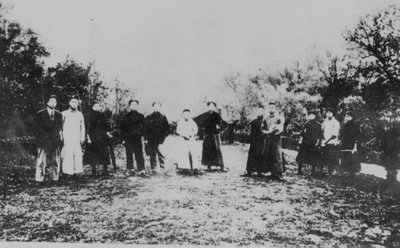
The memorial hall of the first National Congress of the Communist Party of China displays a photo of Mao Zedong and many people in Bansong Garden, a famous garden in Shanghai at that time, on May 8, 1920. This is the photo taken by Mao Zedong and members of the Xinmin Association in Shanghai, who held a meeting in Bansong Garden and sent off Hunan's work-study students to France. In the photo, Xiao San is on the left and Mao Zedong is on the right. Mao Zedong presided over the compilation of the "Xinmin Society Conference Report" No. 1 published the situation of the Bansongyuan Conference, which mentioned: "This day's farewell meeting has completely become a seminar. Late in the day, followed by lights. But each person still felt that many words had not been finished. Take pictures in the rain at noon. Near the Songjiang River half water, green grass and waves, look endless."
The third volume of "New Youth" published on May 1, 1917 introduced the purpose of launching a work-study program in France: "Mr. Zhu, who has this educational movement, really wants to import the two major elements of" scientific truth "and" humanitarianism "of modern European civilization into his country. "it can be seen that the work-study program movement in france fits perfectly with the slogan of" democracy "and" science "put forward by the" may fourth "new culture movement.
The railway was interrupted, only by boat from Shanghai to France.
The work-study movement in France originated in the education of Chinese workers in France. In 1909, Li Shizeng, Wu Zhihui and others, members of the League of the Traveling Pharaohs, realized that through the practice of work-study programs among Chinese workers, they realized that this move would enable more young intellectuals in China to go abroad and receive advanced studies, and finally achieve the goal of "losing world civilization to China" in order to improve Chinese society. They felt that France at that time could be called "a country with advanced people's spirit and wisdom", such as "to create a new society and new citizens", studying in France is undoubtedly the first choice. Therefore, under the advocacy and promotion of Li Shizeng, Cai Yuanpei, Wu Yuzhang, Wu Zhihui, Zhang Ji and others, from 1912 to 1917, they were successively in Beijing, Zhili (now Hebei), Shandong, Shanghai, Hunan, Sichuan, Fujian, Guangdong, Shaanxi, Chongqing and other places established organizations for work-study programs in France, such as the Society for studying in France, the Society for studying in France, the Society for studying in France, the study in France, and the study of work-study in France, and the Chinese Education, and the Chinese Education, and.
Before the outbreak of the First World War, I went to France from China, mostly by train from Beijing, via Fengtian (now Shenyang), Changchun, Harbin, Irkutsk, Chelyabinsk, Moscow, Warsaw, and finally arrived in Paris. There are 89 transfers on the way, 12 days for express trains and 15 days for local trains. After the "October Revolution", the situation in Russia (especially in Siberia) was unstable, and there was a heavy foreign blockade, so the land route to France was terminated. In this way, Chinese work-study students in France could only go to the sea and set off from Shanghai by boat to France. Along the way through Hong Kong, Haiphong, Saigon (now Ho Chi Minh City), Singapore, Colombo, Djibouti, Suez Canal, Port said, Marseille, and then transfer to Paris by train. The time spent by sea is about 40 days. Because work-study students often take cheap no-class cabins, the conditions are poor, and the time on the way is long, so the journey is very hard.
At that time, there were all kinds of work-study students in France. The oldest was Cai Hesen's mother, Ge Jianhao, who was 54 years old and left her hometown to receive secondary women's education in France. The second was Xu Teri, a leader of Hunan education circles, who was 43 years old when he went to France. He was also willing to work in France. In addition, the same is true of Huang Qisheng, a well-known figure in Guizhou education circles and uncle Wang Ruofei. The youngest was Wang Shutang, who was brought to France by Qi Liandeng, a French teacher at the Brie Village Craft Practice School in France in July 1919. He was only 10 years old at the time. The "Current Affairs News" published a photo of Wang Shutang. There are about 20 women among the work-study students in France, such as Xiang Jingyu and Cai Chang. At that time, French society was marked by discrimination against women, with equal pay for equal work between men and women. This is more difficult for them, whether it is work or life, than for men.
As mentioned earlier, after the railway to France was interrupted, Chinese work-study students to France could only take a boat from Shanghai to the sea. In this way, all the work-study students from all over the country concentrated in Shanghai before leaving for France. Especially in the spring of 1919, the work-study movement in France entered a climax. Work-study students from 19 provinces including Sichuan, Hunan, Guangdong, and Yunnan flocked to Shanghai in an endless stream, and then traveled across the ocean from Shanghai in batches to France.
Mao Zedong first came to Shanghai in March 1919, when he made a special detour to Shanghai to send off Hunan work-study students to France. At that time, he returned to Hunan from Beijing. He was supposed to transfer from Beijing-Han Railway to Changsha via Hankou. In order to send off Hunan's work-study students to France, he specially transferred to Shanghai. Then on March 17 and 31, I went to the Huangpu River Wharf twice to bid farewell to two groups of work-study students in France. In December of this year, Mao Zedong came to Shanghai again to bid farewell to Cai Hesen, Cai Chang, Xiang Yingyu, and Cai's mother, Ge Jianhao, who went to France for work-study programs. This is his third visit to Shanghai. The next day, Mao Zedong and others sent Xiao San, Lao Junzhan and other six people aboard the boat on the banks of the Huangpu River and embarked on a work-study journey to France.
Service agencies lend a helping hand
When Shanghai became the sea departure point for work-study students in France, in response to the sudden increase in work-study students from all over the country, Shanghai also set up some corresponding organizations and service organizations in time. For example, in addition to the existing social organization "Shanghai Global Chinese Student Union", which is in charge of foreign student affairs, there is also the "Association of Students Preparing to Go to France" at No. 5, Yuyang Libei Road, Xiafei Road (today's Huaihai Middle Road) in the French Concession; the "Shanghai Society for Studying in France and Thrift" at the opposite door of Shangxian Hall, Xiafei Road "; there is also the" Shanghai Meeting Center "organized spontaneously by students going to France, which was originally located on Songshan Road and later moved to No. 76, Messertio Road (today's Xing'an Road) in the French Concession. The establishment of these organizations or institutions provides convenience for students who want to go to France for work-study programs but suffer from ignorance. Although they are somewhat similar to today's "intermediary" organizations, they are not for profit and are more in line with the membership model.
In the case of the "Association of Students Preparing to Go to France", participants can enjoy the following benefits as long as they are introduced by two people, pay a one-dollar membership fee and agree with the purpose of the association: "Reception when arriving in Shanghai at the beginning of 1.; 2. to order cheap accommodation meals on behalf of others; 3. have to apply to the Shanghai China Law Education Association, pay fees, get passports and buy boat tickets for guidance; 4. have to join the domestic work-study preparatory group (under preparation); the 5. is responsible for handling departure matters (such as dressing up and purchasing supplies on the way); The 6. must have a report on the details of studying in France and working-study programs. When the 7. club invites celebrities to give speeches, they must join the lecture. 8. have to read the books and newspapers prepared by the club."
These services can indeed solve many difficulties and troubles that cannot be avoided for a student who is new to Shanghai and intends to travel across the ocean to go to France for work-study programs, so as to save time, effort and expense, and embark on the journey to France for work-study programs. For example, on September 10, 1920, the "Current Affairs News" published a notice for the Shanghai Meeting: "The students studying in France and the work-study program have already decided before the meeting to send the students once in March. This October, students from all provinces who plan to go to France by Bardosi mail ship have arrived in Shanghai. But it is a long way to apply, scattered everywhere, sound and gas. There are several students, now the French (rent) boundary songshan road 56 organization Chinese students to France Shanghai meeting. Special to connect (contact) network feelings, consultation to go to France, and can do everything from frugal clothing, and can also board and lodging. Students who come to Shanghai can contact the institute and get their welcome."
With such an institutional reception, it is naturally much more convenient for students who are planning to go to France for work-study programs, whether it is to go through relevant procedures or to solve matters such as clothing, food, housing and transportation. So at that time, even if someone suddenly wanted to go to France for a work-study program, they could have been handed over to the above-mentioned institutions to handle it, and then the trip would take place.
On September 22, 1919, the Shanghai Evening News recorded such a thing: that day, an author named Jing took a bath in the "Yude Pool" bathhouse in Shanghai, and overheard a conversation between his neighbors surnamed Lin and Li.
Li asked Lin how he has been recently, and Lin thanked him very well. Then I asked Li how he was doing. This time he came to Shanghai again. Is there anything wrong. It turned out that Li came to Shanghai this time because his hometown was affected by the warlord's melee, the place was not appeasing, and the people suffered. Therefore, he wanted to leave there before he came to Shanghai. Now in Shanghai, he has nothing to do, claiming to be just fooling around. After hearing this, Lin asked Li, "Are you going to fool around like this?" Seeing Li speechless, Lin said to Li, "What's the point of fooling around like this? I think you 'd better go to France with me for a work-study program.
When he heard that he was going to France, it was Li's turn to be surprised. He asked Lin, "Are you going to France? How are you going? What does it mean that you are going to (France) all of a sudden? Where are you rich?"
Lin told Li that he had decided to go to France for a work-study program. As for the money, he had more than ten yuan himself and borrowed another two hundred yuan from a friend. Apart from buying boat tickets and some clothes, there should be some money left. There is no problem in Paris, France, where you can work hard to make money. After hearing this, Li looked at Lin doubtfully and asked, it must be very hard for you to go to a work-study program in France, where you are not familiar with your life.
Lin replied, "What's the pain? What if those who pull carts and do hard work don't have a breath of effort all day? We go to study, how much money do we need to do? What time do you work and read every day, and absorb the new air and knowledge of the West, I'm afraid you'll feel much better spiritually. I think you can go very well. If you are fooling around like this, you will be regarded as the most kind and highest (Shang), but it is just a few cowhide words, saying that you want to fix China. I think since we are a member of the country, if we want to make the country well, we must first make ourselves well. The first thing to do well is to seek knowledge. Seeking knowledge is no more than reading. I dare say you're welcome. You haven't figured it out yet. What else are you talking about. While the world trend is fierce, don't hurry to "personal self-determination", but follow the fool. These warriors and bureaucrats can fight today and tomorrow; this year and next year, they can fight again. They can't make trouble all the time, don't you want to fool around all the time? "Then Lin continued to persuade Li that you are not 30 years old and it is not too late to study. If you are willing to go to France with me to work-study, we can go together. Lin's words finally moved Li, who immediately said, "I'll go. I'll go home and make a turn before I go ".
It is reasonable for Li to make up his mind to go to faraway France, go home and say goodbye to his family, and bring some necessities of life. However, Lin said, "Now the Bodos (round) will open at the end of the month. If you want to go, you can borrow some money from your friends in Shanghai. Why run home and do anything? The family (people) have food to eat and clothes to wear. What do you do? (You have) A wife is terrible. What if we don't know what a wife is for the rest of our lives? I know that you are a person with the greatest vanity and the deepest inertia, but you must know that as long as you can make up your mind, you can fight (overcome) all kinds of problems. And the first thing to do is to take advantage of the opportunity. If you disobey, you will not succeed. That is to say, if I go home to discuss this time, or wait for you to come with my brother, or be afraid of less money and hardship, and turn over and over again, then (where) I will succeed...... ". Next, because Li and Lin got dressed and left the "Yude Pool", the article came to an abrupt end. Perhaps it is unknown that Li will immediately go to prepare for his trip to France.
Some people are weak-willed, but more people are ambitious.
At that time, not all the students who went to France for work-study programs were interested in the revolutionary cause, and even the college students who just stepped out and shrank back were not lacking. For example, a reporter's article published in the Shanghai Evening News on October 1, 1919 told such a story: "among the 15 work-study students carried by the Bodos (ship) yesterday, some of them had just boarded the ship at Wusongkou by tugboat, saying that it was a little" cold "on the ship, so they decided to throw (waste) a 100-yuan ticket and came back by tugboat. People say that they will wait for Russia to calm down and then take the Siberian railway. I first thought that he had tasted the taste of a sea ship in the waves and could not bear it any more, so he came back. The ship is moored in Wusong mouth, did not go to the sea, natural no wind and waves. He understood that it was cold, so he had not tasted the taste of the waves. In the weather of August, it was said that it was cold. Because of this cold, he abandoned a ship ticket and didn't go. Is this kind of person worthy of work-study? They had to use fox leather bags for many years and put them in boxes. A ship ticket cost one hundred yuan, but also casually abandoned, is it still thrifty? The best thing is that he will wait for Russia to calm down and go to Siberia. If Russia is set up indiscriminately, will you not go to school? If there is no railway in Siberia, what about you? I'm afraid you two college students can't go there in this world. Because of the climate in Siberia, the weather in midsummer is the same as in Shanghai 8. September. Since you are so afraid of the cold, naturally there is no chance to go in this world. "The article then revealed that a young man from other places also went to Shanghai to take a ship because of his work-study program in France. Unexpectedly, after arriving in Shanghai, he went to a brothel every day and did not want to go to France for work-study programs. When his father heard the news, he was so anxious that he wrote frequently to urge him to leave, but he always ignored him. Until his father said in the twentieth letter to his son, "Some friends give me a farewell dinner and send me off. If you don't go to France, what will you look like?" This person finally reluctantly set foot on the work-study journey to France. At last, the author of the article couldn't help asking: he was afraid of the cold, or he loved to go whoring, "When this kind of person comes to France, will he still work hard and study frugally? I'm afraid he will make a lot of strange jokes if he doesn't work hard and study".
Of course, as far as the thousands of work-study students who went to France were concerned, most of them were ambitious and ambitious. Many of them later returned to China to devote themselves to the revolutionary cause; others held the belief of "saving the country through science" and buried their heads in studying in a foreign country. They also made many achievements in the future, contributing their wisdom and talents to the construction of the motherland and world civilization. Mao Zedong, who saw them off, and Zhou Enlai, Zhu De, Deng Xiaoping and others who went to France with revolutionary ideals in mind became the first generation of the People's Republic of China leaders.
Source: Liberation Daily

Address: Buildings 4 and 5, Kechuang Huigu Park, Hongshun Road, Huaming High-tech Zone, Dongli District, Tianjin
Tianjin High-end Equipment Research Institute, Tsinghua University, Copyright
Website Construction: China Enterprise Power Tianjin
sweep
Pay attention to the official WeChat public number