




PARTY BUILDING
party building work
The May 4th Movement and the Establishment of the Chinese Communist Youth League
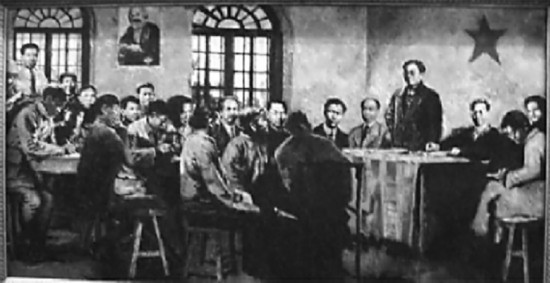
The first National Congress of the Chinese Socialist Youth League (oil painting)
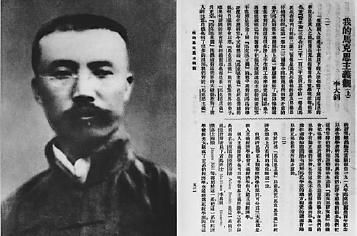
In October 1919, Li Dazhao published an article "My View on Marxism" in "New Youth.
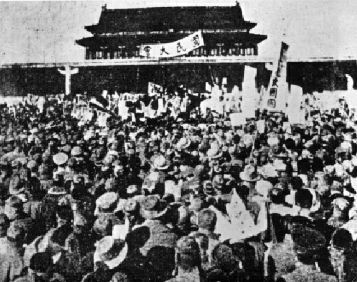
On May 4, 1919, Beijing students gathered in Tiananmen Square.
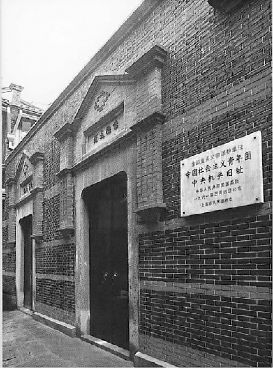
The former site of the Socialist Youth League at No.6 Xinyuyangli, Xiafei Road, Shanghai
The May 4th Movement, which broke out 98 years ago, was a great patriotic revolutionary movement against imperialism and feudalism. Since this movement was spearheaded by a group of advanced young intellectuals, the May 4th Movement was also a great youth movement, which made ideological and organizational preparations for the establishment of the Communist Party of China and the Communist Youth League of China, and opened up a new era of the Chinese youth movement.
The May 4th Patriotic Movement marked the first time that Chinese youth groups stepped onto the social and historical stage.
The awakening of youth:
Exploration and Choice of the Road to National Rejuvenation
After the May 4th movement, the voice of Chinese youth to transform the society resounded through the motherland. Young people from all over the country set up associations one after another. Publications publicizing new thoughts and new culture sprung up in large numbers. In just one year, more than 400 kinds of publications appeared. Among them, there are more than 200 kinds of socialist tendencies of varying degrees.
At that time, several newspapers and periodicals that had an influence on young people strengthened the propaganda of Marxism. One of the most influential publications is The New Youth. In October 1919, Li Dazhao published "My View on Marxism" in "New Youth" in two issues, systematically introducing Marxist historical materialism, political economy and the basic principles of scientific socialism. The publication of this article marks that Marxism has entered a stage of relatively systematic dissemination in China. "New Youth" and another publication "Weekly Review" edited by Chen Duxiu and Li Dazhao became the main publications to promote socialism after the May Fourth Movement.
The Xiangjiang Review, edited by Mao Zedong, is a publication of the Hunan Federation of Students. Published on July 14, 1919. Under the auspices of Mao Zedong, the Xiangjiang Review publicized the ideas of science and democracy, advocated new ideas and new culture, inspired people to fight against the old ideas and old culture, enthusiastically praised the October Revolution, advocated taking the Russian road, and fully affirmed the important role of the people in history. From the founding declaration to the review of major events at home and abroad, almost all the articles in Xiangjiang Review were written by Mao Zedong alone. During Mao Zedong's editing of Xiangjiang Review, there were many things during the day, and writing was often only late at night. After the article is written, you have to edit, typeset, proofread, and even sell it yourself.
China's advanced young intellectuals have made profound reflections and painstaking explorations on the way out for China. "Reforming China" has almost become a consensus among Chinese intellectuals, and the intellectuals who choose the plan to transform China invariably focus their attention on the West. For a time, anarchism, work-study doctrine, mutual aid doctrine, and new village doctrine were widely circulated among young people. After repeated comparison and thinking, a group of advanced intellectuals made a common choice-to use Marxism as their belief and a weapon to transform China, and recognized the relationship between scientific socialism and bourgeois reformism and anarchism. The essential difference is that only scientific socialism can fundamentally transform China.
After Li Dazhao published "My View on Marxism" in October 1919, he completed the transition from democracy to socialism and became the earliest Marxist in our country. Driven by the spirit of the May 4th Movement, Chen Duxiu gradually denied the bourgeois democracy he believed in in the past, began to turn to scientific socialism, and organized and led the workers' movement. After Mao Zedong came to Beijing for the second time in December 1919, he began to search and read a lot of books on Marxism and the Russian revolution. In April 1920, he went from Beijing to Shanghai to discuss with Chen Duxiu Marxism and how to carry out revolutionary activities in Hunan. During this period, Mao Zedong's thinking changed rapidly. He later recalled: "By the summer of 1920, in theory and in a certain way, I became a Marxist. "Soon after the May Fourth Movement, Zhou Enlai edited the" Tianjin Student Federation News "and" Consciousness "from Japan to Tianjin to publicize the masses and guide the work of Tianjin students. In November 1920, he went to Europe to study abroad. Through field visits to Western capitalist countries, after comparing and choosing various doctrines in society, he also changed from a radical democrat to a Marxist. At the same time, a large number of advanced elements who emerged in the May Fourth Movement, such as Li Da, Deng Zhongxia, Cai Hesen, Qu Qiubai, Zhang Tailei, Wang Jinmei and others, successively embarked on the revolutionary road and became Marxists.
In the May Fourth Movement, young intellectuals saw the great power of the working class. Some intellectuals with preliminary communist ideas began to go to the people, opened schools among the workers, organized trade unions, and promoted the combination of Marxism and the Chinese workers' movement. After Chen Duxiu arrived in Shanghai from Beijing in February 1920, he began to go to the workers. Promote Marxism among the masses. Go to the dock workers to learn about the strike, and go to the Chinese Industrial Association, the Chinese Federation of Trade Unions and other labor organizations to investigate. Under his guidance, more than 5000 workers from all walks of life in Shanghai held a rally on May 1 and put forward the slogan "long live the workers. The combination of Marxism and the Chinese workers' movement made ideological and organizational preparations for the establishment of the Communist Party of China and the Chinese Communist Youth League.
Forerunners of the May 4th Movement to Create the Chinese Socialist Youth League
The May 4th Movement in China has attracted the attention of the world, especially the attention of the Communist International. In April 1920, a delegation of the Communist International headed by Vykinsky arrived in Beijing to visit the leaders of the May Fourth Movement, learn about the Chinese revolution, and discuss the establishment of a Communist Party organization. Through the meeting with Li Dazhao, I learned that there was also an important leader of the May Fourth Movement in Shanghai named Chen Duxiu, so he rushed to Shanghai under the introduction of Li Dazhao. In Shanghai, Vykinsky and others had an in-depth discussion with Chen Duxiu on the issue of the Chinese revolution. With the help of the Communist International delegation, in May 1920, Chen Duxiu formed the secret group "Marxism Research Association", and in August established the early Shanghai Communist Party organization. Chen Duxiu absorbed the experience of the international communist movement. When he was planning to form the Communist Party, he advocated organizing a socialist youth league to become the reserve army of the Communist Party of China, which can also be said to be a communist preparatory school. So after the establishment of the early Shanghai Party organization, Chen Duxiu appointed Yu Xiusong, the youngest member, to prepare for the establishment of the Socialist Youth League.
On August 22, 1920, Shanghai Xinyuyangli 6 was extremely lively. Chen Duxiu, Li Hanjun, Shen Xuanlu, Chen Wangdao, Yu Xiusong, Yuan Zhenying, Jin Jiafeng, Ye Tiandi, as well as Wei Jingshi and Yang Mingzhai gathered together to discuss the establishment of the Shanghai Socialist Youth League. Weijingsky introduced the situation of the Communist International, Yu Xiusong introduced the preparation of the Socialist Youth League, and Chen Duxiu proposed Yu Xiusong to serve as the secretary of the Shanghai Socialist Youth League. He was only 21 years old this year.
The organization of the Shanghai Socialist Youth League was located at No. 6, Xinyuyangli, Xiafei Road. Since then, the Shikumen house has become very lively. In September 1920, the sign of "Foreign Language Society" was hung at the gate of No. 6 in Xinyuyangli. On September 28, the front page of Shanghai's "Republic of China Daily" also published the "Foreign Language Society Enrollment Advertisement". In fact, this is a school that trains cadres under the cover of the Shanghai Party Organization. Yang Mingzhai served as the principal, Yu Xiusong as the secretary, and Vykinsky's wife as the Russian teacher. Most of the people who came to study in the Foreign Language Society were progressive youths introduced by the early organization sponsors of the Communist Party in various places, and some were progressive youths who broke away from their families and came to Shanghai to join Chen Duxiu and others. The Foreign Language Society has a small population of 20 or 30 and a large population of 50 or 60. some of them successively joined the socialist youth league in the course of their studies. In the spring of 1921, more than 20 youth league members of this society went to Moscow Oriental University in three groups, including Liu Shaoqi and Ren Bishi.
After the establishment of the Shanghai Socialist Youth League, it sent its seal to communists everywhere. Liaise with local development organizations to establish youth leagues. In the process of establishing the League organization, all localities maintained close contact with the Shanghai Youth League organization, and the Shanghai Socialist Youth League actually played the role of the initiating group. Gu Lin, secretary of the International Oriental Department of the Communist Party of China, praised the Shanghai Socialist Youth League as "the best of the Chinese Youth League".
In October 1920, after the early organization of the Beijing Communist Party was established, Li Dazhao immediately entrusted Luo Zhanglong and Liu Renjing to be responsible for the establishment of the Beijing Socialist Youth League. In early November 1920, under the guidance of Li Dazhao, the first meeting of the Beijing Socialist Youth League was held in the office of the Beijing University Student Association. About 40 members attended the meeting. Almost all the members of the Beijing Party Group have become Youth League members, and some have also held leading positions in the Youth League. Zhang Guotao delivered an opening speech and the meeting elected Gao Junyu as secretary of the Socialist Youth League.
After the establishment of the Beijing Socialist Youth League, it sent people to Changxindian, Nankou, Tangshan and other places to establish preliminary relations with local workers. Deng Zhongxia, He Mengxiong, Luo Zhanglong, Zhang Guotao and others went to various places for activities, and set up Changxindian Labor Cram School on New Year's Day in 1921. Deng Zhongxia, Yang Renqi, He Mengxiong, Zhu Wushan and other league members often taught workers and taught them revolutionary principles. After a period of work, they laid a solid foundation among the workers. On May 1, 1921, Changxindian held an unprecedented celebration of Labor Day. The meeting also announced the establishment of the Changxindian Workers Club. This successful commemoration was organized by the Youth League under the guidance of Li Dazhao. The Beijing Socialist Youth League not only carried out the workers' movement in the Beijing area, but also sent people to help develop the workers' movement in various parts of the north based in Changxindian.
Under the leadership of the party organization, the Youth League organization has developed rapidly. In addition to the League organization of Peking University, other schools have also begun to have League groups. By early April 1921, the Beijing Socialist Youth League had 55 members.
Li Dazhao repeatedly sent members to various places to help establish youth league organizations and promote revolutionary activities in various places. Under the guidance of Li Dazhao and with the help of the Beijing Youth League, Tianjin, Shanxi, Shandong, Shaanxi, Henan, Inner Mongolia and other places were established. The Beijing Youth League has successively sent strong cadres to these places to effectively support the struggle in various places.
In November 1920, appointed by the early organization of the Beijing Party and Li Dazhao, Zhang Tailei began to establish the Socialist Youth League in Tianjin. Soon, the Tianjin Socialist Youth League was formally established in a room above a tailoring shop on Main Road, Tianjin Special Second District (now No. 91 Jianguo Road, Hebei District, Tianjin). Attending the inaugural meeting were Zhang Tailei, members of the Tianjin Progressive Youth Student Organization Consciousness Society Chen Xiaocen and Hu Weixian, as well as Beiyang University student Nanru and two young staff members of the Beijing-Bong Railway Bureau, and Hu Weixian's classmate Tao Mou in Nankai University, a total of 7 people. The meeting was presided over by Zhang Tailei. He first reported on the establishment of the Tianjin Socialist Youth League, and then read out the "Tianjin Socialist Youth League Constitution" drafted by him. The participants discussed the purpose of the Youth League and the methods to achieve it, and finally adopted the constitution of the Youth League and elected Zhang Tailei as its secretary.
After the establishment of the Tianjin Socialist Youth League, it attached great importance to the study and study of Marxism. It held a meeting once a week to discuss how to develop the organization, exchange mutual understanding of the socialist movement, study how to reach the masses, and discuss some theoretical issues. The Tianjin delegation also introduced the "Communist Party" monthly magazine and the "Communist Manifesto" published by the Shanghai Communist Party Group to the masses, and printed "My View on Marxism" published by Li Dazhao in "New Youth" as a pamphlet and distributed in Tianjin. Big. Soon after the establishment of the Tianjin Socialist Youth League, an eight-open newspaper targeting workers and guiding the workers' movement, "Laibao", was published in Tianjin. After the newspaper was published, in addition to being distributed in Tianjin, it was also sent to workers in Tangshan, Nankou, Changxindian and other places. About 20 days after its publication, the newspaper was closed by the French Concession patrol houses.
While Mao Zedong created the early organization of the Hunan Communist Party, he also carried out the early organization of the Hunan Socialist Youth League. After receiving the articles of association of the Socialist Youth League from Beijing and Shanghai, he looked for objects among the students of the first normal School, Commercial Special School and No. 1 Middle School in Changsha and established the League organization. In the process of building the regiment, Mao Zedong attached great importance to the political quality of the members. He especially "paid attention to finding true comrades" and demanded that "only slow down, not rush forward". Therefore, the Changsha Socialist Youth League did not have the problem of twists and turns due to the complexity of its members and different beliefs. It has been developing continuously. When it was first established, there were only 16 members. By July 1921, the number of members had grown to 39.
When preparing for the establishment of the Changsha Socialist Youth League, Mao Zedong invited Chen Duxiu to Changsha in November 1920 to attend the inaugural meeting of the League, but because Chen Duxiu had gone to Guangdong to become chairman of the Guangdong Provincial Education Committee of Sun Yat-sen's military government, he failed to come. Therefore, the inaugural meeting was finally held on January 13, 1921, and Mao Zedong was the secretary.
Mao Zedong focused on developing League members from among the workers. He went to many factories in Changsha to learn about the situation and make friends with the workers. From 1922 to 1923, he also sent Li Lisan, Liu Shaoqi, Guo Liang, Mao Zemin, Mao Zetan and others to Anyuan and Guangdong-Han railway workers to carry out work and develop party organizations. Among the early League members in various places, most of them were students, but there were more League members of Hunan workers, which was inseparable from Comrade Mao Zedong's idea of building the League.
In the autumn of 1920, after Dong Biwu and Chen Tanqiu established the early organization of the Wuhan Communist Party, according to Chen Duxiu's requirements for the establishment of the regiment, based on the progressive students of Wuhan Middle School, they immediately began the work of forming the regiment. On November 7, 1920, the Wuchang Socialist Youth League held its first meeting. A total of 18 people attended the meeting. Dong Biwu made a speech and Chen Tanqiu was elected as the person in charge.
Some advanced young people in Guangzhou, such as Ruan Xiaoxian and Liu Ersong, the student leaders of the May 4th Movement in Guangzhou, Tan Pingshan and Chen Gongbo who graduated from Peking University and returned to Guangzhou, began to plan to establish revolutionary groups as early as the summer and autumn of 1920. At this time, Chen Duxiu, who led the party building work in Shanghai, asked Tan Pingshan, Chen Gongbo and others to establish a youth league organization in Guangzhou. In November of the same year, the Guangzhou Socialist Youth League held its inaugural meeting in Guangzhou Normal University. Early members of the league organization include Tan Pingshan, Chen Gongbo, Tan Zhitang, Liu Ersong, Ruan Xiaoxian, Yang Paoan, Lin Boqu and others.
Because the early Socialist Youth League was a group with socialist tendencies, the composition of the group was very complicated at that time. There are those who believe in Marxism, those who believe in anarchism, and those who believe in Kilt's socialism and syndicalism, and each has different beliefs. In addition, after the establishment of the early youth league organizations in various places, a unified national leadership organization has not yet been formed, especially after the spring of 1921, due to a large number of backbones of the Shanghai Youth League to study in Russia, the organization ties in various places became looser, and funding was tight. Around May 1921, the youth leagues in Shanghai, Beijing, Guangzhou, Wuchang and other places stopped their activities. The seedling of the Chinese Socialist Youth League is in urgent need of support and cultivation.
China Socialist Youth League held a large
In July 1921, the Communist Party of China held its first National Congress and declared its formal establishment. The first National Congress of the Communist Party of China studied the establishment and development of the Socialist Youth League as a preparatory school for the Party, and decided on the method of recruiting outstanding League members into the Party. "After the first National Congress, the central and local party organizations sent a large number of party members to restore and strengthen the work of the regiment.
In August 1921, Zhang Tailei, who attended the Third Congress of the Communist International and the Second Congress of the Junior Communist International, returned to Shanghai from the Soviet Union. Brought back the order of the International Junior Communist Party to organize the Junior Communist Party in China. After discussing with some of the old league members, Zhang Tailei believed that instead of establishing the Chinese Youth Communist Party, it would be better to restore the Socialist Youth League and rectify the league organization. So Zhang Tailei was entrusted by the party organization to be responsible for the restoration and development of the Youth League organization. In this process, the Party Central Committee has strengthened its leadership over the work of the regiment. In November 1921, issued by Chen Duxiu, the Central Bureau of the party issued a circular requiring party organizations in all localities to pay attention to the youth movement and demanded that "the National Socialist Youth League must have more than 2,000 members by July next year".
In the restoration and rectification, we learned the lessons of the 1920 regiment and paid attention to the ideological construction of the regiment. In the reformulated provisional constitution of the League, it is clearly stipulated that "the Socialist Youth League is an organization that believes in Marxism" and "takes the study of Marxism, the implementation of social transformation and the support of youth rights as its purpose". Some of the original members left the regiment because of differences in beliefs; some changed their positions, accepted Marxism, and achieved ideological consensus. The members of the mission were no longer as complicated as in the past. At the same time, in order to strengthen leadership, the provisional charter also stipulates that "when the formal central organs are not formed, the Shanghai organs shall act as the central authorities", with Shi Cuntong as the secretary. On January 25, 1922, the Provisional League Central Committee established the "Herald", an organ newspaper, which played a positive role in the Marxist education of the league members and unified the thinking of the whole league.
After the restoration and rectification of the Youth League, the League organization has developed healthily and rapidly. By the time the first National Congress of the Communist Youth League was held in May 1922, there were 17 places in the country where League organizations had been established: Shanghai, Beijing, Wuchang, Changsha, Guangzhou, Nanjing, Tianjin, Baoding, Tangshan, Tanggu, Anqing, Hangzhou, Chaozhou, Wuzhou, Foshan, Xinhui, Zhaoqing, etc., with more than 5000 members.
From May 5 to May 10, 1922, the first National Congress of the Chinese Socialist Youth League was held in Guangzhou Dongyuan. The conference was attended by 25 representatives from 15 local delegations including Shanghai, Changsha, Wuchang, Nanjing, Tangshan, Tianjin, Baoding, and Hangzhou. chen duxiu, secretary of the cpc central committee bureau, and dalin, representative of youth international, attended and guided the meeting. Also attending the meeting were representatives of the National Labor Congress and guests, a total of more than 1500 people. The meeting was held on the 104 anniversary of Marx's birth on May 5, indicating that the Chinese Socialist Youth League is a revolutionary organization that believes in Marxism.
At one o'clock in the afternoon on May 5, Zhang Tailei first delivered an opening speech to the conference. Chen Duxiu, general secretary of the party, made a speech on the two spirits of Marxism. Dahlin, the representative of the Youth Communist International, gave a speech on "International Imperialism and the Chinese Socialist Youth League.
The General Assembly held eight meetings over six days and heard reports on the situation of the Provisional Central Bureau and the Shanghai delegation, given by Shi Cunzong, it also discussed and passed the "Program of the Chinese Socialist Youth League", "The Constitution of the Chinese Socialist Youth League", "The Resolution on the Improvement of the Living Conditions of Young Workers and Farmers", "The Resolution on Political Propaganda Campaign", and "The Resolution on the Relationship between the Chinese Socialist Youth League and the Chinese Youth League" and the "The Resolution on the Relationship between the Chinese Socialist Youth League and the International Youth League."
On the evening of May 10, the conference elected Shi Cuntong, Gao Junyu, Zhang Tailei, Cai Hesen, and Yu Xiusong as members of the Central Executive Committee of the Youth League, and Shi Cuntong was elected secretary.
The convening of the first National Congress of the Chinese Socialist Youth League enabled the Chinese Socialist Youth League to achieve complete ideological and organizational unity, and become a national advanced youth that is consistent with the Communist Party of China in terms of political program and goals. As a result, the Chinese Youth League was officially born, which is a milestone in the history of the development of the Chinese youth movement.
May 04, 2017 Source: People's Political Consultative Conference

Address: Buildings 4 and 5, Kechuang Huigu Park, Hongshun Road, Huaming High-tech Zone, Dongli District, Tianjin
Tianjin High-end Equipment Research Institute, Tsinghua University, Copyright
Website Construction: China Enterprise Power Tianjin
sweep
Pay attention to the official WeChat public number