




PARTY BUILDING
party building work
Faithful and Faithful for the Revolution Chivalrous and Tender Feelings for Heroes-Reading Xia Minghan's suicide note to his wife
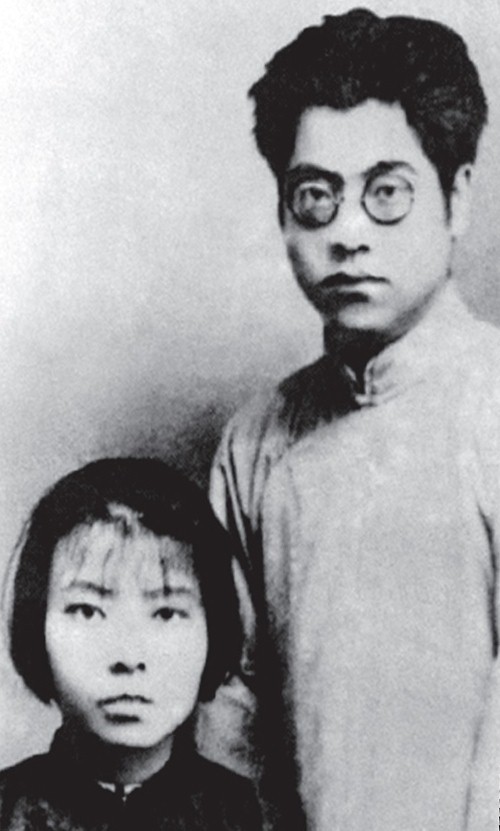
Xia Minghan and his wife Zheng Jiajun
Dear Madam Jun:
Comrades often say that only Jia Jun is good in the world. Today I think you are a woman. I have no worries and no tears in my life. You must not cry with sorrow. Looking around, this life, several couples have aged together for a hundred years. Throwing his head and spilling his blood, Minghan has long been regarded as idle. "Each gets what he needs" will eventually come, and the revolutionary cause will be passed on from generation to generation. Red beads remain as phase thoughts, red clouds lonely hope to complete. Adhere to the revolution and follow my ambition, and vow to pass on the truth to the world!
On March 18, 1928, Xia Minghan was arrested in Wuhan due to betrayal by traitors. In the dark and damp prison, he wrote this tear-jerking letter to his wife Zheng Jiajun with half the pencil that the enemy had written to him. This is also Xia Minghan's suicide note. After writing, at the age of 28, he couldn't restrain his strong love and missing for his wife and daughter. With his lips and blood, he kissed a deep kiss on the suicide note. This bloody kiss before where will you go shows Xia Minghan's chivalrous tenderness, deep affection and unswerving revolutionary love as a great revolutionary. Two days later, Xia Minghan was shot by the Kuomintang reactionaries in Yingwuzhou, Wuhan.
"There is only one good family in the world"
"Comrades often say that only Jia Jun is good in the world. Today I think you are a woman. "At the beginning of the letter, Xia Minghan unabashedly praised his wife.
In the autumn of 1920, Xia Minghan came to Changsha and met Mao Zedong, whom he had admired for a long time. In the winter of the following year, he joined the Communist Party of China through the introduction of Mao Zedong and He Shuheng and engaged in the labor movement in Changsha. He led a strike by rickshaw workers, forcing the governor of Changsha County to announce a cut in car rentals.
It was at this time that Zheng Jiajun, a female embroidery worker in Hunan Province, was shot and injured in her right arm when she was covering Xia Minghan, who was leading the strike struggle. Xia Minghan often came to visit her. During the contact process, the two talked freely about their ideals, exchanged revolutionary experiences and mutual love.
The time of love flies by, and several years of love have deepened the feelings of the revolutionary couple. One day in April 1926, Mao Zedong came to Xia Minghan's room and saw him washing clothes. He said with emotion: "Minghan, it's time to find a partner! Isn't Zheng Jiajun good to you?"
Xia Minghan replied, "Hello, Jia Jun! Good for Jia Jun! "Mao Zedong said happily:" You two are like-minded, like-minded, start a family early!"
Mao Zedong pointed out that in 1926, on the fourth day of the ninth month of the lunar calendar, Zheng Jiajun and Xia Minghan held their wedding in a shabby house, which was on the 4th of Qingshuitang in Changsha City. At that time, although the wedding was simple, it was full of friends. He Shuheng, Li Weihan, Xie Juezai, Guo Liang, Yi Lirong, Gong Yinbing and so on all came to attend the wedding. They also sent gifts to the couple. He Shuheng sent an ink cartridge and a pen holder, Li Weihan sent a pair of exquisite small pots, and Yi Lirong sent a goldfish bowl with red happy characters cut and pasted on it. At the same time, Li Weihan, He Shuheng, Xie Juezai and others also sent them a pair of wedding couplets: "Only family is good in the world. Who is better than Minghan in the world."
On the eve of the Spring Festival in 1927, the two moved to No.1 Wangluyuan in Changsha City and lived in the same courtyard with Mao Zedong and Yang Kaihui. From that Spring Festival onwards, Xia Minghan and Zheng Jiajun agreed that after work, they would not go to relatives or friends, and wholeheartedly help Zheng Jiajun with his tutoring culture. From Arabic numerals to common Chinese characters, from writing poems and lyrics to Marxism-Leninism, Xia Minghan taught his wife and children to learn culture at home. He also prepared lessons as carefully as in Xiangjiang Middle School and Workers' and Peasants' Night School. He explained in detail and took pains over and over again. According to Zheng Jiajun's recollection: "Just talking about the word 'one', it took one night. "Under the dedication of Xia Minghan, Zheng Jiajun grew up rapidly. Later, the Great Revolution failed. In the adversity of white terror, she accompanied Xia Minghan to the government, sent secrets, met comrades, and even pretended to be the daughter and noble wife of a famous family. She played tricks on the enemy and finally subdued her opponent and became Xia Minghan's right-hand man.
One night, as soon as Xia Minghan entered the house, he happily said to his wife, "Jia Jun, I bought you a good thing. "Seeing that her husband came home safely, Zheng Jiajun was very happy, and even more so when he heard that he had bought some good things for her, she greeted him and asked," What kind of good things? "Xia Minghan mysteriously teased her and said," Guess! "Zheng Jiajun didn't guess for half a day. Seeing her anxious appearance, Xia Minghan smiled and opened the paper bag in his hand. It turned out to be a sparkling red bead. Although Zheng Jiajun was very happy, he didn't understand why he gave her this, so he smiled and asked why he bought it. Xia Minghan said wittily, "Are you satisfied with setting a ring for you to wear on your finger? I even wrote two poems on the paper!"
Hearing this, Zheng Jiajun hurriedly unfolded the paper wrapped with red beads and found that it really said: "I give red beads as a heart, I hope your heart is like my heart!
"After reading these two poems, Zheng Jiajun suddenly realized why her husband gave her this red bead. She understood that her husband hoped that she would always have a red heart, be loyal to the people, the party, and the cause of communism, and never change her mind in the face of severe tests. She was both happy and excited, carefully wrapped the red beads, and looked at her husband with firm and infinitely affectionate eyes, and did not speak for a long time. After Xia Minghan's death, this red bead became her only precious relic in memory of her husband.
"Stick to the revolution and follow my ambition"
Revolutionary comrades and life partners, from acquaintance, acquaintance, love to marriage, now have to be separated from yin and yang, how can people not be heartbroken?! In the letter, Xia Minghan forcibly endured his grief and comforted his wife: "Don't burst into tears of grief. Looking around, this life, several couples have aged together for a hundred years. "At the same time, Xia Minghan showed his firm revolutionary will and the spiritual realm of seeing death as home in his family book:" Throwing his head and spilling his blood, Minghan has long regarded it as idle. "Xia Minghan would rather die than surrender in the face of the enemy's torture. In the early morning of March 20, 1928, when the executive asked Xia Minghan what else to say, he said loudly: "Yes, bring me a pen and paper! "So, Xia Minghan wrote a righteous poem:" It doesn't matter to behead, as long as the doctrine is true. Kill Xia Minghan, and others! "When Xia Minghan dropped his bullet, his mouth was still reading his righteous poem. Poetry is like a person, every word is a thousand gold, every word is blood, and every pen is heart! This poem is his character and his lofty belief! A few days later, after learning of the death of her husband, Zheng Jiajun, with extreme grief, wrote a poem to his husband: "give the red heart to the party and devote all his life to the people. With his head held high and his blood spilled on the execution ground, his loyal soul still circled Hanyang City. The hanging sacrifice came late and was even more sad. Parrot Island was red the day before yesterday. Without the spirit of bones, the revolution will come later."
After Xia Minghan's heroic death, Zheng Jiajun followed her husband's last words: "Red Cloud is lonely and wants to be completed","Persist in the revolution and follow my ambition, and swear to pass the truth to the world". On the one hand, she insisted on engaging in revolutionary activities, and at the same time, she worked hard to bring up her daughter. In 1930, Zheng Jiajun went to Shanghai from Changsha to work as a domestic worker for a large family. Because of his unique skill in Hunan embroidery, he was welcomed by his employers. In fact, while working as a domestic worker, Zheng Jiajun was also an underground traffic officer. He mainly collected and kept documents for the underground party in Shanghai, and then handed them to the designated person at the designated place. All work was a single line contact. She inherited her husband's career with amazing courage and daring.
Xia Minghan and his wife named their daughter Xia Chiyun, which means red clouds, and pinned Xia Minghan's wish that "children and grandchildren, generation after generation, will remain red forever. In order to avoid being rooted out by the Kuomintang reactionaries, after Xia Minghan's sacrifice, Zheng Jiajun changed his daughter's name to Zheng Yiyun (later changed to Xia Yun) and grew up in the countryside with his grandmother. According to Xia Yun's memory: "As long as I can remember, I have often followed my grandmother and mother to hide from difficulties. My mother pushed a tricycle and had no luggage. It was also this family that lived for 10 days and that family that stayed for half a month. The days were very hard. "In my memory, my mother always spun and woven cloth day and night to maintain the household. "During the Anti-Japanese War, Zheng Jiajun and his daughter took refuge in places such as Xiaowumen and Gaoqiao in Changsha City, Dongxiang and Wangcheng around Changsha, and even Chenzhou and Leiyang. Zheng Jiajun embroidered and sewed clothes day and night in exchange for a meager income to make ends meet. After the victory of the Anti-Japanese War, Xia Yun returned to Changsha and was admitted to Hunan Private Zhounan Girls' Middle School. For Xia Yun, "I 've only had enough food since then". In 1949, Xia Yun was admitted to Wuhan University and only studied for half a year. Because he could not afford the tuition, he had to transfer to Beijing Agricultural University. At this time, as she grew older, Zheng Jiajun gradually could not see the small things and could not do embroidery. She made a living by pasting cardboard boxes all the year round. She was poor and low-key, and never asked the organization for anything. Every time Xia Minghan's comrades-in-arms Li Weihan, Xie Juezai and other party and state leaders went to Changsha, they would visit Zheng Jiajun and affectionately called her "old sister-in-law". After graduating from Beijing Agricultural University, Xia Yun resolutely obeyed the organizational arrangements and worked successively in Gannan, Yichun, Jiujiang and other places in Jiangxi, always practicing the life motto of "indifferent to fame and gain. Most of the work she is engaged in is difficult and the environment is harsh. She has taken root in the mountains all year round, eating and living in karst caves, but few people know about it. As a descendant of the martyr Xia Minghan, after retirement, Xia Yun lived in silence in Jiujiang City. "Life cannot be luxurious. My children and I are nothing special. They all live on their own abilities. "Xia Yun taught her children from an early age to keep a low profile, not to feel different because of the" descendants of martyrs ", but to work and live by their own labor. What she has done is worthy of her status as a "successor!
After Xia Minghan died, in addition to his wife and daughter, there were countless Chinese heroes and sons and daughters who continued to move forward in the footsteps of martyrs, and finally ushered in the victory of the revolutionary cause. After liberation, Zheng Jiajun made a special trip to Hanyang to pay his respects to her husband and wrote a song of seven words: "After hearing the emperor's death in the Han River City, he generously sang 'ism and truth '. The mountains and rivers are swallowed with gas, and the blood splashes on the sandbar. The bones push the waves and roll the huge waves, and the heart will always shine on the "future generations '. I am glad to see that today's Gankun is red, and the heroic soul smiles at the morning sun. "This is her nostalgia for her husband, and it is also the triumphant song she sings to her husband!
Wang Yue
December 28, 2016 Source: People's Daily Online-Communist Party of China News Network
Previous Page
Previous Page

Address: Buildings 4 and 5, Kechuang Huigu Park, Hongshun Road, Huaming High-tech Zone, Dongli District, Tianjin
Tianjin High-end Equipment Research Institute, Tsinghua University, Copyright
Website Construction: China Enterprise Power Tianjin
sweep
Pay attention to the official WeChat public number