




PARTY BUILDING
party building work
The "University of Sword" in Jinchaji"
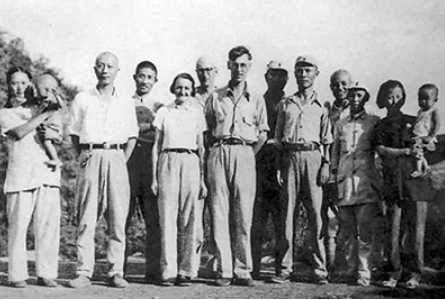
Nie Rongzhen (second from left) took a group photo with Lin Maican (fifth from left), Li Xiaoli (first from left) and William Ban (sixth from left) and Claire (fourth from left).
During the Anti-Japanese War, the Jinchaji Military Region opened radio training classes and advanced classes in the village of Diaoer, Pingshan County, Hebei Province. The senior class was taught by two "foreign professors" from Beiping Yenching University ". After two years of study, "Professor Yang" believes that students "can compare the results of any first-class university without shame" and "we should call it" Diaoer University '". It is this little-known battlefield "university" that has trained the founders and leaders of the the People's Republic of China missile and aerospace industry.
Training classes set up in the war of resistance against Japan
In 1937, Nie Rongzhen, political commissar of the Eighth Route Army's 115 Division, led his troops to establish the Jinchaji Anti-Japanese Base. Due to the shortage of radio technicians, Nie Rongzhen instructed to run his own training courses to train radio technicians. Under the auspices of Zhong Fu Xiang, the leader of the radio team of the military area command, the radio training class was held for six sessions, training more than 500 students, basically meeting the needs of the number of personnel for the operation of radio stations in the whole region, but these people generally only use, can not repair, let alone use the new radio stations seized from the Japanese army. for this reason, nie rongzhen invited lin mai-can and william ban from yenching university to serve as mentors.
Nie Rongzhen attaches great importance to advanced classes and has made specific instructions and arrangements from the selection of students to the arrangement of teaching content. In order to ensure the quality of students, the political department of the military region has selected some outstanding young people who have attended universities and Senior high school from different districts to supplement them to advanced classes. He also sent people to Beiping, Tianjin, Baoding and other places to buy university physics, mathematics, radio technology teaching materials and radio radios. After nearly a month of intense preparation, the senior class finally started.
The senior class classroom is located about 0.5 kilometers away from the "International Peace Hotel". It is a dilapidated house. In rainy days, water leaks everywhere. The desk is a few wooden boards on several adobe. All the "belongings" of each student are his clothes, toothbrushes, bowls and chopsticks, a change of uniform and a pair of cloth shoes. Teaching chalk, pencils, ink, pens, paper, etc., are all captured from the Japanese spoils. William Ben described the teaching environment at that time as follows: "On one side are students who study hard, on the other side are pigs and chickens, donkeys and stone mills, and on the other side, an old woman often sits on the threshold of the classroom and rubs hemp into ropes with her hands".
Among the 26 students in the advanced class, some had gone to universities in Peiping, Tianjin, and Jinan, and some had gone to Senior high school. They all interrupted their studies and joined the War of Resistance. "Professor Yang" divided the students into two groups according to their different enrollment time and different cultural levels. Group A is taught directly in English by Lin Michael and William Ban. Lin Michael teaches professional courses such as radio engineering, and William Ban teaches basic theoretical courses such as advanced physics, 12 hours a week each. In the teaching of group B, group a students Wang shiguang and Lin Shuang translated the lecture notes into Chinese and engraved them into lecture notes. in the afternoon, Wang shiguang tutored the contents taught by Lin maiker and Lin Shuang tutored the contents taught by William in class. They were both students and "gentlemen", and they were affectionately called "assistant professors".
When teaching these Eighth Route Army soldiers the basic theory of the university, William Ben always felt uneasy and confessed to Nie Rongzhen that he wondered: How could the Eighth Route Army transfer these much-needed talents back from the front line to take courses such as calculus? What's the use of this for the war? Nie Rongzhen replied that the Eighth Route Army is not only a combat team, but also a big school. Comrades with conditions should learn various construction skills. China's post-war construction required a large number of engineers, especially those with revolutionary ideals. These outstanding young people gave up their studies to participate in the Anti-Japanese War. They have proved their loyalty in the Anti-Japanese War and are undoubtedly the essence of talents. Our current training program is to train engineers for our future.
William Ben nodded frequently, and the "foreign professor" had to be deeply impressed by Nie Rongzhen's foresight.
learn for the liberation of the people
In terms of teaching, although the level of students is uneven and the basic courses have been left behind for three or four years, everyone studies hard. The two professors were very happy and the teaching was even more exciting. They strictly follow the teaching requirements of regular universities to speed up the teaching progress. The students can always try to keep up, and the good ones sincerely and selflessly help the poor ones, so that everyone's academic performance can go hand in hand. William Ben was deeply surprised and asked, "How can good students and talents come to the Eighth Route Army? I have been teaching there for a long time, why haven't I met such good students?" The students replied: We are all revolutionary youth who went to the anti-Japanese base areas in pursuit of truth, we study for a purpose, for the cause of the people's liberation and for the construction after the liberation of the whole country. This is both our current task and our ideal.
Due to the "mopping up" of the Japanese army, the senior squad moved from south to north with the military command headquarters to several villages in Pingshan and Fuping counties. The ravines were getting deeper and deeper, and the conditions became more and more difficult. Even so, the teaching was not interrupted. They sometimes used the sheep fold of their fellow villagers as classroom teaching. When they encountered enemy airstrikes, they hung a small blackboard in the woods outside the village to continue their classes.
The research, led by Michael Lin, focuses on radio technology. With the support of Nie Rongzhen, Lin Maik gathered the radio components scattered in various units for students' internship, and instructed the students to use these components to assemble portable radio stations for use by the front troops. He also led the students to upgrade the radio transmitter. In the transformation, a mathematical problem needs to be solved, so he contacted the Shanxi-Chahar-Hebei mathematical talents to focus on tackling key problems and deduced the key formula.
Lin Maik led the students to upgrade and transform hundreds of radio stations in the military region headquarters and various military divisions, so that the entire Jinchaji radio communication command system was kept in the best operating condition. From one military division to another, it was necessary to cross the railway, highway blockade and bunker stronghold controlled by the Japanese army. Once, they encountered the Japanese army. In order to cover their safe transfer, all the soldiers of a class died. The Battlefield Art Troupe also compiled a tragic and moving song "Protect International Friend Lin Maike", which was sung in the Jinchaji base area.
In the teaching process of about two years, the two "foreign professors" have strict requirements and strict assessment on students, including weekly examination, monthly examination and final examination. They write comments on each student's performance and are meticulous. The two professors were very satisfied with the students' results and commented that they "fully reached the level of the most advanced university". Students are also proud to call the advanced class "Diaoer University". Wang Shiguang said that "the advanced class is a university school run by the liberated areas".
In August 1943, the basic theory course of the advanced class was almost completed. Due to health reasons, Ban William and his wife left Jinchaji and lived in Yan 'an for more than 3 months. In the Spring Festival of 1944, all the senior class students graduated. nie rongzhen supported lin mai's idea of going to yan'an. In May, Lin Maibut arrived in Yan'an and designed and built a 600-watt large transmitter and directional antenna, allowing the world to hear the voice of Yan'an for the first time.
After the two "foreign professors" left, the "diaoer university" (advanced class) continued to be held by the backbone trained by them. it recruited four more students and trained nearly 300 radio talents. In order to meet the needs of the war, in 1947, "daoer university" was officially upgraded to Jinchaji radio Junior College school. in 1948, it was renamed as the telecommunications engineering Junior College school of north China military region. after its establishment in the People's Republic of China, it was upgraded and renamed several times until 1988, when it was renamed xidian university. In other words, the "Daoer University" in Jinchaji is the predecessor of Xidian University (Xidian University), a well-known key university in the country.
Out of the missile space industry leader
"Dao 'er University" not only laid a solid foundation for the development of "Western Military Power", but also trained a group of founders and leaders of China's missile and aerospace industry, such as Zhong Fuxiang, Lin Shuang, Wang Siguang, and Liang Ji.
Zhong Fixiang, the founder of the missile and aerospace industry, was the highest-ranking student in the senior class who held a leading position after the establishment of the the People's Republic of China. in 1953, zhong foxiang was appointed vice minister of the state ministry of posts and telecommunications. In July 1956, the Fifth Bureau of the Ministry of National Defense (Missile Administration) was formally established, with Zhong Fu Xiang as the director and Qian Xuesen as the first deputy director and chief engineer.
Lin Shuang, the first chief designer of ballistic missiles, was a top student in the Jinchaji Advanced Class. In 1958, the Fifth Academy decided to imitate the "Dongfeng No. 1" missile. Lin Shuang proposed to learn in the process of imitation without copying, imitation without moving. After the Soviet Union withdrew its experts, Lin Shuang worked with everyone to develop the "fighting bomb" and successfully launched the imitation liquid short-range ballistic missile "Dongfeng 1" and the self-developed medium-and short-range missile "Dongfeng 2". Because solid missiles are the direction of world development, the Fifth Academy of the Ministry of National Defense (later reorganized into the Seventh Department, later the Ministry of Aerospace Industry and Aerospace Science and Technology Group) decided to set up the fourth branch of the Solid Missile Research Institute. Lin Shuang was appointed as the president of the fourth branch. He went from Beijing to remote areas to work hard with everyone, and made pioneering and groundbreaking contributions to China's solid ballistic missiles and solid missile engines. In 1978, Lin Shuang attended the National Science Conference as a representative, and 34 major scientific and technological achievements of the Fourth Academy won awards at the conference.
Wang Singuang, the pioneer of the "two bombs and one satellite" ground measurement and control system, graduated from Peking University and Tsinghua University, and has the highest academic qualifications among the advanced students. In 1963, Wang Shiguang was appointed Vice Minister of the Fourth Machinery Department, responsible for production and military science and technology. He participated in and led the development of supporting electronic equipment for missiles, aircraft, submarines, tanks and other systems, as well as ground guidance, communications and navigation and other electronic equipment, and successively successfully trial-produced remote control systems for atomic bomb explosions, as well as ground-to-ground, ground-to-air, air-to-air, ship-to-ship missile guidance systems.
Liang Ji, an outstanding leading cadre of the aerospace industry, was the captain of the radio team of the Jinchaji First Army Division when he was studying in the advanced class. He organized the development of a 60-ton spinning machine tool, which created important conditions for the development and production of solid rockets, and made important contributions to the development of my country's aerospace industry and ranking among the forefront of the world.
In 1983, Lin Maike visited China and Xiao Ke introduced him to some students in the Jinchaji senior class. Lin Maike later wrote: "I am very happy to know that some people who participated in our radio engineering research class at that time have been promoted to the leadership positions of electronic remote communication institutions, such as Wang Siguang, Zhong Fuxiang, Liang Ji, Lin Shuang, etc." This should also be the pride of the "hanging son university.
Source: Communist Party Network
Previous Page
Next Page
Previous Page
Next Page

Address: Buildings 4 and 5, Kechuang Huigu Park, Hongshun Road, Huaming High-tech Zone, Dongli District, Tianjin
Tianjin High-end Equipment Research Institute, Tsinghua University, Copyright
Website Construction: China Enterprise Power Tianjin
sweep
Pay attention to the official WeChat public number