




PARTY BUILDING
party building work
The Birth and Dissemination of a Brilliant Document
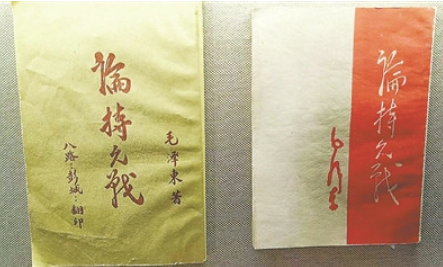
In the Military Museum of the Chinese People's Revolution, multiple versions of Mao Zedong's "On Protracted War" are displayed in the collection. This is a programmatic document guiding the National War of Resistance Against Japan. Once published, it was highly praised by all parties, people from all walks of life and overseas people in China.
1
In 1938, at the critical moment of China's War of Resistance Against Japanese Aggression, it was also a critical juncture that determined the historical destiny of the Chinese nation. Mao Zedong, with his rich war practice and political wisdom and keen insight beyond ordinary people, from May 26 to June 3 He gave a lecture on "On Protracted War" at the Yan'an Anti-Japanese War Research Association.
In this speech, Mao Zedong revealed the law of the War of Resistance against Japan through the analysis of the balance of power between China and Japan, especially the characteristics of the times, incisively discussed the future, course, and strategic and tactical principles of the War of Resistance against Japan, and came to the scientific conclusion that "the War of Resistance against Japan is a protracted war, and the final victory is China's", thus thoroughly refuting the "theory of national subjugation" and ". On Protracted War is another of the most important military works written by Mao Zedong after Strategic Issues in China's Revolutionary War. It is a great Marxist-Leninist document and Mao Zedong's outstanding contribution to Marxist-Leninist military theory. The full text of a total of 120 sections, discusses 21 issues, including the three stages of protracted war, anti-Japanese political mobilization, soldiers and people is the basis of victory and so on. This document further strengthened the confidence of the Chinese people in the protracted war of resistance and pointed out the correct direction and specific path for the victory of the war of resistance against Japan.
2
By May 1938, the Chinese people, suffering from the war, were eager for victory. However, many people are confused about the process of the war, whether and how to win. What is more negative is that erroneous views such as "the theory of national subjugation" and "the theory of quick victory" were rampant at that time. If these problems are not resolved, it will be very detrimental to our country's persistence in the long-term war of resistance. Therefore, in the face of the crazy attack of Japanese imperialism, in order to explore the strategy to guide the Chinese nation to win the War of Resistance against Japan, Mao Zedong read a variety of philosophical and military works, conducted theoretical research, closely integrated with practice, made new theoretical generalizations, and then used new ones. The theory guides practice.
In order to write "On Protracted War", Mao Zedong read a large number of Marxist philosophical works. As long as he could find philosophy books in Yan'an, he studied them carefully. Because he knew very well that during the War of Resistance against Japan, there were many wrong views in society because people's way of looking at problems was subjective and one-sided. Therefore, Mao Zedong read many philosophy books, increase the knowledge reserve. When Mao Zedong was reading Ai Siqi's "Philosophy and Life", he wrote his own unique insights; when he was reading Li Da's "Sociology Outline", he left tens of thousands of words of comments on the eyebrows and blanks; when he was reading Pan Zinian's "Logic and Logic", Mao Zedong even finished reading it in one breath and wrote an article to recommend the Chinese People's Anti-Japanese Military and Political University, focusing on the relationship between dialectics and formal logic.
At the same time, Mao Zedong focused on military issues. Mao Zedong, who had studied the ancient Chinese military history, carefully studied Clausewitz's "On War" at this time, and set up a special research group in Yan'an to conduct in-depth study by reading and discussing. Mao Zedong left a large number of reading notes in order to get a clue to military theoretical issues by studying "War Theory" and other military works. This is also the reason why some of the views in "On War" are reflected in Mao Zedong's "On Protracted War. At that time, under the advocacy of Mao Zedong, the academic circles in Yan'an set off a wave of translation and study of "War Theory.
"On Protracted War" is full of dialectical and materialist standpoints. It always insists on proceeding from reality, objectively and comprehensively studying and analyzing the historical background and war process of the War of Resistance against Japan, always focusing on the overall situation of the war, studying and analyzing the contradictions between the enemy and ourselves, as well as the various factors that cause these contradictions, so as to scientifically foresee the trend of the War of Resistance against Japan, that is, "will China perish? Answer: Will not die, the final victory is China. Can China win quickly? Answer: No quick victory, it must be a protracted war."
3
In July 1938, the Yan'an Liberation Society issued a separate edition of "On Protracted War", which was circulated by officers and soldiers in various base areas. In the same month, Xinhua Daily libraries in Hankou, Chongqing, Guilin, Xi'an and other places successively published printed revisions. For a time, "On the Protracted War" was in short supply, sweeping away the confusion in the hearts of the Chinese people.
"On Protracted War" not only has important guiding significance for the resistance of the Eighth Route Army and the New Fourth Army, but also has an impact on the Kuomintang and its army. As soon as Mao Zedong's On Protracted War was published, Zhou Enlai introduced its basic spirit to some senior Kuomintang generals. Fu Zuoyi and others deeply appreciated and spoke highly of it, believing that this is the highest strategic policy for defeating the enemy. The post-war situation in Wuhan also confirmed the "three stages of protracted war" mentioned in "On Protracted War", namely: the stage of strategic defense, the stage of strategic stalemate, and the stage of counter-offensive to recover lost ground. Subsequently, with the consent of Zhou Enlai, the military Commission of the National Government ordered the whole country to take the ideas contained in "on protracted War" as the strategic guiding ideology in the War of Resistance against Japan ".
"On Protracted War" has also caused major repercussions in the international community. At that time, Zhou Enlai sent a copy from Wuhan to Soong Ching Ling in Hong Kong and asked her to help translate it into English. After reading the article, Soong Ching Ling deeply agreed with Mao Zedong's penetrating analysis and judgment. She found her close friends, journalist Epstein and others, and translated "On Protracted War" into English for publication overseas. Mao Zedong attached great importance to this matter and wrote a preface for the English version: "I hope this book can arouse some sympathy among English-speaking countries, for the interests of China and the interests of the world." "On Protracted War" has received widespread attention and high praise overseas, which has greatly enhanced the international influence of Mao Zedong, the Communist Party of China and the Eighth Route Army and the New Fourth Army under its leadership.
With extraordinary hard work and dedication, through in-depth research, Mao Zedong sublimated the rich practical experience of revolutionary war into a high theoretical summary, and wrote a brilliant work that correctly guided the practice of the Chinese People's War of Resistance Against Japan. "On Protracted War" answered the questions that people could not answer at that time, and solved the contradictions that people could not solve at that time, so that people had a clear understanding of the development process of the War of Resistance against Japan and China's future and destiny, and greatly improved the people of the whole country. Persist in the War of Resistance and the belief and confidence that the War of Resistance will win.
(From PLA Daily, March 17, 2024)
Previous Page
Previous Page

Address: Buildings 4 and 5, Kechuang Huigu Park, Hongshun Road, Huaming High-tech Zone, Dongli District, Tianjin
Tianjin High-end Equipment Research Institute, Tsinghua University, Copyright
Website Construction: China Enterprise Power Tianjin
sweep
Pay attention to the official WeChat public number